They’re vs. Their vs. There: Meaning, Rules, and Examples
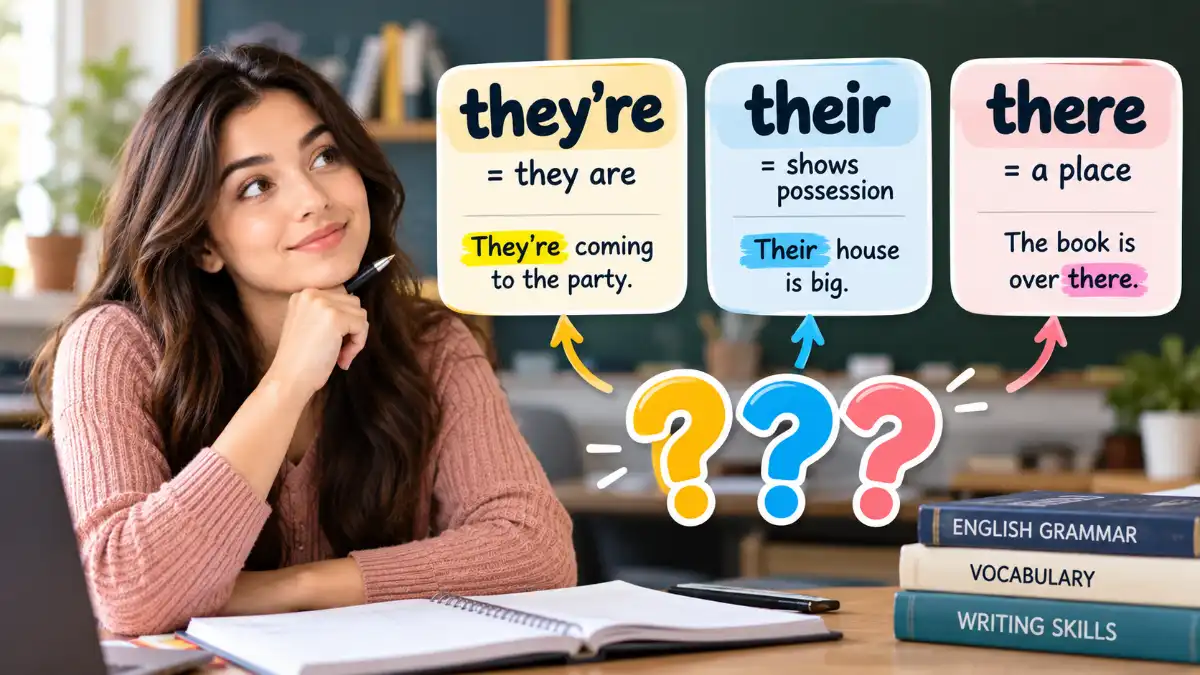
They’re means “they are.” It is a contraction used to describe what people are doing, feeling, or being. Although “their” and “there” sound exactly the same, each word has a different meaning. “Their” shows possession or association, while “there” refers to a place or introduces something that exists. Choosing the correct word depends on the meaning of your sentence, not its pronunciation.
The easiest way to check this contraction is to replace it with “they are.” For example, “They’re waiting outside” becomes “They are waiting outside,” which makes perfect sense. However, “Their waiting outside” is incorrect if you mean that people are waiting. This simple distinction helps prevent mistakes in school assignments, emails, and everyday writing.
They’re, Their, and There: What’s the Difference?
These three words are homophones, meaning they share the same pronunciation but have different spellings and meanings. Understanding their grammatical functions makes choosing the correct word easier.
| Word | Meaning | Grammatical function | Correct example |
| They’re | They are | Contraction | They’re studying for tomorrow’s exam. |
| Their | Belonging to or associated with them | Possessive determiner | Their teacher assigned homework. |
| There | A location or the existence of something | Adverb or introductory construction | There are several books on the table. |
The key distinction is simple: one combines two words, another indicates possession or association, and the third identifies a location or introduces existence.
Consider how the meaning changes in these sentences:
- “They’re planning a vacation next month” describes an action.
- “Their vacation starts next month” identifies whose vacation it is.
- “There is a vacation schedule on the desk” introduces something that exists.
All three sentences are correct because each word serves its intended grammatical purpose.
When to Use They’re in a Sentence
Use this contraction whenever “they are” expresses the intended meaning and fits grammatically.
The apostrophe replaces the missing letter “a” from “are,” combining two words into one shorter expression.
Here are three common situations where it works naturally.
Describing an action
“They’re playing basketball after school.”
Expanded: “They are playing basketball after school.”
Both versions describe the same activity.
Describing a condition or feeling
“They’re excited about their graduation.”
Expanded: “They are excited about their graduation.”
Here, the contraction connects the subject to a description.
Describing someone’s identity or role
“They’re the new employees at our office.”
Expanded: “They are the new employees at our office.”
The sentence identifies who the people are.
Contractions are common in everyday American English, including conversations, friendly emails, and informal writing. Some formal assignments or professional documents may prefer the expanded form, depending on their style requirements.
How to Choose the Correct Word Every Time
Learning when to use they’re becomes easier when you apply three straightforward checks instead of relying on pronunciation.
1. Try the “They Are” Substitution Test
The most useful method is the contraction substitution test. Replace the contraction with “they are” and read the complete sentence.
Original: “They’re arriving at noon.”
Test: “They are arriving at noon.”
The sentence remains grammatical and keeps its meaning, so the contraction fits.
Now consider:
Incorrect: “They’re house is near the park.”
Substitution: “They are house is near the park.”
The expanded sentence is ungrammatical. Because the intended meaning concerns a house belonging to someone, “their” is correct.
This test confirms whether the contraction works, but it cannot independently distinguish possession from location. Those meanings require separate checks.
2. Check Whether the Sentence Shows Possession
Use “their” when something belongs to or is associated with a person or group.
“The students forgot their notebooks.”
Ask yourself, “Whose notebooks?” If the answer is “the students’ notebooks,” the possessive word is appropriate.
“Their” can also refer to one person when singular “they” is used, as in “Someone left their jacket.”
3. Look for a Place or Something That Exists
Use “there” when indicating a location or introducing existence.
“The restaurant is over there.”
“There are four chairs in the room.”
The first sentence identifies a place, while the second introduces the existence of four chairs.
These English grammar rules offer a quick decision process: test “they are,” check possession, or identify location and existence.
Common They’re, Their, and There Mistakes
Many common homophone mistakes happen when someone chooses a word based on its sound rather than its meaning. The following incorrect sentences show how to recognize and correct those errors.
Mistake 1: Confusing an action with possession
Incorrect: “Their going to the library.”
Correct: “They’re going to the library.”
Explanation: The intended meaning is “They are going to the library.” It describes an action, not possession.
Mistake 2: Using a contraction before a possessive noun
Incorrect: “They’re parents attended the meeting.”
Correct: “Their parents attended the meeting.”
Explanation: The sentence identifies parents associated with particular people. “They are parents” is grammatical by itself, but cannot replace “their” in the original sentence.
Mistake 3: Using possession instead of location
Incorrect: “Please leave the package over their.”
Correct: “Please leave the package over there.”
Explanation: The speaker identifies a location rather than someone who owns the package.
Mistake 4: Confusing location with a description
Incorrect: “There excited about the new project.”
Correct: “They’re excited about the new project.”
Explanation: The intended meaning is “They are excited,” which requires the contraction.
Mistake 5: Using a contraction to introduce existence
Incorrect: “They’re are several ways to solve this problem.”
Correct: “There are several ways to solve this problem.”
Explanation: “There are” introduces the existence of several possible solutions.
These corrections demonstrate why checking sentence meaning is more reliable than choosing words by pronunciation.
Practice: Fill in the Blanks
Choose “they’re,” “their,” or “there” to complete each sentence. Try answering every question before checking the solutions.
- _____ preparing for an important presentation.
- The children left _____ backpacks in the classroom.
- We should meet over _____ after lunch.
- _____ expecting good results from the experiment.
- The employees submitted _____ reports yesterday.
- _____ are several mistakes in this document.
- _____ bringing _____ friends to the party.
- _____ putting _____ bicycles over _____.
Answers and Explanations
- They’re — Means “they are preparing.”
- Their — Indicates possession of the backpacks.
- There — Identifies a meeting location.
- They’re — Means “they are expecting.”
- Their — Associates the reports with the employees.
- There — Introduces the existence of mistakes.
- They’re / their — Describes an action followed by association.
- They’re / their / there — Describes an action, indicates possession, and identifies a location.
If you missed a question, expand the contraction or ask whether the sentence expresses possession, location, or existence. That approach is more useful than simply memorizing the answers.
Quick Proofreading Tips
Even confident writers occasionally confuse these homophones, particularly when typing quickly. A few practical proofreading techniques can catch errors before submitting an assignment or sending an email.
Start by finding each occurrence of the three words. Read the entire sentence and consider its intended meaning.
For contractions, substitute “they are” and check whether the sentence remains grammatical. For possession, identify who owns or is associated with the noun. For location or existence, examine what the sentence is pointing to or introducing.
Finally, review your writing manually rather than relying entirely on spelling software. A word may be correctly spelled but still be wrong for its sentence.
Remember: They’re means “they are,” their indicates possession or association, and there refers to a place or introduces existence. Understanding these three functions makes correct word selection much easier.
Frequently Asked Questions
“They’re” is a contraction of “they are.” It describes what people are doing, feeling, or being. For example, “They’re happy” means “They are happy.”
“They’re” means “they are,” whereas “their” indicates possession or association. For example, “They’re studying” describes an activity, while “Their books” identifies books associated with them.
Use it when substituting “they are” keeps the sentence grammatical and preserves the intended meaning. For example, “They’re coming tomorrow” means “They are coming tomorrow.”
Remember that the contraction expands to “they are,” “their” expresses possession or association, and “there” indicates a place or introduces existence. Checking meaning helps prevent confusion.
Yes. It is a standard English contraction commonly used in everyday conversation and informal writing. Some formal writing styles prefer “they are,” but the contraction itself is grammatically correct.
Yes. For example, “They’re finishing their homework.” The first word means “they are,” while the second connects the homework to the people completing it.
The apostrophe replaces the omitted letter “a” in “are.” Combining “they” and “are” creates a shorter form without changing the meaning.
Expand the contraction to “they are,” check whether possession or association is intended, and look for references to location or existence. Reading the complete sentence helps you make the right choice.