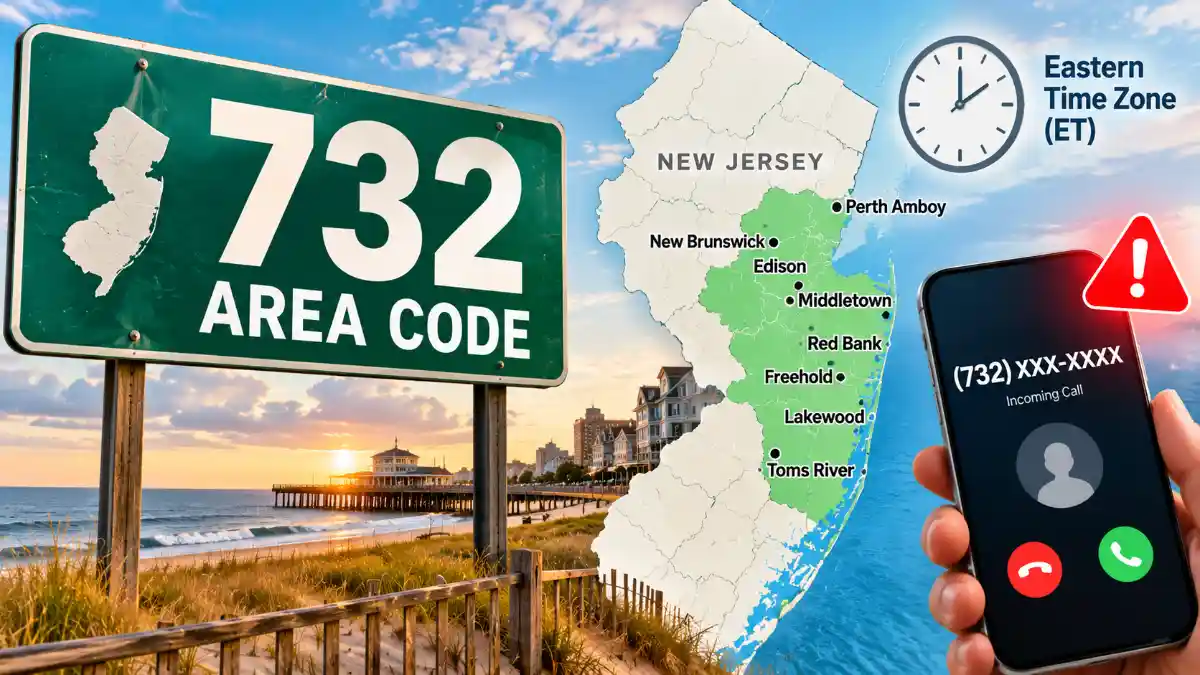
732 Area Code: New Jersey Location, Cities, Time Zone & Scam Calls
The 732 area code is located in New Jersey, United States. It primarily serves east-central New Jersey, including Toms River, New Brunswick, Edison, Lakewood, Perth Amboy, and Middletown. Its coverage extends across parts of Middlesex, Monmouth, Ocean, Somerset, and Union counties.
Area code 732 follows the Eastern Time Zone and shares its geographic region with area code 848. It is a legitimate geographic telephone area code, not a toll-free code or a sign of fraud. Still, a call displaying 732 doesn’t necessarily mean the person calling is in New Jersey.
Where Is the 732 Area Code Located?
The 732 area code covers much of east-central New Jersey, stretching across communities along the Jersey Shore and inland areas around New Brunswick and Edison.
Residential, business, and mobile phone numbers throughout the region use this code. However, not every phone number in these communities begins with 732. Some use other area codes, including 848.
732 Area Code Cities and Counties
The table below shows several major communities served by area code 732.
| City or Community | County |
| Toms River | Ocean County |
| New Brunswick | Middlesex County |
| Edison | Middlesex County |
| Lakewood | Ocean County |
| Perth Amboy | Middlesex County |
| Middletown | Monmouth County |
| Freehold | Monmouth County |
| Red Bank | Monmouth County |
| Piscataway | Middlesex County |
| Point Pleasant | Ocean County |
The broader numbering region also reaches communities in Somerset and Union counties.
Telephone service boundaries don’t always follow city or county lines. New Jersey’s official telephone rate-center records identify the communities associated with different area codes.
It’s also possible to keep a 732 phone number after moving to another city or state through number portability. That’s why the area code tells you where a number was originally assigned geographically, not necessarily where its owner lives today.
What Time Zone Is the 732 Area Code In?
The 732 area code uses Eastern Time (ET), the same time zone observed throughout New Jersey.
The region switches between two time standards:
- Eastern Standard Time (EST): UTC−5, generally observed during winter.
- Eastern Daylight Time (EDT): UTC−4, observed during daylight saving time.
Daylight saving time normally begins on the second Sunday in March and ends on the first Sunday in November. You can check New Jersey’s time zone and daylight saving schedule when planning a call.
For example, when it’s noon in New Jersey, it’s 9:00 a.m. in California. The two states are three hours apart.
If you’re calling a 732 number, Eastern Time is a reasonable starting point. Just remember that the person you’re trying to reach could be living or traveling elsewhere.
How to Dial a 732 Phone Number
Phone numbers in the 732 region follow the standard North American 10-digit format. Each number includes the three-digit area code and a seven-digit local number.
Here’s how to dial:
- Within the United States: 732-XXX-XXXX
- For domestic long-distance calls: 1-732-XXX-XXXX, if your phone service requires a leading 1.
- From another country: +1-732-XXX-XXXX, with +1 representing the United States country code.
When calling internationally, the plus sign represents the international dialing prefix supported by your phone service.
Because 732 shares its region with 848, 10-digit dialing is required for local calls, even when both callers are nearby. New Jersey’s telephone consumer guidance explains how overlay area codes work and why they require 10-digit dialing.
Area code 732 is not toll-free. The cost of calling depends on your carrier, phone plan, and whether the call is local, long-distance, or international.
When Was Area Code 732 Introduced?
Area code 732 entered service on June 1, 1997, when part of New Jersey’s existing 908 numbering region was assigned a separate area code.
The change was necessary because demand for telephone numbers had increased. More households and businesses needed phone lines, while mobile phones, fax machines, and other telecommunications services were becoming more common.
At first, 732 served its designated territory without an overlay. On December 29, 2001, area code 848 was introduced to provide additional numbers within that same region.
What Is the Difference Between 732 and 848?
The main difference between 732 and 848 is their introduction date, not their geographic coverage.
The two codes form an overlay, meaning they serve the same numbering region. This arrangement makes additional phone numbers available without requiring existing customers to change their numbers.
For example, two businesses in Edison could have different area codes, with one using 732 and the other using 848.
Both area codes follow Eastern Time and require 10-digit dialing. The North American Numbering Plan Administrator’s planning letters document the introduction of 848 as an overlay for 732.
Are Calls From the 732 Area Code Scams?
A call from the 732 area code is not automatically a scam. Many legitimate individuals, businesses, and organizations in New Jersey use 732 numbers every day.
Unfortunately, scammers can make their calls appear to come from local phone numbers. This technique, known as caller ID spoofing, allows someone to display a number that doesn’t actually belong to them.
For that reason, seeing 732 on your screen doesn’t prove who’s calling or where the call originated. The Federal Trade Commission’s guidance on caller ID spoofing explains how scammers disguise their numbers to make calls appear familiar or trustworthy.
Warning Signs of a Suspicious 732 Call
Be careful if an unfamiliar caller:
- Demands immediate payment or threatens arrest or legal action.
- Asks for banking information, passwords, Social Security numbers, or one-time verification codes.
- Claims to represent a government agency or financial institution but discourages you from verifying their identity.
- Insists on payment through gift cards, cryptocurrency, or wire transfers.
- Pressures you to act immediately before you’ve had a chance to check their claims.
These behaviors can indicate fraud regardless of the caller’s area code. A familiar-looking number alone is never enough to establish trust.
What Should You Do If an Unknown 732 Number Calls?
If you don’t recognize a 732 number, there’s no need to answer immediately. You can let the call go to voicemail and decide whether it deserves a response.
If the caller claims to represent your bank, a business, or a government agency, hang up and contact the organization directly using a phone number you trust. Don’t rely on the number displayed on your caller ID.
Avoid sharing sensitive information or sending money in response to an unexpected call, especially if the caller pressures you to act quickly.
You can also enable your phone’s spam-filtering features or use call-blocking services offered by your carrier.
If you suspect fraud, report the incident through the FTC’s official reporting system. For unwanted calls that don’t involve financial loss, the FTC’s National Do Not Call Registry guidance explains how to submit a report.
Reverse phone lookup services may provide information about an unfamiliar number, but their results aren’t always current or accurate. Even when a lookup identifies a legitimate person or company, the displayed number may have been spoofed.
Read Also: 732 Area Code
Frequently Asked Questions :
Yes. Number portability generally allows you to keep an existing mobile phone number when moving to another state, provided your service arrangement supports it. Landline transfers may have additional geographic restrictions.
Yes. The 732 area code is used for mobile phones as well as landlines and business telephone services. You cannot reliably determine whether a number is mobile or landline from its area code alone.
Not from the area code alone. A reverse phone lookup might provide additional details, but phone numbers can be reassigned, transferred between carriers, or spoofed. If the caller claims to represent an organization, verify their identity independently rather than relying on caller ID.