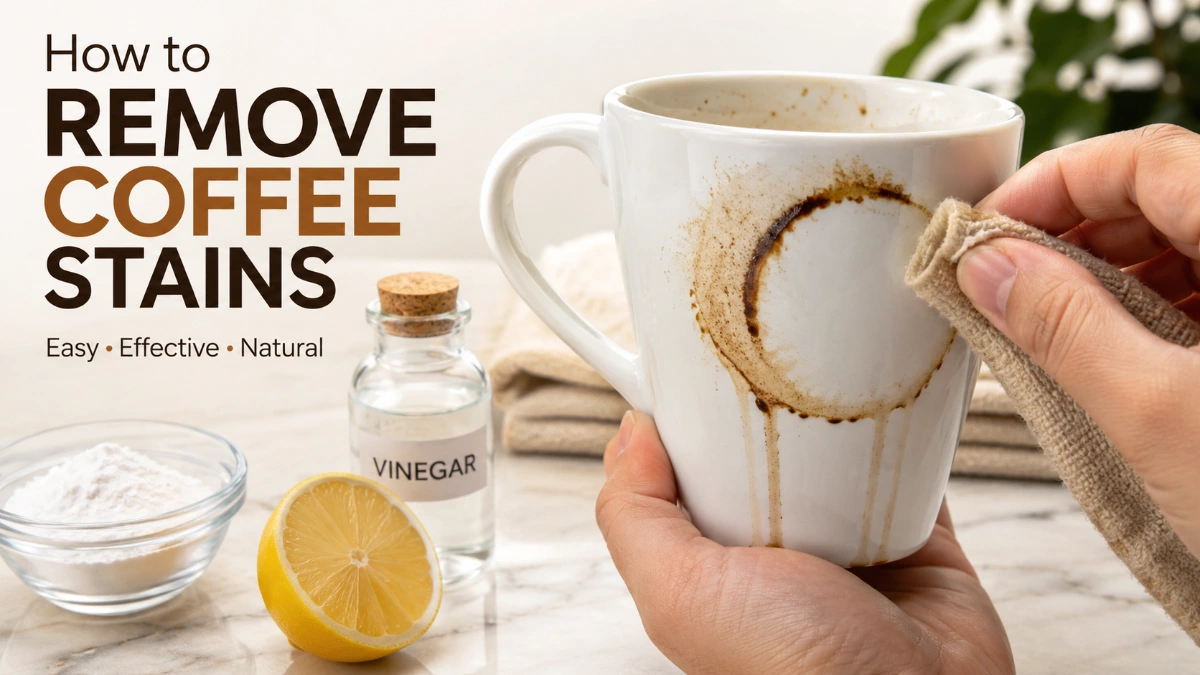
How to Remove Coffee Stains: 7 Powerful, Safe Methods by Surface
A fresh coffee spill is easiest to handle when you blot it immediately, avoid rubbing, and use a method that matches the material. For washable fabric, begin with cool water, pretreat with liquid laundry detergent or a stain remover, then wash according to the care label.
How to Remove Coffee Stains: Start with the right first aid
Before choosing a cleaner, remove as much liquid as possible without spreading it.
- Blot the spill with a clean, colourfast cloth or paper towel.
- Work from the outside of the spill toward the centre.
- Check the garment label or the manufacturer’s care instructions before adding water or cleaner.
- Use a cleaner made for the material; do not assume a laundry method is suitable for carpet, upholstery, leather, wood, or stone.
- Do not use a dryer, iron, or other heat on washable fabric until you have checked that the stain has gone.
Coffee with milk, cream, or sugar can leave additional residue, so it may need a careful second treatment even after the brown colour looks lighter.
Choose your surface
| Surface | Best first move | Suitable next step | Avoid |
| Washable clothes and linens | Blot, then sponge or rinse with cool water | Pretreat with liquid detergent or a prewash stain remover; launder to the care label | Drying before checking the stain |
| Carpet or rug | Blot with a clean, colourfast cloth | Use a carpet-appropriate spot treatment sparingly, then blot and rinse out residue | Scrubbing, soaking, or pouring cleaner directly on the area |
| Upholstery or mattress | Blot immediately | Check the furniture or mattress care instructions before using any cleaning product | Saturating cushions, foam, or filling |
| Mug, glass, ceramic, or sealed nonporous surface | Wipe promptly | Wash with a suitable nonabrasive cleaner, rinse, and dry | Abrasive tools on delicate coatings |
| Wood, leather, natural stone, silk, wool, suede | Blot only | Use the maker’s approved care method or consult a specialist | Generic DIY remedies or untested cleaners |
How to remove coffee stains from clothes
For machine-washable clothing, towels, sheets, and similar fabrics, treat the item before laundering.
- Sponge or soak the stained area in cool water.
- Apply a prewash stain remover or liquid laundry detergent according to its label.
- If needed, let the item soak in cool water for at least 30 minutes.
- Launder at the temperature and cycle permitted by the care label.
- Use oxygen bleach or chlorine bleach only when the fabric and product instructions specifically allow it.
- Inspect the fabric before drying. If the mark remains, repeat the process rather than exposing it to heat.
The American Cleaning Institute recommends cool-water treatment, pretreatment with a prewash remover or liquid detergent, and fabric-safe bleaching only where appropriate. It also advises checking that a stain has cleared before placing an item in the dryer.
Delicate or dry-clean-only items
If the label says “dry clean only,” or the item is silk, wool, suede, leather, vintage, or valuable, do not experiment with laundry products. Blot the coffee, preserve the care label information, and seek advice from the manufacturer or a professional cleaner.
How to remove coffee stains from carpet
A carpet spill needs controlled cleaning: the goal is to lift the coffee without driving moisture, detergent, or pigment into the pile and backing.
- Blot the fresh spill using a clean cloth. Replace it as it becomes wet.
- Test a carpet-specific spot cleaner in a concealed spot, following the product label.
- Apply a small amount of the cleaner to the cloth or use it exactly as directed; do not flood the carpet.
- Dab gently from the outer edge toward the centre, then blot with a dry cloth.
- Rinse sparingly with clean water and blot repeatedly to remove cleaning-product residue.
- Let the area dry fully before deciding whether further treatment is necessary.
The Carpet and Rug Institute advises blotting rather than rubbing, testing cleaning solutions before use, using limited quantities, and removing residue because it can attract soil. Its guidance also warns against allowing solvents to reach carpet backing
If the coffee contained cream or sugar, repeat the same measured cleaning-and-rinsing cycle instead of escalating to harsher products.
Upholstery and mattress spills
For upholstery or a mattress, the safest broadly applicable response is to blot first and consult the item’s care instructions before applying a cleaner. Cushions and foam can retain moisture, and fabrics can have manufacturer-specific cleaning restrictions.
If the care instructions permit a particular cleaning method, use only the stated product type and apply the minimum amount needed. Stop if dye transfers to the cloth, the fabric changes texture, or the area becomes overly wet. For water-restricted upholstery, delicate fabric, or a large spill, contact the manufacturer or a professional upholstery cleaner.
Mugs and nonporous hard surfaces
For glazed ceramic, glass, stainless steel, and other washable nonporous surfaces, wipe up the coffee promptly. Wash using a suitable nonabrasive cleaner, rinse away residue, and dry with a soft cloth.
Do not treat finish-sensitive materials as ordinary countertops. For natural stone, finished wood, leather, or an unknown coating, blot the spill and follow the manufacturer’s approved cleaning guidance. The American Cleaning Institute recommends checking surface-care directions and avoiding abrasive cleaning methods on susceptible household surfaces.
How to remove coffee stains that have dried
A dried mark may need more than one careful treatment, but stronger chemicals are not automatically the answer.
For washable fabric, start again with cool water, then pretreat and launder as the care label allows. For carpet, return to the controlled spot-cleaning method: test first, apply limited solution, blot, lightly rinse, and let the area dry before reassessing. For upholstery, mattresses, wood, leather, stone, and other sensitive surfaces, use only the item-specific care method.
When deciding how to remove coffee stains after they have dried, avoid scrubbing, excessive water, and heat on washable textiles. Repeat the appropriate surface method before moving to a stronger product.
Do not make these mistakes
- Do not rub the spill; blotting limits spreading and fibre disturbance.
- Do not use a dryer or iron on washable fabric until the stain is fully gone.
- Do not assume bleach is safe for every fabric; follow both the textile care label and the bleach label.
- Do not use carpet cleaner on upholstery or laundry products on sensitive surfaces unless the manufacturer explicitly permits it.
- Do not keep adding cleaning solution without removing residue.
- Do not combine cleaners.
Poison Control advises never to mix household cleaning products. In particular, combining bleach with ammonia can produce chloramine gas, while mixing bleach with an acid can produce chlorine gas. Follow product labels and work with ventilation when a label calls for it.
If cleaners have been mixed and fumes are present, leave the area for fresh air. Seek medical attention for trouble breathing or other serious symptoms; in the United States, Poison Control can also be reached at 1-800-222-1222 or through its online tool
When professional care is sensible
Professional assistance is a prudent next step when:
- The item is dry-clean-only, antique, silk, wool, suede, leather, or particularly valuable.
- A stain remains after careful, material-appropriate treatment.
- A carpet stain is stubborn, or the spill is extensive.
- Manufacturer care directions prohibit the cleaner or method you would otherwise use.
- Testing causes colour transfer, fading, or a change in texture.
For persistent carpet stains, the Carpet and Rug Institute advises considering professional cleaning rather than continuing aggressive treatment
Read more: How to Make a latte at home: 3 Smart Ways to Get Café-Style Milk
Frequently Asked Questions
Blot it as soon as possible. Removing excess liquid early gives you a better starting point, but the correct treatment still depends on the material.
For washable fabrics, cool water is a recommended starting point for coffee and tea stains. Then use a suitable pretreatment and launder according to the care label.
Only when the garment’s care label and the bleach label confirm it is appropriate. The American Cleaning Institute advises using oxygen or chlorine bleach only if it is safe for the fabric.
Treat it promptly and rinse or remove cleaning-product residue carefully. Milk, cream, or sugar can leave extra residue, so a second treatment may be necessary.
Inspect the item first and re-treat if needed. The American Cleaning Institute advises making sure the stain is gone before placing a garment in the dryer
Do not assume vinegar is suitable for every item. Its compatibility depends on the material and finish, and it should not be mixed with bleach or other cleaners. Follow the item and product instructions instead.
Leave the area for fresh air. If you have trouble breathing or serious symptoms, seek medical attention; in the United States, contact Poison Control at 1-800-222-1222 or use its online tool
It can be, particularly for delicate, valuable, dry-clean-only, or stubbornly stained items. For difficult carpet spills, professional cleaning is a reasonable escalation path