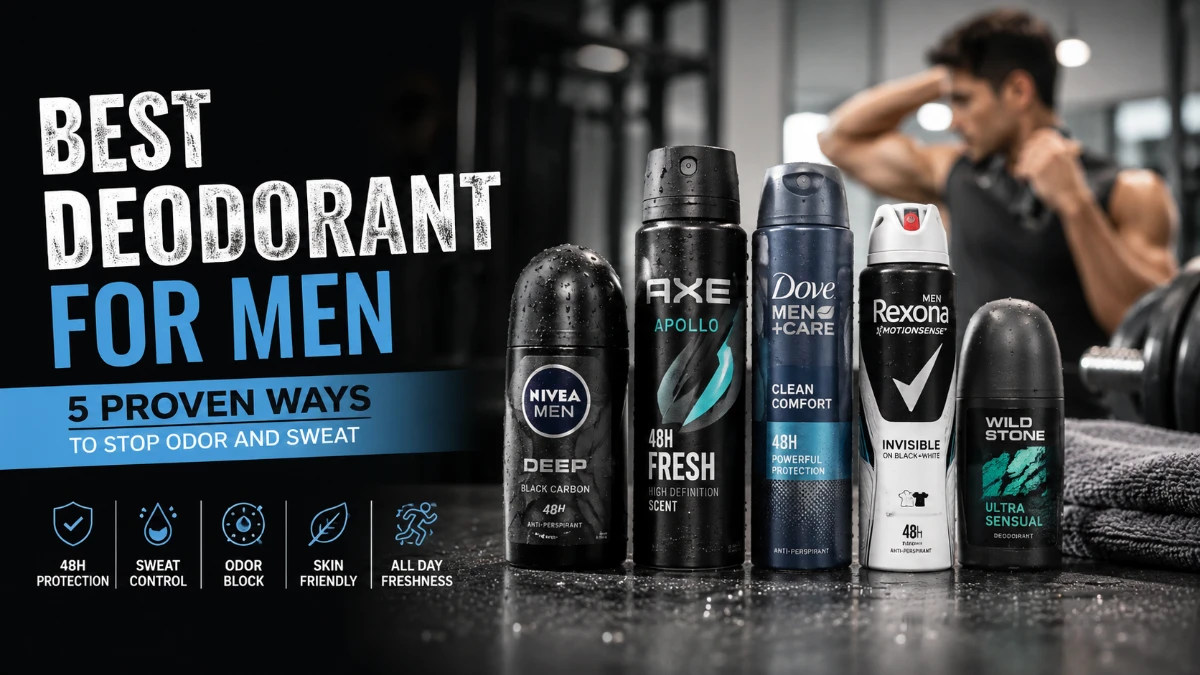
Best Deodorant for Men: How to Match the Right Formula to Your Sweat and Skin Type
Choosing the best deodorant for men starts with a question most buying guides skip: Are you fighting odor, sweat, or both? Deodorant and antiperspirant solve different problems, and picking the wrong category is the most common reason a product “doesn’t work” even when it’s a genuinely good one.
Deodorant vs. Antiperspirant: Know Which One You Need
Deodorant neutralizes odor by killing odor-causing bacteria and masking scent with fragrance, but it does nothing to reduce how much you sweat. Antiperspirant works differently — it contains aluminum-based compounds that form a temporary physical plug in the sweat duct, reducing perspiration itself. Many products marketed as the best deodorant for men are actually antiperspirant-deodorant hybrids, combining both functions in one stick or spray.
If your main issue is smell rather than visible sweating, a standalone deodorant is usually enough. If you deal with sweat stains, dampness, or heavy perspiration, you need a product with an antiperspirant active ingredient — deodorant alone won’t stop that.
What Actually Separates a Strong Deodorant from a Weak One
Independent testing coverage from grooming and wellness outlets doesn’t agree on one single overall winner, and that disagreement is itself useful information: it means the best deodorant for men depends more on matching ingredients to your skin and sweat profile than on chasing a single “top” product. Two ingredient approaches consistently earn strong marks across multiple testing outlets: aluminum-free formulas built around odor-neutralizing acids like mandelic acid, and clinical-strength aluminum-based antiperspirant sticks for heavier sweating. Brands frequently report high sweat-reduction figures — some claiming above 90% — but these numbers come from manufacturer-run clinical testing rather than independent lab verification, so they should be read as brand-reported claims, not universally confirmed results.
Best Picks by Skin and Sweat Type
Matching the best deodorant for men to your actual profile, rather than buying whatever ranks first on a generic list, is where most of the real decision-making value lies.
| Category | What to look for | Why it matters |
| Heavy sweat | Antiperspirant with aluminum chlorohydrate or aluminum zirconium | Physically blocks sweat ducts; deodorant alone can’t do this |
| Sensitive skin | Baking-soda-free, fragrance-free or hypoallergenic formulas | Reduces risk of contact irritation common with alkaline ingredients |
| Natural/aluminum-free preference | Odor-neutralizing acids (mandelic, citric) or probiotic formulas | Controls bacteria without blocking sweat glands |
| Budget-conscious | Drugstore antiperspirant-deodorant hybrids | Often comparable active-ingredient concentration to premium sticks at lower cost |
How to Apply It So It Actually Works
Application timing changes effectiveness more than most people realize, and it’s one of the most consistently under-explained parts of choosing the best deodorant for men. Dermatologists, including guidance echoed by the American Academy of Dermatology, recommend applying antiperspirant at night on clean, dry skin rather than in the morning. At night, sweat gland activity drops, giving the aluminum-based compound several uninterrupted hours to form the duct-blocking effect it needs — moisture from daytime sweat or a fresh morning shower can dilute the active ingredient and reduce how well it works.
A practical routine that reflects this: apply antiperspirant before bed, then use a lighter deodorant in the morning if extra fragrance or freshness is wanted. Limiting application to one or two swipes is enough — more product doesn’t improve results and raises the chance of skin irritation.
Is Aluminum in Antiperspirant Safe?
This question comes up in nearly every search for the best deodorant for men, and current research is reassuring on this specific point. Major reviews, including a widely cited 2014 toxicology analysis and public statements from the American Cancer Society, have found no convincing evidence linking aluminum-based antiperspirants to breast cancer. Aluminum salts work by forming a physical blockage at the skin’s surface rather than being absorbed in meaningful amounts into the body.
Absorption estimates have actually been revised downward over time as testing methods improved: an early 2001 study estimated roughly 0.012% of applied aluminum was absorbed through the skin, while a more recent, better-controlled 2022 assessment — corroborated by European regulatory scientists — put the figure closer to 0.0005%, an even smaller amount. Either way, the consistent finding across both older and newer research is that dermal absorption is minimal.
This doesn’t mean every man should default to aluminum-based products. Those with diagnosed aluminum allergies or significant skin sensitivity may still prefer aluminum-free alternatives, and that’s a legitimate personal-fit reason to choose differently, not a safety objection to aluminum itself.
Choosing Between Stick, Spray, Roll-On, and Cream
Format affects comfort and staining more than efficacy. Sticks offer the most consistent coverage of the active ingredient and are least prone to under-application. Sprays dry faster and reduce white-mark staining on dark clothing but can deliver a less concentrated dose per swipe. Roll-ons and creams tend to suit sensitive skin better because they apply with less friction, and they’re worth considering if you’re active outdoors or in hot climates where reapplication is more frequent.
Frequently Asked Questions
No. Deodorant masks and neutralizes odor, while antiperspirant reduces sweat itself by blocking sweat ducts with aluminum-based compounds.
Dermatologists recommend applying it at night on clean, dry skin, since sweat gland activity is lower and the active ingredient has more time to work before morning.
Major scientific reviews have found no convincing link between aluminum-based antiperspirants and cancer. Absorption through the skin is minimal, and newer research puts the figure even lower than earlier estimates.
Baking-soda-free or fragrance-free formulas, often in roll-on or cream format, reduce the risk of irritation compared to stick antiperspirants with alkaline ingredients.
Aluminum-free formulas using odor-neutralizing acids or probiotics can control odor effectively, but they don’t reduce sweat volume the way antiperspirants do.
Independent testing outlets don’t agree on a single top pick, and personal skin sensitivity and sweat levels vary enough that matching by category is more reliable than chasing one ranked winner.
Yes — many men apply antiperspirant at night and a lighter deodorant in the morning for extra freshness without over-applying the active ingredient.