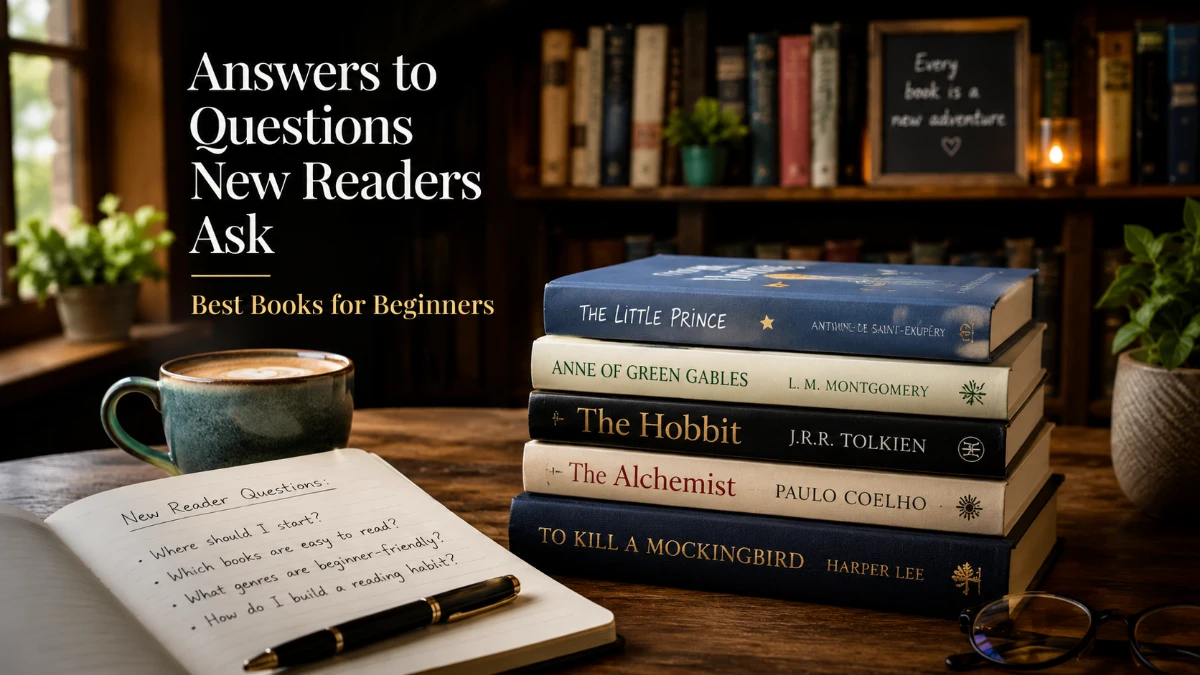
Best Books for Beginners Reading: Answers to the Questions New Readers Actually Ask
“What should I even start with?” is usually the first question anyone asks before searching for the best books for beginners reading — and it’s a fair one, because the wrong first book can end a reading habit before it starts. This guide works through that question and the ones that typically follow it: how long a beginner book should be, which genre fits your taste, and what to do if the book you picked isn’t working.
This is written for teens and adults building or rebuilding a reading habit, not for early-literacy readers. Page counts below come from publisher listings where available and are noted as approximate elsewhere, since editions vary.
“Where Do I Even Start?”
Most people asking this already have a genre they enjoy in film, TV, or podcasts — that’s usually the fastest way into the best books for beginners reading, because genre familiarity does more to keep you reading than a book’s reputation does. Someone who loves mystery shows is more likely to finish a plot-driven mystery than a celebrated literary classic that takes its time to develop.
The eight picks below are grouped by the situation they suit best.
“I Want Something Short and Simple” — The Alchemist
Imagine finishing a full novel in a weekend without feeling rushed. The Alchemist by Paulo Coelho makes that realistic: most editions run roughly 160 to 210 pages, and its parable-style plot follows a single journey without competing subplots to track.
It suits readers who want a reflective, symbolic story rather than a fast-paced one — closer to a long conversation with a mentor than a thriller.
“I Want Something Fast-Paced and Fun” — Percy Jackson and the Lightning Thief
If you enjoy superhero movies or mythology-based games, this is likely the fastest way into the best books for beginners reading in the fantasy genre. Rick Riordan’s conversational narration and compact scenes keep the plot moving, and it opens directly into a wider series, so a second book is already waiting once you finish the first.
Editions vary noticeably in length across hardcover, paperback, and international printings, so check the specific copy before assuming a page count.
“I Want Something Emotionally Gripping” — The Kite Runner
Khaled Hosseini’s The Kite Runner, confirmed at 352 pages in its most recent anniversary edition, is a heavier read than the others on this list, but its plot stays direct and character-driven throughout. It works well for readers who are drawn to serious family dramas or films built around difficult choices and their consequences.
This isn’t the lightest starting point, so choose it when you’re ready for emotional weight rather than an easy escape.
“I Want a Mystery I Can’t Put Down” — Where the Crawdads Sing
An unanswered question is one of the strongest reasons to keep reading, and Delia Owens builds Where the Crawdads Sing around exactly that. At roughly 380 to 400 pages, it’s longer than some entries here, but its coming-of-age story combined with an unresolved death tends to pull readers through the length rather than making it feel like a slog.
Fans of atmospheric crime dramas are likely to find this one of the more absorbing best books for beginners reading in the fiction category.
“I Don’t Want Fiction — I Want Something Useful” — Atomic Habits
James Clear’s Atomic Habits, confirmed at 320 pages in its hardcover edition, is structured around short, practical chapters rather than a continuous narrative. Readers who are more motivated by usable ideas than by story tend to move through it faster than fiction of similar length, since each chapter delivers a self-contained takeaway.
This is the pick to choose if your goal is learning a skill rather than following a plot.
“I Want Short Chapters I Can Read in Small Bursts” — The House on Mango Street
At 160 pages made up of brief, self-contained vignettes rather than long chapters, Sandra Cisneros’s The House on Mango Street is built for readers who want visible progress in short sessions. Its brevity doesn’t come at the cost of depth — it explores identity, family, and growing up with precision within very small spaces.
It suits commuters, parents, or anyone reading in short, interrupted windows rather than long evening sessions.
“I Want a Quick, Thought-Provoking Story” — The Giver
Lois Lowry’s The Giver, confirmed at 240 pages, opens with an immediately clear premise: a society that has removed pain, memory, and choice. Fans of dystopian or speculative films tend to move through it quickly because the plot answers its own central question steadily rather than making the reader wait.
It also works as a stepping stone toward longer dystopian and science-fiction novels once you’re ready for more length.
“I Want Something Warm and Character-Driven” — A Man Called Ove
Fredrik Backman’s A Man Called Ove introduces a distinctive, initially unlikeable character and slowly reveals the reasons behind his behavior. Readers who enjoy humor mixed with genuine emotional payoff tend to connect with this structure, since each chapter adds another layer to why Ove is the way he is.
It fits readers drawn to relationship dramas more than those looking for suspense or fast plotting.
“What If the Book I Picked Isn’t Working?”
This is one of the most common — and most avoidable — reasons people give up on the best books for beginners reading entirely. A mismatch between book and reader usually isn’t a sign that reading “isn’t for you”; it’s a sign to change one variable.
Diagnose the friction before switching:
- Feels too slow → move to a plot-driven mystery or adventure.
- Language feels dense → try contemporary fiction or an audiobook version.
- Feels emotionally heavy → switch to humor, romance, or lighter adventure.
- Feels pointless without practical value → move from fiction into structured nonfiction.
- Feels too long to finish → choose a novella or a book built from short vignettes.
“How Do I Actually Stick With It?”
James Clear, whose own book appears on this list, has suggested starting with something as small as one page a day and placing the book somewhere you’ll naturally see it — a small, repeatable cue rather than an ambitious target. That approach applies just as well to fiction as it does to the habit-focused nonfiction he writes about.
A workable first-month approach:
- Choose one title based on genre familiarity, not reputation.
- Attach reading to an existing daily moment — a commute, a meal, before sleep.
- Keep the book visible in that location.
- Switch formats (print, ebook, audiobook) if access is the real obstacle.
- Give yourself permission to abandon a book that clearly isn’t working after a fair attempt.
“What Should I Read Next?”
Once you’ve finished a first book, the best move is usually to stay close to what worked rather than jumping to something demanding. Someone who enjoyed Percy Jackson can continue the series or move into other fast-paced fantasy; someone who finished Atomic Habits might try a second practical nonfiction title on a related topic before attempting a denser one.
Building momentum across two or three approachable books tends to matter more for long-term reading habits than any single “best” choice does.
Frequently Asked Questions
It depends on your taste, but The Alchemist and The House on Mango Street are among the shortest and most straightforward entries on this list, while Percy Jackson and the Lightning Thief offers pace and humor for readers who want more energy
No. Classics aren’t automatically the best books for beginners reading — accessibility and genre fit matter more than a book’s literary reputation. You can explore denser classics later once reading feels more natural.
There’s no fixed length requirement. A 160-page book with dense language can feel harder than a 350-page book with a fast-moving plot, so judge by pacing and readability rather than page count alone.
Choose fiction for story and emotional engagement, and nonfiction if you’re more motivated by learning a specific skill or idea. Neither is inherently easier — fit depends on what draws you to reading in the first place.
Yes. Audiobooks work well for people who struggle to find dedicated reading time, and they can make long or descriptive books feel more accessible during commutes or chores.
Yes. Abandoning a book that isn’t working, after giving it a fair chance, is generally more useful for building a reading habit than forcing through a mismatch.
Stay close to the genre or format that worked well the first time — a similar adventure, a related nonfiction topic, or another book with short chapters — before moving to more demanding material.