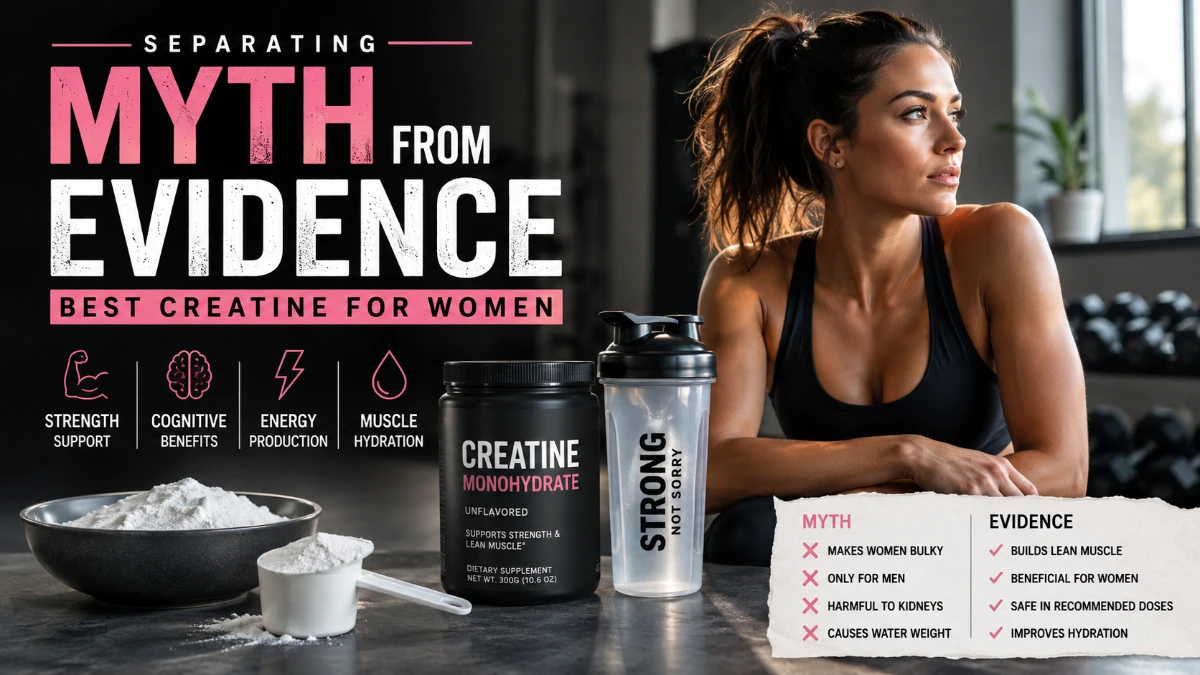
Best Creatine for Women: Separating Myth From Evidence
Ask five different women about creatine, and you may hear five contradictory claims: that it is “only for bodybuilders,” that it causes bloating, that it is unsafe for the kidneys, or that women need a completely different product than men.
Most of those claims are incomplete.
The better question is not whether women need a special form of creatine. It is worth considering which creatine is worth buying, how much to take, whether loading is necessary, and what the evidence actually says about women at different life stages.
For most healthy adults, the answer starts with a simple ingredient: creatine monohydrate. The bigger differences come from dosage, product quality, testing, format, and the reason you are taking it.
This guide separates the most common myths from the evidence, compares several practical product options, and explains what to look for when choosing the best creatine for women.
This article focuses primarily on creatine monohydrate. Supplement use during pregnancy, breastfeeding, or in people with kidney disease or other significant medical conditions requires individualized medical advice rather than a generic supplement recommendation.
Quick Picks: Best Creatine for Women
| Product | Best for | Creatine per serving | Form | Third-party certification | Why it stands out |
| Thorne Creatine | Best overall | 5 g | Powder | NSF Certified for Sport | Simple formula, transparent dosing, strong testing credentials |
| Klean Creatine | Best simple alternative | 5 g | Powder | NSF Certified for Sport | One-ingredient formula and clear dosing |
| Momentous Creatine Monohydrate | Best for athletes who want third-party testing | 5 g | Powder | NSF Certified for Sport | Straightforward monohydrate with athlete-focused certification |
| Lemme Creatine Body Toning Gummies | Best gummy format | See current label | Gummies | NSF Certified for Sport | Convenient option for people who strongly prefer chewables |
| Creatine monohydrate powder in general | Best value category | Usually 3–5 g | Powder | Varies by product | The ingredient itself is inexpensive, extensively studied, and does not require a women-specific formula |
Thorne’s current NSF listing identifies its creatine as an unflavored powder with a 5 g serving size and 450 g or 900 g package sizes. Klean Creatine is listed by NSF as a 5 g serving of unflavored powder, and Klean’s current product page states that each serving contains 5 g of creatine monohydrate with no other ingredients. Momentous also has NSF-listed creatine monohydrate products with a 5 g serving. Lemme’s creatine gummies are listed by NSF as a certified gummy product, with four gummies per serving; because gummy formulations can change, check the current Supplement Facts panel for the exact creatine amount before buying.
Our Top Pick: Thorne Creatine
Best overall for most women: Thorne Creatine is a strong default when you want a simple, clearly dosed creatine monohydrate powder from a brand with NSF Certified for Sport certification.
Thorne’s NSF listing identifies a 5 g serving of unflavored powder, while Thorne’s current site lists the 90-serving product at $44.00 at the time of review. Prices and package sizes can change, so verify the current price before purchasing.
There is nothing inherently more “female” about the formula, and that is precisely the point. The product is easy to dose, easy to mix, and does not depend on a proprietary blend to justify its price.
Best Alternative: Klean Creatine
Klean Creatine is another strong option when simplicity is the priority. The current product provides 5 g of creatine monohydrate per scoop, with approximately 60 servings per 315 g container and no other ingredients listed on the product page.
Klean’s 2026 U.S. price list lists an MSRP of $34.50 for the 315 g product. Its product is also listed through NSF Certified for Sport.
Best for Athletes: Momentous Creatine Monohydrate
Momentous is worth considering for athletes who place a high value on third-party sports certification. NSF’s current listing identifies Momentous Creatine Monohydrate as an unflavored powder with a 5 g serving and multiple package sizes.
The important takeaway is not that Momentous is biologically superior to other creatine monohydrate products. It is that a straightforward, clearly labeled product with credible independent testing can make purchasing easier when sport-specific quality controls matter.
Best Gummy Option: Lemme Creatine Body Toning Gummies
Gummies can make daily supplementation easier for people who dislike powders. Lemme’s creatine gummies are currently listed in NSF’s Certified for Sport database, with four gummies per serving.
The tradeoff is that convenience can come with more calories, carbohydrates, sweeteners, and a more complicated ingredient list than a plain powder. If you choose gummies, compare the actual amount of creatine monohydrate per serving, not just the number of gummies or the marketing claims on the front of the package.
How We Chose the Best Creatine for Women
The label “for women” is not enough to make a creatine product a good choice.
We prioritize the following:
- Creatine monohydrate: This is the form with the largest evidence base for increasing muscle creatine stores and supporting high-intensity exercise.
- Transparent dosing: You should be able to see exactly how much creatine you are getting per serving.
- Independent testing: NSF Certified for Sport and similar third-party certifications can provide additional quality-control information, especially for competitive athletes.
- Simple formulas: A product does not become more effective simply because it contains more ingredients.
- Reasonable cost per dose: Compare the price of the actual creatine dose rather than the sticker price alone.
- Practical format: Powder, gummies, or another delivery format can work; adherence matters more than branding.
- No misleading women-specific promises: A supplement should not imply that women require a special creatine molecule when the ingredient is the same.
Third-party certification is a quality-control consideration, not proof that one brand produces better physiological results than another. A well-tested, clearly labeled creatine monohydrate product is the goal.
Creatine Benefits for Women
Creatine is best known for supporting the phosphocreatine system, which helps regenerate ATP during short, high-intensity efforts. That is one reason creatine has such a strong evidence base in resistance training and explosive exercise.
For women, the potential benefits are not limited to bodybuilding.
Research in women has examined creatine in relation to strength, lean mass, exercise performance, and several health-related outcomes, although the female-specific evidence base is still smaller than the overall creatine literature. A lifespan-focused review concluded that creatine may offer benefits across different stages of women’s health while also emphasizing that more female-specific research is needed.
Strength and Training Performance
Creatine can increase the availability of rapidly regenerated ATP during repeated high-intensity efforts. Over time, that can help support training quality and adaptations when creatine is combined with resistance exercise.
Lean Mass
Creatine supplementation can increase lean mass, especially alongside resistance training. This does not mean that every pound of weight gained is new muscle; early changes can also reflect increased water stored within muscle.
Postmenopausal Muscle Support
This is one of the areas where the female-specific evidence has become more useful.
A 2026 systematic review and meta-analysis of seven randomized controlled trials involving 608 postmenopausal women found that creatine supplementation was associated with a modest increase in lean mass and improved leg-press strength. The clearest benefits appeared when creatine doses were at least 5 g per day and were combined with resistance training. The review did not find an overall improvement in bone density, and the authors described the evidence as having some limitations.
That makes creatine particularly relevant to women interested in maintaining muscle and strength as they age, but it should not be marketed as a standalone osteoporosis treatment.
Possible Cognitive or Other Health Benefits
Creatine is also being studied for cognitive and broader health applications. Some findings are promising, but these outcomes are less established than the evidence for exercise performance and muscle-related outcomes.
For that reason, choose creatine primarily for its established uses rather than buying a product because its marketing promises large cognitive, hormonal, or anti-aging effects.
Myth: Creatine Is Basically the Same for Everyone, So “For Women” Is Just Marketing
Fact: The creatine molecule itself is not different for women and men.
Women have been reported to have 70% to 80% lower endogenous creatine stores than men on average, with differences influenced by factors such as muscle mass and dietary intake. However, lower average stores do not automatically mean that every woman will respond more strongly to supplementation or that every woman needs a higher dose. Female-specific creatine research remains less extensive than the broader literature.
That distinction matters.
The “for women” label can be useful when a product or article addresses questions that are particularly relevant to women, such as menopause, pregnancy, breastfeeding, dietary creatine intake, and concerns about bloating or weight changes.
But it does not mean women need a different kind of creatine.
For most healthy adult women, creatine monohydrate is the same compound used by men.
Myth: Creatine Causes Dangerous Water Retention or Kidney Strain
Fact: Creatine can increase the amount of water associated with muscle, particularly when supplementation begins, but that is different from gaining body fat.
The kidney question is more nuanced than simply saying “creatine is completely harmless.”
A 2026 systematic review and meta-analysis of randomized controlled trials found that creatine supplementation was associated with a modest change in serum creatinine but did not produce a statistically significant reduction in GFR, suggesting that the serum-creatinine increase does not necessarily represent kidney damage. The authors interpreted the change as more consistent with creatine metabolism than with impaired filtration.
Another 2026 systematic review similarly evaluated kidney outcomes and did not find evidence of clinically meaningful renal harm in the populations studied.
Can Creatine Raise a Creatinine Blood Test?
Yes, potentially.
That is an important distinction because serum creatinine is a laboratory marker used in assessing kidney function, and creatine supplementation can influence that number.
A higher creatinine result does not automatically mean that creatine has damaged your kidneys. A clinician may consider the full clinical context and, when appropriate, other measures of kidney function rather than interpreting one laboratory value in isolation.
Anyone with known kidney disease, unexplained kidney abnormalities, or another significant medical condition should discuss creatine supplementation with a healthcare professional before starting.
Myth: You’ll Get Bloated No Matter What
Fact: Early scale-weight changes from creatine are often related to water associated with increased muscle creatine storage, while gastrointestinal bloating is more likely to become an issue when larger loading doses are used.
A loading phase commonly involves approximately 20 g per day, divided into several doses, for about 5–7 days. A simpler alternative is to skip loading and take 3–5 g per day consistently. The second approach increases muscle creatine more gradually and may be easier for people who are sensitive to gastrointestinal discomfort.
Not every woman experiences noticeable bloating, and the response varies.
If bloating is your main concern, the simplest first step is usually to skip the loading phase and use a standard daily maintenance dose.
Myth: More Loading Means Faster, Better Results
Fact: A loading phase can saturate muscle creatine stores faster, but it is not required.
A widely used approach is approximately 0.3 g/kg/day for 5–7 days, followed by 3–5 g/day. Another practical approach is simply taking 3–5 g every day from the beginning.
The key difference is speed.
With loading, muscle creatine levels rise more rapidly. Without loading, the same general goal can be achieved more gradually.
For most women, there is no compelling reason to force a loading phase if taking a steady daily dose is simpler and more comfortable.
Loading vs. No Loading
| Approach | Typical amount | Main advantage | Main drawback |
| Loading | ~0.3 g/kg/day for 5–7 days, then 3–5 g/day | Saturates stores faster | More chance of GI discomfort and early water-weight changes |
| No loading | 3–5 g/day | Simple and often easier to tolerate | Takes longer to reach full saturation |
Myth: One Dose Fits All Women
Fact: There is a well-established practical range for general creatine supplementation, but special situations deserve separate consideration.
For healthy adults, 3–5 g of creatine monohydrate per day is a straightforward maintenance approach.
Postmenopausal women are a more specific population. The 2026 systematic review found the clearest effects on lean mass and leg-press strength in trials using at least 5 g/day alongside resistance training, while overall bone-density results were unchanged.
That does not mean every postmenopausal woman needs more than 5 g/day.
The historical 0.3 g/kg/day figure is better understood as a high-dose/loading protocol used in some research rather than a universal lifelong maintenance recommendation.
| Situation | What the evidence actually supports |
| Healthy adult, general training | 3–5 g/day is a practical maintenance range |
| Postmenopausal, bone/muscle focus | Research supports creatine, with several trials using ≥5 g/day alongside resistance training |
| Loading phase | ~0.3 g/kg/day for 5–7 days can raise stores faster, but loading is optional |
| Pregnant or breastfeeding | No established routine dosing guidance; discuss use with a clinician |
| Existing kidney/chronic condition | Get individualized medical advice before starting |
How Much Creatine Should Women Take?
For most healthy adult women using creatine for resistance training, strength, or general performance, 3–5 g of creatine monohydrate per day is a reasonable evidence-based maintenance approach.
You do not need to calculate the dose from your height, sex, or body-fat percentage.
A loading phase can be used when rapid saturation is important, but it is optional.
A simple daily routine
Option 1 — No loading:
Take 3–5 g every day.
Option 2 — Loading:
Take about 0.3 g/kg/day for 5–7 days, generally divided across several doses, then continue with 3–5 g/day.
For most people, option 1 is easier.
Should Women Take Creatine Every Day?
Yes, consistency matters more than trying to time every serving around a workout.
Creatine supplementation is generally intended to maintain elevated muscle creatine stores, so taking it daily makes sense whether you train that day or not.
You do not need to take it immediately before your workout.
A convenient routine is usually the best routine: add your daily dose to a shake, smoothie, yogurt, water, or another regular meal or drink.
When Should Women Take Creatine?
There is no strong reason for most women to obsess over a specific “perfect” time.
Taking creatine at the same time each day can make adherence easier. If you train in the morning, you can take it with breakfast or after training. If you train later, you can take it at another consistent time.
The important part is taking the appropriate amount consistently, not finding a narrow pre-workout window.
Does Creatine Cause Weight Gain in Women?
It can cause a small increase in scale weight, especially when supplementation starts, but that does not mean you are gaining body fat.
Creatine increases the amount of creatine stored in muscle, and water is associated with that storage. A scale increase is therefore not automatically a sign that creatine is making you “fatter.”
This matters especially for women who are tracking body weight during fat loss.
Creatine weight gain vs. fat gain
| Change | What it may represent |
| Early increase in scale weight | Often increased water associated with muscle creatine storage |
| Gradual increase with resistance training | May include additional lean mass over time |
| Increased body fat | Determined by overall energy balance, not creatine itself |
If minimizing early scale fluctuations matters to you, skipping the loading phase can make the transition more gradual.
Does Creatine Make Women Bulky?
No.
Creatine does not automatically make women bulky, and it does not override training, nutrition, or genetics.
It may help you perform more effectively during resistance training, which can support strength and lean mass over time. How much muscle you ultimately gain depends on your training program, food intake, recovery, genetics, and consistency.
If your goal is to build a small amount of lean mass, maintain strength, or improve performance, creatine can fit within that goal.
Creatine for Women Over 40
Creatine becomes particularly interesting after 40 because maintaining muscle and strength becomes increasingly important with age.
That does not mean every woman over 40 needs a special formulation.
A straightforward creatine monohydrate supplement combined with progressive resistance training is usually a more evidence-based strategy than paying extra for a product marketed specifically as “women’s creatine.”
The product should still meet the same core standards:
- Clearly stated creatine dose
- Preferably creatine monohydrate
- Transparent ingredients
- Good manufacturing and quality controls
- Independent testing when available
Creatine for Postmenopausal Women
Postmenopausal women are one of the more important populations in female-specific creatine research.
A 2026 systematic review and meta-analysis examined seven randomized controlled trials involving 608 postmenopausal women. Creatine was associated with a mean increase in lean mass of approximately 0.37 kg and an improvement of approximately 7.5 kg in leg-press 1RM, although the strength analysis included fewer participants and the evidence has limitations. Benefits were most evident when creatine was used at 5 g/day or more alongside resistance training. Bone density did not improve overall.
This does not make creatine a replacement for resistance training, adequate protein intake, or appropriate medical care.
Think of it as a potential addition to a broader muscle-maintenance strategy.
Creatine During Your Menstrual Cycle
There is not enough evidence to justify a complicated creatine schedule based on the menstrual cycle.
Research has examined relationships between female hormones and creatine-related physiology, but that does not establish a reliable need to change your dose from one phase of the menstrual cycle to another.
For most women, a consistent daily routine is simpler and better supported than changing the dose every week.
Can Women Take Creatine While Trying to Lose Fat?
Yes, creatine can still be useful during a fat-loss phase.
Creatine does not act as a fat burner. Its main value is supporting muscle creatine stores, which can help maintain training performance and strength while dieting.
The main issue is scale interpretation.
If creatine causes some early water-weight gain, the number on the scale may temporarily move in the opposite direction from your fat-loss goal even when body fat is decreasing.
For that reason, women using creatine during a cut may want to track more than body weight alone, including:
- Waist measurements
- Progress photos
- Strength performance
- Average weekly weight
- How clothing fits
What Is the Best Form of Creatine for Women?
For most people, the simplest answer is creatine monohydrate.
It is the form with the strongest research base and is available in a wide range of products.
You do not need a product labeled “female creatine,” “lean creatine,” or “women’s creatine” simply because you are a woman.
Other forms may be marketed as more advanced, easier to absorb, or less bloating, but that marketing should not be confused with a demonstrated need to avoid monohydrate.
For most buyers, a transparent creatine monohydrate product is the logical starting point.
Powder vs. Creatine Gummies
Both formats can be practical, but the label matters more than the shape of the supplement.
Powder
Pros:
- Usually simple
- Easy to reach a standard 3–5 g dose
- Often lower cost per gram
- Many single-ingredient options
Cons:
- Requires mixing
- Texture may be unpleasant for some people
Gummies
Pros:
- Convenient
- No mixing required
- Easy to carry
Cons:
- May contain added carbohydrates, sugar, sweeteners, or other ingredients
- Often more expensive per dose
- Serving sizes can require multiple gummies
Lemme’s current NSF listing, for example, shows four gummies per serving and lists 40 calories, 9 g carbohydrate, and 4 g sugar for the certified product listing.
The important question is not whether a gummy looks more “female-friendly.” It is whether you are getting an appropriate amount of creatine without paying a large premium for the format.
Are Creatine Gummies as Effective as Powder?
They can deliver creatine, but effectiveness depends on the actual amount of creatine in the serving, not whether the product is a gummy.
If two products provide comparable amounts of creatine monohydrate, the delivery format itself is unlikely to be the deciding physiological factor.
However, gummies can contain other ingredients that do not contribute to creatine’s primary purpose.
For a simple supplement routine, powder generally makes it easier to see exactly what you are taking.
How to Choose a Creatine Supplement
Before buying, check these five things.
1. Look for creatine monohydrate
Avoid assuming that a complicated formula is automatically better.
2. Check the exact dose
A reputable label should clearly identify how much creatine you receive per serving.
3. Look for independent testing
NSF Certified for Sport is one example of third-party certification that can provide additional quality-control assurance.
4. Compare cost per serving
A large tub is not necessarily cheaper if each serving contains less creatine.
5. Ignore unnecessary gender marketing
A pink label, “women’s wellness” branding, or claims about “toning” do not make the underlying creatine more effective.
What About Creapure?
Creapure is a branded source of creatine monohydrate produced by Alzchem.
It can be a legitimate quality consideration, but it is not a requirement for effective creatine supplementation.
The important correction is that “Creapure” should not be treated as synonymous with “best.”
A product can be a good choice because it contains a clearly stated amount of creatine monohydrate and has strong quality controls, whether or not the consumer-facing package emphasizes a particular branded raw-material source.
Klean’s older and current product materials have identified its creatine as Creapure-sourced, while its current product page emphasizes the 5 g creatine monohydrate dose and one-ingredient formula.
Are Third-Party-Certified Creatine Products Better?
Not necessarily better in terms of physiological effectiveness.
Third-party certification answers a different question:
Can I have more confidence in the product’s identity, purity, and compliance with the certification program?
For athletes subject to sport testing, this can be especially valuable.
NSF’s current Certified for Sport database includes Thorne Creatine, Klean Creatine, Momentous Creatine Monohydrate, and other creatine products.
Certification should therefore be treated as a quality-control advantage, not as proof that a supplement will outperform every non-certified creatine monohydrate product.
Pregnancy and Breastfeeding
This is one area where the usual “creatine is safe for healthy adults” discussion should not be generalized.
Pregnancy and breastfeeding have different evidence requirements, and the available human evidence is not sufficient to establish a routine creatine supplementation recommendation for every pregnant or breastfeeding woman.
That means the safest approach is to discuss creatine with your obstetrician, primary care, or other qualified healthcare professional rather than relying on general adult dosing advice.
The same principle applies if you have kidney disease, take medications that require careful kidney monitoring, or have another significant health condition.
Who Should Talk to a Clinician Before Taking Creatine?
Seek individualized medical advice before starting creatine if you:
- Have diagnosed kidney disease or unexplained abnormal kidney tests
- Are pregnant or breastfeeding
- Have a significant chronic medical condition
- Take medications for which kidney function or fluid balance is clinically important
- Have been told to restrict certain supplements or nutrients
The evidence for creatine in healthy adults should not automatically be applied to populations that were not adequately represented in the relevant trials.
Is Creatine Safe for Women Long-Term?
Current evidence is generally reassuring for healthy adults taking standard creatine doses, but “safe” should always be interpreted in the context of the population studied.
The 2026 postmenopausal meta-analysis reported that adverse events were mild and similar to placebo, while renal indices were unchanged in the included trials.
Likewise, recent kidney-focused systematic reviews have not found convincing evidence that standard creatine supplementation causes meaningful loss of kidney function in the populations studied.
That is different from claiming that every person, at every dose, and under every medical circumstance can use creatine without professional guidance.
Best Creatine for Women: Final Recommendations
The best creatine for women is usually not the product with the most elaborate marketing.
For most healthy adult women, the best starting point is a clearly labeled creatine monohydrate supplement providing about 3–5 g per daily serving.
Best Overall: Thorne Creatine
Choose this if you want a simple product with a 5 g serving and NSF Certified for Sport status.
Best Simple Alternative: Klean Creatine
Choose this if you want a straightforward one-ingredient formula providing 5 g of creatine monohydrate per serving. It is also NSF Certified for Sport.
Best Athlete-Focused Alternative: Momentous Creatine Monohydrate
Choose this if NSF Certified for Sport certification is an important part of your supplement selection process. The certified product provides 5 g per serving.
Best Convenience Format: Lemme Creatine Gummies
Choose this only if gummies make daily adherence substantially easier for you. Compare the current label carefully because the serving contains additional calories and carbohydrates, and convenience may come at a higher cost than plain powder.
For everyone else, a basic creatine monohydrate powder from a reputable manufacturer is often the most economical and least complicated option.
Bottom Line
For most healthy adult women, the best creatine for women is not a special women’s formula. It is a reputable, clearly labeled creatine monohydrate product that delivers a practical daily dose, ideally with strong quality controls.
A daily 3–5 g dose is a simple starting point. Loading is optional. Early scale increases do not automatically mean fat gain. A small change in serum creatinine does not automatically mean kidney damage. And for postmenopausal women, current evidence supports creatine as a potentially useful addition to resistance training for lean mass and strength, while bone-health claims should remain appropriately cautious.
When choosing between products, prioritize ingredient transparency, creatine dose, independent testing, cost per serving, and a format you will actually use consistently.
That matters more than whether the label is pink, says “for women,” or promises a proprietary advantage.
Sources and Evidence
- Naddafha S, Antonio J, Kreider RB, Stout JR. Creatine monohydrate for lean mass, strength, and bone density in postmenopausal women: a systematic review and meta-analysis. 2026.
- Tsiaras A, et al. The effect of creatine supplementation on kidney function: a systematic review and meta-analysis of randomized controlled trials. 2026.
- Almeida AS, et al. Impact of creatine supplementation on kidney health: a systematic review and meta-analysis. 2026.
- Effect of creatine supplementation on kidney function: a systematic review and meta-analysis. 2025/2026 publication record.
- Smith-Ryan AE, et al. Creatine Supplementation in Women’s Health: A Lifespan Perspective.
- NSF Certified for Sport product listings for Thorne Creatine, Klean Creatine, Momentous Creatine Monohydrate, and Lemme Creatine Gummies.
- Thorne official product and NSF certification information.
- Klean Athlete official Klean Creatine product information and 2026 price list.
Editorial disclosure: Product prices, package sizes, formulations, certifications, and availability can change. Verify the current product label and certification status before purchase. This article is educational and is not a substitute for individualized medical advice.
Frequently Asked Questions
No. The creatine molecule is the same. Women have been reported to have lower average endogenous creatine stores than men, but that does not mean women require a unique type of creatine. The practical differences are more about individual diet, training, life stage, and health context.
For most healthy adult women, a simple creatine monohydrate product with a transparent 3–5 g daily serving is the best starting point. Thorne, Klean, and Momentous are examples of products with current NSF Certified for Sport listings and clearly stated creatine servings.
Not necessarily. Creatine can increase water associated with muscle storage, especially during the first several days of use, while gastrointestinal bloating is more commonly an issue with larger loading doses. Skipping the loading phase and taking 3–5 g daily may be more comfortable for people who are sensitive to this effect.
Current systematic reviews are generally reassuring for healthy adults. Creatine can affect serum creatinine measurements, but recent analyses have not found a significant reduction in GFR or convincing evidence of kidney impairment from standard supplementation.
People with diagnosed kidney disease or abnormal kidney tests should seek individualized medical advice
Yes. A small increase in serum creatinine can occur with creatine supplementation and does not automatically mean kidney damage. Clinicians should interpret kidney function using the full clinical context rather than assuming that any creatinine increase equals renal injury.
No. Loading can increase muscle creatine stores faster, but taking 3–5 g daily without a loading phase is a reasonable approach for most people.
For general training, 3–5 g of creatine monohydrate per day is a practical maintenance range. Some postmenopausal research has used at least 5 g/day alongside resistance training, but this does not establish a universal higher dose for every woman.
Not automatically. Current evidence suggests that creatine can support lean mass and strength in postmenopausal women, particularly when used at 5 g/day or more with resistance training. The older 0.3 g/kg/day figure should not be interpreted as a universal maintenance recommendation.
Yes. Creatine does not prevent fat loss. It may cause some initial water-weight gain, so the scale can temporarily become harder to interpret. Track trends in body weight, measurements, strength, and other progress markers rather than relying on a single weigh-in.