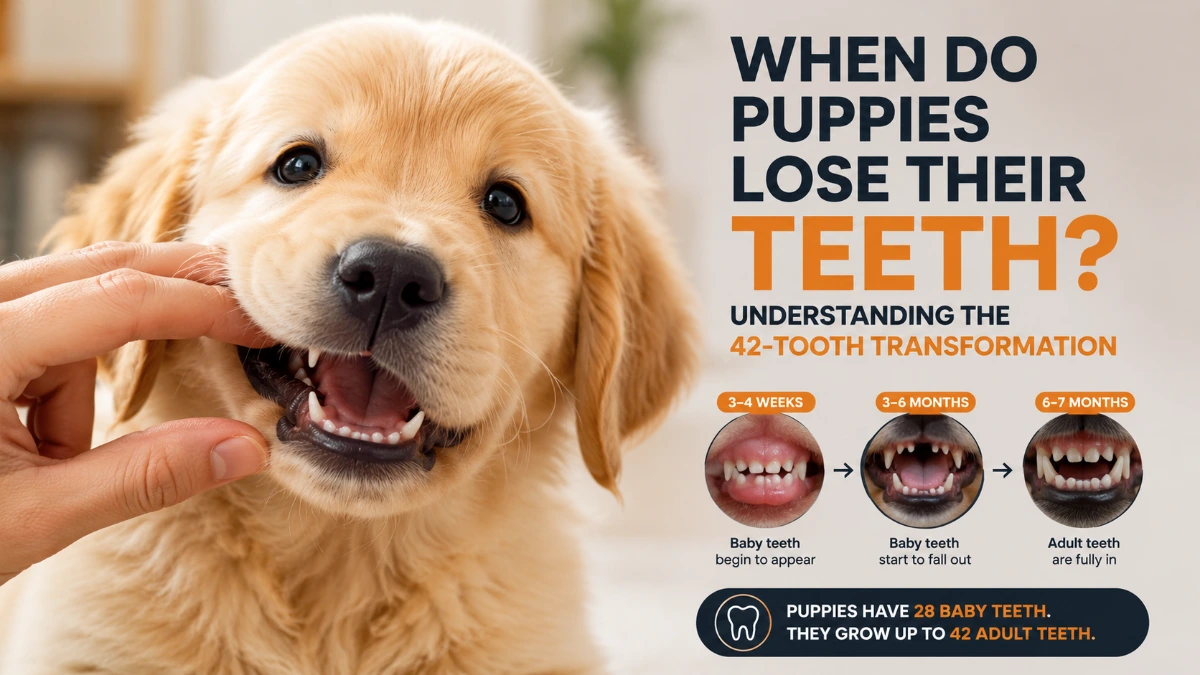
When do puppies start losing their teeth: Understanding the 42-Tooth Transformation
Puppies are born without teeth, then grow a full set of 28 temporary baby teeth before losing them and growing 42 permanent teeth in their place. Understanding this tooth-replacement process explains why baby teeth fall out, when it happens, and what should raise concern.
How a puppy’s mouth develops
A puppy’s first teeth, called deciduous or baby teeth, begin erupting at around 3 to 5 weeks old. By roughly 6 to 8 weeks, most puppies have a complete set of 28 baby teeth: incisors, canines, and premolars, but no molars.
When do puppies start losing their teeth relates directly to this early foundation. Baby teeth exist temporarily to let a young, small jaw function while the skull grows large enough to support the permanent set that follows.
Permanent teeth develop beneath the baby teeth from early in a puppy’s life. As each adult tooth matures, it gradually resorbs the root of the baby tooth above it, which is what allows the baby tooth to loosen and fall out.
When the tooth change begins
Baby teeth commonly begin to loosen and fall out at around 12 to 14 weeks of age, typically starting with the small front incisors. This marks the point most owners associate with the phrase when do puppies start losing their teeth, since it is usually the first visible sign of the transition.
The process is gradual rather than immediate. Canines and premolars follow over the next several weeks, while permanent molars, which have no baby-tooth predecessor, erupt directly behind the premolars as new additions to the mouth.
| Age | Dental stage |
| 3–5 weeks | Baby teeth erupt |
| 6–8 weeks | Full baby set of 28 teeth present |
| 12–14 weeks | Tooth loss begins, usually with incisors |
| 4–6 months | Canines, premolars replaced; molars erupt |
| 6–7 months | Full adult set of 42 teeth typically complete |
Because different teeth change at different rates, a puppy’s mouth can show baby and adult teeth side by side for weeks. This is one reason when do puppies start losing their teeth is best understood as a multi-month process rather than a single date.
Why this matters beyond curiosity
Understanding the tooth-replacement sequence helps owners interpret what they see instead of guessing. A missing incisor at three months and a missing premolar at five months are both normal, but they represent different stages of the same underlying process.
This knowledge becomes especially useful when a tooth does not follow the expected pattern, since the anatomy explains why some deviations matter more than others.
Normal signs versus problem signs
Most puppies show mild, temporary signs during tooth replacement: increased chewing, occasional light gum bleeding, a missing tooth that is never found because it was swallowed, and brief periods when a baby tooth and its replacement appear together.
When do puppies start losing their teeth? Questions often arise because an owner spots one of these signs and wants reassurance. In most cases, these observations reflect the normal resorption-and-eruption process described above, not an injury or illness.
The distinction that matters is whether a baby tooth is shedding on schedule or being retained. A tooth genuinely falling out becomes progressively looser; a retained tooth stays firmly in place even as the permanent tooth erupts beside it.
Retained teeth: when the process stalls
A retained, or persistent, deciduous tooth occurs when the baby tooth’s root fails to resorb properly, so the tooth does not loosen even though the permanent tooth beneath it is already erupting. The result is two teeth in the same position, most commonly seen with the canines.
This matters mechanically: two teeth competing for one space can push the permanent tooth into an abnormal angle, trap food between the teeth, and contribute to bite misalignment or later gum disease. Small-breed and short-nosed dogs are more frequently affected by this failure of normal resorption.
A retained tooth will not resolve simply by waiting, because the biological process that should have removed it did not occur. This is the main scenario where the anatomy of tooth replacement, rather than age alone, determines the right action.
Supporting the process safely
Because permanent teeth are still anchoring into a healing jaw, chew choices during this period should avoid unnecessary force on the mouth. Puppy-appropriate chew toys, sized correctly and supervised, allow normal chewing behavior without stressing erupting teeth.
Very hard objects, such as antlers, hard bones, or rigid, non-yielding toys, can fracture a tooth that is still developing its full structure. Avoid these, and never pull at a loosening baby tooth, since forcing removal can damage the tissue guiding the permanent tooth into place.
Introducing gentle mouth handling during this stage, such as briefly lifting the lips and touching the muzzle, also prepares a puppy for later tooth brushing with dog-specific toothpaste. Human toothpaste is unsuitable because it is formulated to be spat out, not swallowed, and dogs cannot follow that instruction.
When to involve a veterinarian
Because the underlying anatomy determines outcomes, a veterinary exam is the appropriate way to check whether tooth replacement is proceeding normally. This is especially relevant once permanent teeth are visibly erupting.
Seek veterinary assessment if you observe:
- A baby tooth still present beside an already-erupted adult tooth
- Persistent or heavy bleeding, rather than a brief spot
- Swelling, discharge, or a strong odour from the mouth
- Refusal to eat, yelping while chewing, or repeated pawing at the mouth
- A tooth angled into the gum, palate, or another tooth
- A mouth still appearing incomplete or crowded near 7 months of age
A veterinarian examining the mouth can determine whether a retained tooth needs extraction and whether imaging is needed to check the position of the permanent tooth’s root, since this cannot be judged from the surface alone.
Putting the timeline in context
When do puppies start losing their teeth? There is a fairly consistent biological answer, around 12 to 14 weeks, but the completion of the whole process by roughly 6 to 7 months is just as relevant for owners tracking normal development. Both ends of that range matter for recognizing when something has gone off track.
Viewing puppy teething as root resorption and eruption, rather than just “teeth falling out,” makes it easier to understand why some signs are routine and others need prompt attention.
Frequently Asked Questions
Most puppies begin losing baby teeth around 12 to 14 weeks old, generally starting with the incisors at the front of the mouth.
The root of each baby tooth resorbs as the permanent tooth beneath it develops, which loosens the baby tooth until it falls out naturally.
The main tooth-change period runs from about 3 to 6 months, with most puppies having a complete adult set by around 6 to 7 months.
It is a baby tooth that fails to resorb and loosen even though the permanent tooth is already erupting, leaving two teeth in one spot, often a canine.
The permanent canine has erupted, while the baby canine’s root has not resorbed properly. This is a retained tooth and should be checked by a veterinarian.
Yes. Very hard, non-yielding objects can fracture a tooth that is still developing, so puppy-appropriate, correctly sized chews are safer.
No. Removing it yourself can damage the tissue guiding the permanent tooth into place. Let it fall out naturally or have a veterinarian assess it.
Small-breed and short-nosed dogs are more commonly affected by retained deciduous teeth, though it can occur in any breed.
This warrants a veterinary oral exam, since it may indicate a retained tooth or an eruption problem needing evaluation.