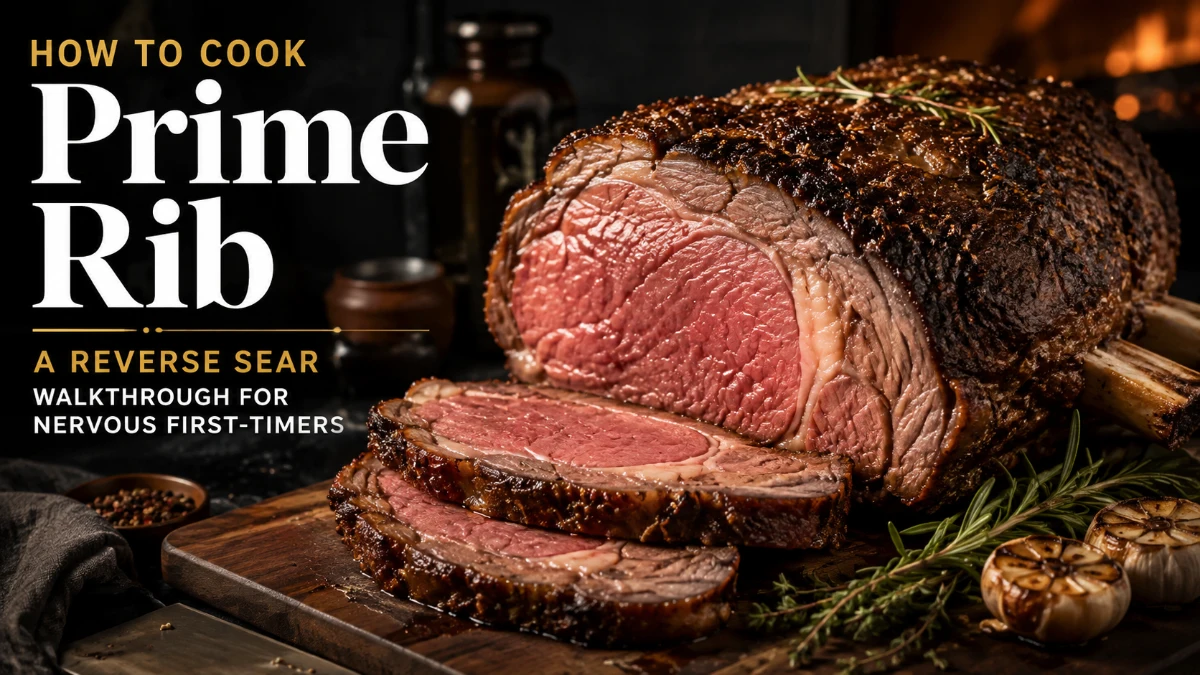
How to Cook Prime Rib: A Reverse Sear Walkthrough for Nervous First-Timers
If you’ve ever bought an expensive standing rib roast and worried about ruining it, here’s the short answer: how to cook prime rib comes down to salting it early, roasting it gently, finishing it hot, and trusting a thermometer over the clock. Get those four things right and everything else — timing, carving, sides — falls into place.
Why does prime rib intimidate so many home cooks?
Because it’s expensive, it’s large, and it only gets one shot in the oven. Unlike a steak you can slice into and check, a whole roast hides its doneness until you cut it, by which point it’s too late to fix. That’s exactly why a thermometer-driven method matters more here than almost any other cut.
What is prime rib made of, and why does it matter?
Prime rib is a standing rib roast cut from the rib primal, carrying several rib bones and a thick fat cap along the top. Its heavy marbling is what rewards a whole-roast approach rather than individual steaks, but that same size is what makes even cooking tricky without the right method. Anyone learning how to cook prime rib needs to understand this before touching the oven dial.
Bone-in and boneless versions behave a little differently. A bone-in roast is insulated by its bones, often costs less per pound, and adds flavor as it cooks, while boneless (sometimes called ribeye roast) carves more easily and yields slightly more usable meat per pound since there’s no bone weight. Neither is “better” outright — the method for how to cook prime rib works for both, with bone-in simply needing a touch more time, which is worth knowing before you decide which one to buy.
How much roast do I actually need, and what do I need to buy?
Budget about a pound of bone-in roast per person, a little less if going boneless. A 4- to 8-pound roast suits a smaller table; holiday-sized gatherings often call for 8 to 12 pounds or more.
The one tool that changes everything is a reliable instant-read or leave-in meat thermometer. Timing charts are only estimates — actual ovens vary, and roast shapes vary, so a thermometer is what actually tells you when to stop guessing. Round out your kit with a rack-fitted roasting pan, kitchen twine if the roast needs tying, and a sharp carving knife — the full checklist for how to cook prime rib is short, but each item matters.
Should I season it right before cooking, or earlier?
Earlier, ideally. Dry brining — coating the roast generously in kosher salt (plus any herbs or garlic you like) and leaving it uncovered in the fridge — pulls moisture to the surface, which then reabsorbs along with the salt and seasons the meat all the way through. A same-day salt 45 minutes ahead still helps, but 24 to 48 hours ahead is where the real payoff shows up: deeper seasoning and a drier surface that browns better under high heat later.
What’s actually the best way to cook it?
Reverse searing. Instead of blasting the whole roast with high heat and hoping the center catches up before the outside overcooks, you roast it low and slow first, then finish with a short, hot sear at the very end. The payoff is a roast that’s evenly pink from edge to edge, without the thick gray ring of overdone meat that high-heat-only methods tend to leave just under the crust.
Here’s how the reverse sear plays out in practice:
- Rest at room temperature. Let the roast sit out for 1 to 2 hours before cooking. Starting cold means the outside finishes long before the center warms through — an uneven result you’ll taste in every slice.
- Roast low and slow. Set the oven between 200°F and 250°F, and place the roast fat-side up on a rack. This gentle heat is the core of how to cook prime rib without drying it out — it gives the center time to catch up instead of racing ahead of the surface.
- Watch the thermometer, not the clock. Check the internal temperature with an instant-read thermometer in the thickest part, away from any bone. This single check decides everything: pull too late and you’ve overshot your target doneness for good.
- Sear it hot at the end. When the reading sits 10 to 15 degrees below your target, pull the roast and let the oven climb to 450°F–500°F. Return it for 10 to 15 minutes just to build a deep crust, then move it straight to resting — that short blast of heat is what a slow roast alone can never produce on its own.
How do I know when it’s actually done?
Because a roast keeps cooking even after it leaves the oven, a phenomenon called carryover cooking, your pull temperature has to sit lower than your target final temperature. That’s the entire logic behind knowing how to cook prime rib to a specific doneness rather than guessing.
| Doneness | Pull Temperature | Final Temperature (After Resting) |
| Rare | 110–115°F | 120–129°F |
| Medium-rare | 120–125°F | 130–134°F |
| Medium | 125–130°F | 135–144°F |
| Medium-well | 135–140°F | 145–154°F |
| Well-done | 145–150°F | 155–164°F |
Treat these as reliable ranges rather than exact science — slight variation between sources is normal, so when unsure, pull a touch early and let resting do the rest.
Why can’t I just carve it right away?
Because resting is where carryover cooking finishes and juices settle back through the meat instead of pooling onto your cutting board the second you cut in. Tent the roast loosely with foil and give it 20 to 30 minutes for a mid-sized roast, up to 40 minutes for something large. Skip this step, and you’ll lose exactly the juiciness the rest of the process was built to protect.
What’s the right way to carve it?
Stand the rested roast on its base, cut along the bones first if it’s bone-in to free the meat in one piece, then slice against the grain into roughly half-inch portions. Cutting against the grain shortens the muscle fibers in each bite, a small detail that makes a noticeable difference in tenderness at the table.
Is there a faster way, even if it’s not quite as good?
Yes: traditional high-heat roasting, where you cook the whole roast at a consistently high temperature, often starting around 450°F–500°F before dropping to moderate heat. It’s quicker, but the trade-off is real: more uneven doneness and a thicker overcooked layer near the surface. Anyone comparing methods for how to cook prime rib should know this shortcut costs some evenness for speed.
The same reverse-search logic works outdoors too. A grill set up for indirect heat, followed by the same monitored sear, gets you comparable results. The heat source changes; the principles behind how to cook prime rib properly, thermometer-based doneness and a proper rest, don’t.
What typically goes wrong, and how do I avoid it?
- Skipping the thermometer and trusting time charts alone, which shift with oven accuracy and roast shape
- Salting too close to cooking time, leaving the interior underseasoned
- Pulling at your final target temperature instead of building in room for carryover
- Carving immediately instead of resting, which sends juices onto the board instead of into the meat
- Buying a roast size that doesn’t match your guest count, throwing off timing expectations
What goes well alongside prime rib?
Au jus made from the pan drippings and a sharp horseradish sauce both cut nicely through the richness, and simple roasted vegetables or mashed potatoes round out the plate without competing with the main event.
Frequently Asked Questions
Yes — given the cost of the cut and how easy it is to misjudge doneness by eye, an inexpensive instant-read thermometer is the single best investment for a reliable result.
Around 120–125°F, which rises to the target 130–134°F range after resting due to carryover cooking.
Roughly 15 to 20 minutes per pound at a low oven temperature, though actual time varies with oven accuracy and roast shape, so treat it as a rough estimate rather than a fixed rule.
After. Reverse searing at the end produces more even cooking than searing first, since it builds the crust without overcooking the meat beneath it.
Both work with the same method; bone-in offers slightly more insulation and flavor, while boneless is easier to carve and yields a bit more usable meat per pound.
About 20 to 30 minutes for a mid-sized roast, up to 40 minutes for a very large one, to let carryover cooking and juice redistribution finish.
Juices that should redistribute through the meat will instead run out onto the cutting board the moment you slice, leaving a drier result.
Yes, using indirect heat and the same low-temperature-then-sear sequence, monitoring internal temperature exactly as you would in the oven.
It saves time but trades away some evenness, typically leaving a thicker, overcooked band near the surface compared with reverse searing.