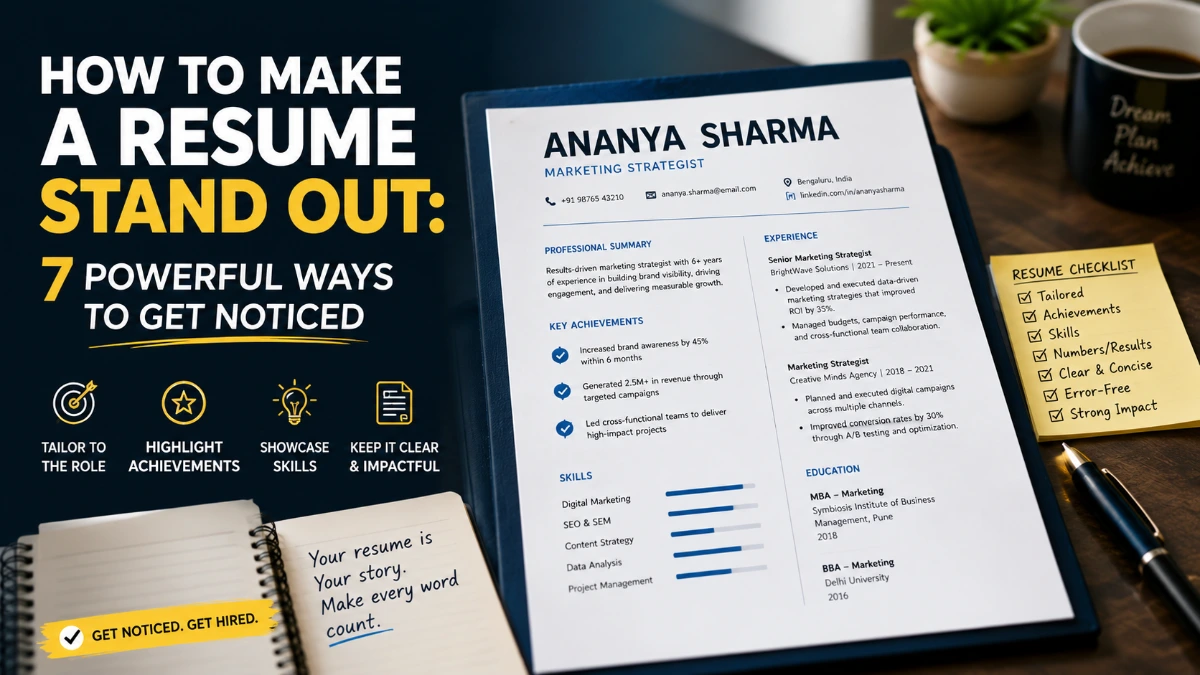
How to make a resume stand out: 7 Powerful Ways to Prove You Fit
A resume does not need unusual graphics or a long list of skills to stand out. It needs to make a convincing, truthful case that your experience matches the work an employer needs done.
What employers need to see
Before learning how to make a resume stand out, identify the decision an employer is trying to make: Can this person do the important parts of this role?
Your resume should answer that through:
- A clear target role or professional direction
- Experience, projects, or education that relate to the vacancy
- Specific evidence of what you contributed
- Skills supported by examples, not simply listed
- A clean document that is easy to review and submit
Berkeley Career Engagement advises applicants to tailor accomplishments to the employer’s needs, highlight relevant skills, and focus on the outcomes of their efforts.
1. Turn the job post into a priority list
Do not treat every phrase in a job description as equally important. Mark each requirement as one of the following:
| Priority | Signals in the posting | Resume response |
| Must show | “Required,” “essential,” repeated responsibilities, mandatory qualification or tool | Put accurate proof near the top of the document |
| Strong advantage | “Preferred,” experience that appears several times, industry-specific knowledge | Include a relevant accomplishment, project, or skill where supported |
| Background detail | Broad cultural language or minor preferences | Use only if it helps clarify genuine fit |
This is the working method behind how to make a resume stand out: select evidence according to the employer’s priorities instead of giving every past responsibility the same space.
Build an evidence bank before you draft:
| Employer need | Evidence you can honestly use | Where to place it |
| Coordinate projects | Maintained a launch schedule for a six-person team | Experience bullet |
| Analyse performance | Built a weekly Excel reporting tracker | Experience bullet and skills |
| Communicate with clients | Presented progress updates to 20 accounts | Experience bullet |
| Relevant training | Completed an analytics certification | Education or certifications |
Only use a term when it accurately reflects your work, education, training, or project experience. A resume should be tailored, but it must never misrepresent qualifications.
2. Make every bullet earn its space
The answer to how to make a resume stand out is rarely “add more.” It is usually “replace vague content with evidence.”
Start bullets with a precise verb, then show the work, context, and contribution:
Action + task or problem + scope/context + result or deliverable
| Less useful | More useful |
| Responsible for social media | Planned and scheduled campaign content across three channels, supporting event-registration activity |
| Answered customer questions | Resolved email and chat queries and documented recurring issues for the product team |
| Helped with reports | Built a weekly performance report that consolidated campaign activity for managers |
A result can be numerical, but it does not have to be. A completed deliverable, clearer workflow, resolved issue, informed decision, trained group, or well-managed process can show value when a percentage or revenue figure is unavailable.
When numbers are accurate, use them to explain scale: people trained, accounts supported, reports produced, hours saved, budget handled, error rate reduced, or response time improved. Do not invent statistics to make a bullet seem stronger. Texas State Career Services recommends using action verbs and quantifying accomplishments where possible.
3. Put the best proof where it is noticed
A reader should not need to reach the bottom of the page to understand your relevance. Organise the document so the evidence closest to the employer’s needs appears early.
For many conventional applications, this sequence works well:
- Name and contact details
- Optional role-focused headline or summary
- Relevant skills
- Experience, projects, research, internships, or volunteering
- Education, certifications, and selected additional details
A summary is optional. Use one if it clarifies a career transition, specialist area, or level of experience. Leave it out if it repeats generic language or pushes stronger proof too far down the page.
Example
Operations coordinator with experience supporting cross-team workflows, maintaining reporting systems, and improving administrative processes for service-focused teams.
For a student or new graduate, relevant projects, research, or academic work may provide stronger proof than a summary. Berkeley includes work, research, volunteer, and project experience among the sections candidates can use to show their background.
4. Match skills to real examples
When considering how to make a resume stand out for an online application, do not rely on a keyword list. Important skills become more believable when the experience section shows how you used them.
| Required capability | Weak presentation | Stronger presentation |
| Stakeholder communication | “Stakeholder communication” | “Prepared weekly project updates and incorporated stakeholder feedback into launch plans” |
| Excel reporting | “Excel” | “Built an Excel tracker that consolidated weekly activity data for team reporting” |
| Customer service | “Customer service” | “Resolved customer queries across email and chat, recording common issues for follow-up” |
A useful skills section can group tools, technical methods, languages, or role-specific capabilities. Match the exact job-post wording where it is truthful and meaningful, especially for required tools, credentials, and job titles. Then support the most important terms with context in a project or experience bullet.
Grinnell College recommends standard headings such as Work Experience, Education, and Skills, and cautions applicants against stuffing copied keywords into a resume.
5. Make the document dependable
A clear resume is easier for people to scan and less likely to lose important information when uploaded to an application portal. Use familiar headings, concise bullets, consistent dates, and enough white space to make sections distinguishable.
For standard online applications:
- Use straightforward text and one readable font
- Keep your contact details separate and easy to find
- Use reverse chronological order unless another format better serves the role
- Keep titles, employers, locations where relevant, and dates consistent
- Avoid dense blocks of text
- Treat tables, graphics, icons, images, text boxes, and multi-column layouts cautiously
This practical formatting check is a central part of how to make a resume stand out. Follow the file-format instructions in the vacancy. If a portal converts your upload into application fields or offers a preview, check that the content is correctly captured before you apply.
If no file type is specified, retain both a clean PDF and an editable DOCX version. The appropriate submission format can depend on the employer and application system, so avoid assuming that one choice is always correct.
For creative roles, use a portfolio to show visual or interactive work unless the employer requests a design-led resume. A conventional, text-forward version is still useful for many portals.
6. Add proof beyond employment
Formal work history is not the only source of relevant evidence. Projects, freelance work, coursework, research, volunteer roles, internships, leadership activities, and professional certifications can all help when they demonstrate a capability the employer needs.
To describe a project, include:
- The aim or problem
- Your own contribution
- Relevant tools or methods
- The finished output, finding, improvement, or learning result
This is especially important for candidates with limited work history and for career changers. It gives a reader tangible evidence rather than asking them to infer capability from a skills list.
A portfolio link is worthwhile when it gives direct access to your best relevant work—such as a case study, code repository, writing sample, design project, or research output. Texas State Career Services recommends tailoring portfolio material to the role, choosing only the best samples, and using concrete evidence of skills.
7. Test the resume before sending it
The last step in how to make a resume stand out is not visual polish; it is verification. Review the document as if you were an employer who has only a short time to decide whether to read further.
Use this check:
- Is the target role apparent near the top?
- Are the required qualifications supported by real evidence?
- Does each significant bullet show contribution, scope, outcome, or a useful deliverable?
- Are priority skills demonstrated in context?
- Are job titles, dates, employers, credentials, and metrics accurate?
- Is the file easy to read after uploading?
- Have you followed every instruction in the job posting?
- Do all LinkedIn, portfolio, or work-sample links open correctly?
- Have you removed old, repeated, or irrelevant details?
- Has another careful reader checked it for clarity and errors?
A resume cannot guarantee an interview. It can, however, reduce uncertainty about your fit by making relevant evidence visible, credible, and easy to assess.
Adjust for your background
Students and graduates
Use coursework, internships, research, class projects, student organisations, volunteer work, and part-time employment where they demonstrate relevant abilities. Explain what you did and what you produced rather than apologising for limited full-time experience.
Career changers
Translate past work into transferable evidence. A retail manager may show scheduling, training, customer resolution, reporting, and operational coordination. A teacher may show planning, communication, facilitation, stakeholder management, and data-informed improvement.
Experienced professionals
Give the greatest detail to recent work that relates directly to the target role. Older positions may need less space unless they establish a qualification the employer requires.
Candidates without metrics
Use scope and specifics instead. Mention the system, process, audience, deliverable, responsibility, or decision your work supported. Accuracy matters more than forcing a number into every line.
Frequently Asked Questions
There is no universal page count. A concise one-page resume may suit students and early-career candidates, while professionals with substantial relevant experience may need more space. Keep it relevant, readable, and consistent with any employer instructions.
Yes. The level of tailoring can vary, but you should reorder evidence, adjust terminology where truthful, and remove content that does not help the employer assess your fit.
No. Systems vary. Use straightforward formatting, conventional headings, and the file type requested in the job post. Where a portal shows a parsed preview, inspect it before submitting.
No. Use a summary when it immediately clarifies your expertise, career direction, or transition. Skip it if it merely repeats generic descriptions.
Use accurate evidence such as a completed project, process improvement, supported decision, solved problem, documented workflow, training contribution, or relevant responsibility.
Follow the employer’s local norms and instructions. Do not add a photo simply for decoration when space could be used to show relevant ability or results.
A clean template can save time if it preserves readability and leaves room for tailored proof. Avoid templates that depend on graphics, dense columns, or unusual layouts in standard online applications
Include it when the link provides relevant, polished work that helps an employer verify your ability. Curate it carefully, label samples clearly, and check that access works.