How Big Is 10 cm? 10 Everyday Objects and Size Comparisons
The conversion of 10 cm is roughly equivalent to 3.94 inches. This measurement is only slightly less than 4 inches. In addition to being equal to 100 millimeters, it is exactly one-tenth of a meter. To help visualize this distance, imagine the smaller side of a standard 4 x 6-inch photo. That dimension is 10.16 cm, which is only 1.6 mm longer than 10 cm.
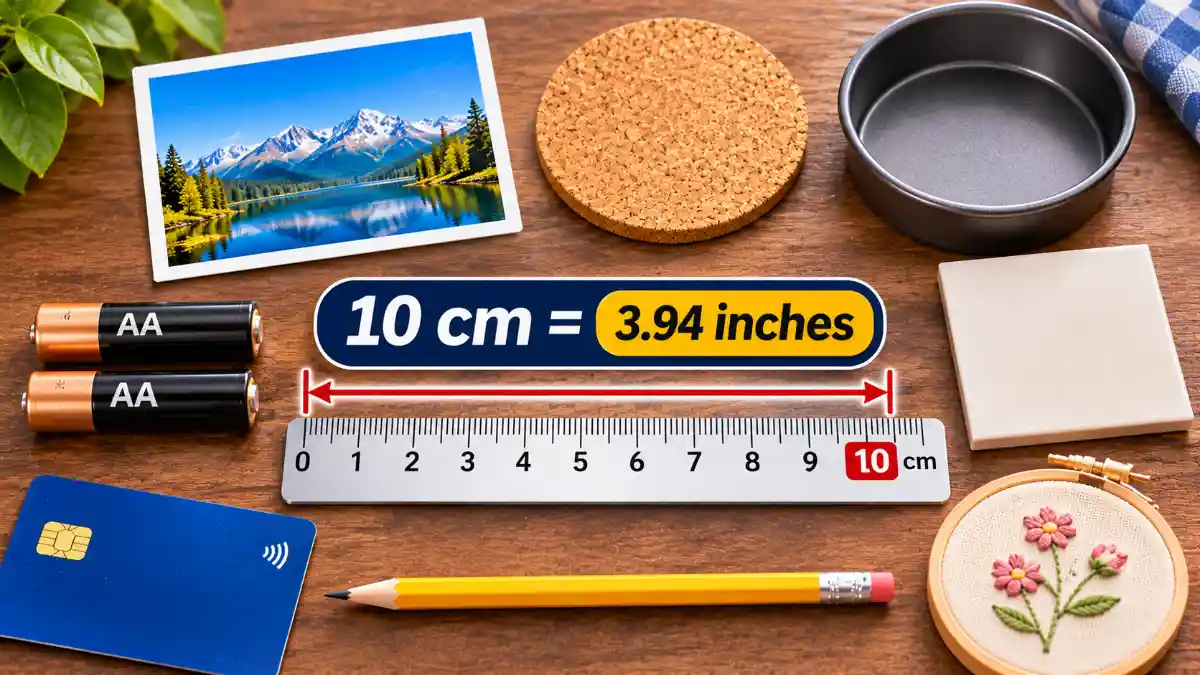
If you are unsure of how big 10 centimeters is in your daily routine, many common items will assist you with estimating the size. A 4-inch beverage coaster, two AA batteries placed together, or a small square tile can aid in the estimation process if you do not have a ruler available.
How Big Is 10 cm in Inches and Other Units?
Ten centimeters is about 3.94 inches, so it has nearly the same length as four inches.
Here’s how 10 cm converts into other common units:
| Unit | Equivalent to 10 cm |
| Inches | 3.937 inches |
| Millimeters | 100 mm |
| Meters | 0.1 m |
| Feet | 0.3281 ft |
| Yards | 0.1094 yd |
To convert a measurement from centimeters to inches, you will need to divide the measurement in cm by 2.54. Since an inch is defined as exactly 2.54 cm, this is a very simple process.
10 ÷ 2.54 = 3.937 inches (approximately 3.94 inches).
The exact measurement of four inches is equivalent to 10.16 cm. Therefore, the measurement of ten cm is slightly shorter than four inches by approximately 0.16 cm (1.6 mm).
What Does 10 cm Look Like? 10 Everyday Objects
A useful method for understanding the scale of 10 centimeters would be to compare it to everyday items you can view and utilize. While many items have standard dimensions, there are some items that have similar scales to 10 cm.
Shorter Edge of a 4 × 6-Inch Photograph
The short side of a typical 4″ x 6″ photo measures 10.16 cm. It’s almost the same size as 10 cm, with only a 1.6 mm variance.
Holding a printed photo (horizontally) in front of your face will give you an idea of what 10 centimeters looks like on the shorter side of that picture.
A 4-Inch Drink Coaster
A round coaster labeled as 4 inches in diameter measures 10.16 cm across.
This isn’t true for all coasters, but it’s important to find out how big the coaster is. If you’re looking at a 4-inch coaster, then you can see what 10 centimeters would be in terms of a radius around a circular shape as opposed to a straight line.
Two AA Batteries End to End
The approximate length of an AA battery is about 5 cm. If you place two AA batteries next to each other (end-to-end), then the total distance of the two batteries would be approximately 10 cm.
As an example, some manufacturers provide the maximum length for a single AA battery as being up to 50.5mm. Therefore, when two such batteries are placed next to each other, they will total approximately 10.1cm.
The actual size of the model will vary from one to another. Thus, while it can give you a general idea of how long the item is, it cannot provide an accurate measurement.
A 10 cm Square Tile
Small decorative and mosaic tiles are available in sizes labeled 10 × 10 cm.
You could use either the length or width of a tile that is exactly 10 cm on each side. It will be easier for you to see how far something is when using the square form.
Some tiles may have a slightly different “nominal” size than what they actually measure; therefore, you should verify these measurements if you are looking for precise results.
A Standard Credit Card
The standard size of a credit card is roughly 8.56 centimeters (cm) in length and 5.40 centimeters (cm) in width. These sizes conform to the ID-1 Identification Card Standard.
The longer side of this object is approximately 1.44 cm (or 0.57 in) shorter than 10 cm. If you were to add slightly more than 0.50 in to the longer side, it would be within the range of being close to the actual length.
Shorter Edge of a 4 × 6-Inch Index Card
A 4 × 6-inch index card has a shorter edge measuring 10.16 cm.
Index cards are a very popular tool for students, individuals taking notes, and people who create crafts. A 4 x 6-inch index card provides almost as much reference material as a photo; however, the index card’s flat surface may be more convenient than the photograph’s curved surface for measuring items on paper.
A US Dollar Bill
A modern US dollar is about 15.6 cm wide. The official measurements for US money are about 6.14 by 2.61 inches.
This means that the length of a dollar bill is about 5.6 cm longer than the length you are trying to imagine.
Ten centimeters is roughly 64 percent of the longer side of the bill. Although not exactly equal to ten centimeters, a dollar bill can be used to approximate smaller measurements if there are no other options.
A 10 cm Round Cake Pan
You can find small round cake pans that measure 10 cm in diameter, which is about 4 inches.
The measurement on the label of a pan with a 10cm diameter refers to how far apart the edges of the circular top of the pan are. It has nothing to do with the height of the pan, nor does it refer to the amount of liquid that can fit in the pan.
This can help you imagine the width of many smaller kitchen products.
A 4-Inch Embroidery Hoop
An embroidery hoop listed as having a 4-inch (10.16 cm) measurement has a width of about 10.16 cm.
The shape of a circle allows us to easily see the distance across the top (or bottom) from left to right. However, there can be differences between the diameter of the inside of the frame versus the diameter of the outside. You will need to determine whether the manufacturer based their measurements on the inside or outside of the frame.
A hoop this size is especially helpful for making direct comparisons between the size of circular craft supplies.
A 10 cm Square Piece of Craft Paper
A 10 x 10 cm square made from a sheet of craft paper has exactly 10 cm edges when you measure it with your ruler, assuming that you make the correct cuts.
You can create a template with a metric ruler, and then use it over and over again as an easy-to-read reference. This will come in handy when you are trying to draw, arrange smaller items, or check rough measurements during crafting activities.
How Big Is 10 cm on a Ruler?
On a metric ruler, 10 cm is the distance from the 0 cm mark to the 10 cm mark.
There are ten millimeters in every centimeter, so the total length of the area is 100 millimeters.
To measure it correctly:
- Place the ruler on a flat surface.
- Place the first part of the object at the zero-centimeter line (usually a short distance from the physical end of the ruler).
- Find the 10 cm mark to identify the full length.
- Check the smaller millimeter divisions if you need a more precise measurement.
On a dual unit (metric/imperial) ruler, the 10 cm line is positioned directly below the 4 inch line.
Use caution when using digital rulers shown on a phone or PC screen. Digital rulers are affected by screen resolution, display scaling, and browser zoom, which can alter how large they appear; thus, a digital ruler will only give you an accurate physical reading after being calibrated.
How to Measure 10 cm Without a Ruler
A ruler is not required to provide an approximate measurement of 10 cm.
The easiest way to do this would be to use a standard 4″ x 6″ photograph. The width of a 4″ x 6″ photo is approximately 10.16 cm (about 0.6 inches wider than what you need). Similarly, you can also use a 4″ index card edge or a coaster with a 4″ diameter.
You can also use two AA batteries side-by-side (lengthwise) for measurement purposes. When placed together, they will provide you with a reading of approximately 10 centimeters; however, the actual combined length of these batteries depends upon which type of battery you choose to utilize.
A square tile or other object marked with “10cm” may be used as an alternative reference.
These techniques are used to estimate the dimensions of items that may go into a drawer, to help determine how much material is required for a craft project, or to provide an estimate of the size of a household item. However, if you need to measure something precisely and even a few millimeters can make a difference (e.g., cutting material to the correct size), then a ruler or tape measure remains the best option.
Read Also: How Big Is 10 cm
How Does 10 cm Compare With Other Lengths?
Looking at nearby measurements can make the size of 10 cm easier to judge.
| Length | Inches (Approx.) |
| 5 cm | 1.97 inches |
| 8 cm | 3.15 inches |
| 10 cm | 3.94 inches |
| 12 cm | 4.72 inches |
| 15 cm | 5.91 inches |
Ten centimeters is twice the length of five centimeters, two centimeters longer than eight centimeters,s and five centimeters shorter than fifteen centimeters. This comparison will be helpful in determining how far apart things are without measuring each one.
Frequently Asked Questions:
10 cm is approximately 3.94 inches, which is slightly less than 4 inches. The exact conversion is 3.937 inches. Since 4 inches equals 10.16 cm, the difference is only 1.6 millimeters.
Several everyday objects are close to 10 cm long, including the shorter edge of a 4 × 6-inch photograph, two AA batteries placed end to end, and the shorter edge of a 4 × 6-inch index card. A 4-inch drink coaster also measures approximately 10 cm across its diameter.
No, 10 cm is not exactly 4 inches. Ten centimeters equals approximately 3.94 inches, while 4 inches equals exactly 10.16 cm. The difference is just 0.16 cm, making the two measurements nearly identical for everyday size estimates.
You can estimate 10 cm using the shorter edge of a standard 4 × 6-inch photograph or by placing two AA batteries end to end. Both provide a close approximation. For measurements requiring precision, use a ruler or measuring tape.
On a metric ruler, 10 cm is the distance between the 0 cm and 10 cm marks. It contains 100 millimeters and falls just before the 4-inch mark on a ruler that displays both metric and imperial measurements.