Twin Bed Size: Dimensions in Inches, Feet, and CM
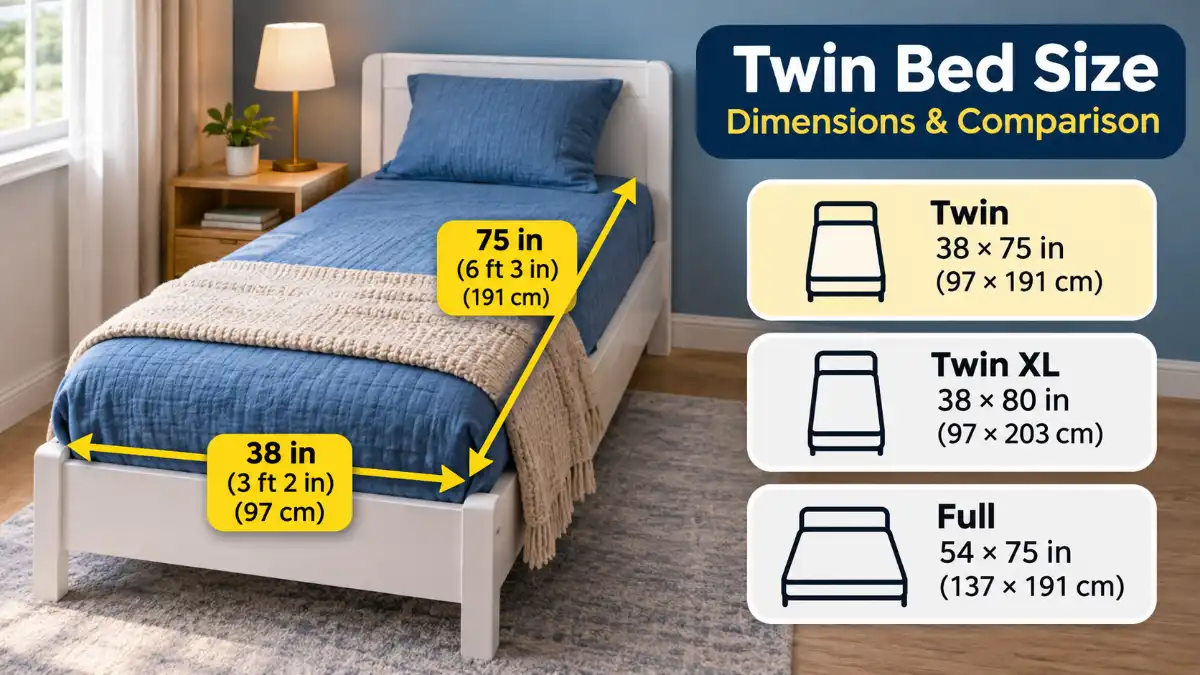
A standard twin bed size is 38 inches wide and 75 inches long, equivalent to 3 feet 2 inches wide by 6 feet 3 inches long, or approximately 97 × 191 cm. These are the mattress dimensions, not the measurements of the entire bed frame. Some manufacturers make twin mattresses 39 inches wide, and the overall frame size depends on its design.
Twin beds are meant primarily for one person. They’re a practical option for children, teenagers, single adults, bunk beds, and smaller bedrooms. If you need more legroom, a twin XL adds 5 inches of length, while a full mattress offers 16 inches of extra width.
What Are the Dimensions of a Twin Bed?
In the United States, standard twin bed dimensions are 38 × 75 inches. A twin is one of the smallest standard mattress sizes suitable for children and adults, making it particularly useful when floor space is limited.
Here’s the twin mattress size in inches, feet, centimeters, and meters:
- Inches: 38 inches wide × 75 inches long
- Feet and inches: 3 feet 2 inches wide × 6 feet 3 inches long
- Centimeters: Approximately 97 cm wide × 191 cm long
- Meters: Approximately 0.97 m wide × 1.91 m long
- Sleeping surface: Approximately 19.8 square feet
Knowing the twin bed size in feet and cm can help when comparing mattresses from different countries or planning a bedroom using metric measurements.
In the United States, twin bed and single bed generally refer to the same mattress category. However, single-bed measurements aren’t identical worldwide, so it’s worth checking the actual dimensions before purchasing.
Another important distinction is the difference between mattress size and bed-frame size. A frame with a substantial headboard, footboard, or wide side rails may take up several additional inches. For example, the dimensions of a twin bed frame can be larger than the mattress it supports.
Mattress thickness varies as well. When shopping for sheets, mattress protectors, or a frame, check the mattress height rather than assuming every twin mattress has the same depth.
Twin vs. Twin XL vs. Full: Size Comparison
The right mattress size depends on your height, how much room you need to sleep comfortably, and the space available in your bedroom.
Here’s how three common U.S. mattress sizes compare.
| Mattress Size | Dimensions (Inches) | Approx. Size (CM) | Best For |
| Twin | 38 × 75 | 97 × 191 | Children, single sleepers, small rooms |
| Twin XL | 38 × 80 | 97 × 203 | Taller teenagers, college students, single adults |
| Full | 54 × 75 | 137 × 191 | Single adults wanting more width |
These are common nominal measurements. Actual dimensions may vary slightly between manufacturers.
Twin vs. Twin XL Bed
The biggest difference between a twin and twin XL mattress is length. Both are typically 38 inches wide, but a twin XL measures 80 inches long instead of 75 inches.
That extra 5 inches can make sleeping more comfortable for taller individuals, especially those around 6 feet tall or above who like to stretch out.
Twin XL mattresses are also common in college dormitories. They offer additional legroom without taking up more width, making them practical for narrow sleeping areas.
For children and shorter adults, a regular twin is often sufficient. However, choosing between a twin and twin XL also depends on sleeping position and personal comfort. Someone who sleeps stretched out may appreciate the longer mattress even if they’re under 6 feet tall.
Twin Bed vs. Full Bed
A full mattress measures 54 × 75 inches, making it 16 inches wider than a standard twin while keeping the same length.
The extra width gives a single sleeper more space to turn over, stretch out, or change positions during the night.
For adults who prefer more personal space, a full bed may be the better choice. The trade-off is that it takes up more floor space, which can make furniture placement difficult in a compact bedroom.
Neither a standard twin nor a full provides the additional length of a twin XL. If you’re tall, consider mattress length before deciding that a wider bed will automatically be more comfortable.
Who Is a Twin Bed Best For?
A twin mattress makes sense when the bed is intended for one person and saving floor space is a priority. Its compact dimensions suit several sleeping arrangements.
Children: Twin mattresses are a popular next step when children outgrow smaller beds. They provide room to grow without occupying as much bedroom space as a full mattress.
Teenagers: Many teenagers have enough room on a standard twin. Taller teens, particularly those still growing, may be more comfortable with a longer mattress.
Single adults: A twin can work well for one adult who doesn’t need much space to spread out. People who move frequently while sleeping may appreciate the extra width of a full mattress.
Bunk beds: Twin mattresses are commonly used in bunk beds, but not every bunk bed accepts the same mattress dimensions or thickness. Follow the manufacturer’s instructions and the bunk bed safety requirements, particularly those concerning mattress height and guardrail clearance.
Guest rooms: A twin bed provides a comfortable sleeping option for one guest while leaving room for other furniture.
Smaller bedrooms: Because a twin is narrower than a full, it can free up valuable space for desks, dressers, and walking areas.
A standard twin generally isn’t a comfortable choice for two adults. With only 38 inches of total width, two people sharing equally would have approximately 19 inches each, leaving very little room to move.
How Much Room Do You Need for a Twin Bed?
A standard twin mattress covers approximately 19.8 square feet, but you’ll need more space than that to accommodate the bed frame and move comfortably around the room.
There’s no single minimum bedroom size that works for every layout. A room’s shape, door positions, closets, and furniture placement all affect how well a bed fits.
Before purchasing, take a few measurements:
- Measure the available floor space. Record the room’s length and width, including any alcoves or awkward corners that could affect placement.
- Check the complete bed-frame dimensions. Don’t rely on mattress measurements alone, particularly if the frame has a large headboard, footboard, or built-in storage.
- Leave enough walking space. Make sure you can get in and out of bed comfortably without blocking doors or walkways.
- Consider nearby furniture. Check whether your dresser drawers, closet doors, and desk chair will have enough room to function.
- Plan for storage access. If the bed has drawers underneath, measure how far they extend when fully opened.
Placing a twin bed against a wall can make a small bedroom feel more spacious. Just make sure the position allows convenient access and doesn’t interfere with doors or other furniture.
What Size Sheets and Bed Frame Fit a Twin Mattress?
Standard twin fitted sheets are commonly labeled for mattresses measuring approximately 39 × 75 inches. Although they’re designed to accommodate typical twin mattresses, the fit can vary depending on the fabric, elasticity, and pocket depth.
When choosing bedding, check these details:
- Fitted sheets: Choose sheets labeled Twin and confirm their supported mattress dimensions.
- Flat sheets: A twin-size flat sheet generally provides suitable coverage, although you can choose a larger size if you prefer more fabric to tuck in.
- Mattress protectors: Select a protector that matches the mattress length, width, and thickness.
- Bed frames: Make sure the frame supports a standard twin mattress rather than a twin XL or another size.
Mattress height is especially important when buying fitted sheets. Shallow pockets may slip off a thick mattress, even when the sheet’s width and length are correct.
It’s also worth checking the fitted sheet size chart before purchasing. Standard twin and twin XL fitted sheets aren’t generally interchangeable because a twin XL mattress is 5 inches longer. However, some sheets designed for both sizes can accommodate the difference.
The same attention should go into choosing a bed frame. A properly sized frame supports the mattress as intended, while an incompatible frame can create fitting or support problems.
Read Also: Twin Bed Size
Frequently Asked Questions
Two standard twin mattresses placed side by side measure approximately 76 inches wide and 75 inches long. That’s the same nominal width as a king mattress but 5 inches shorter. Two twin XL mattresses, each measuring 38 × 80 inches, create the standard king-size dimensions of 76 × 80 inches.
Many daybeds are designed for standard twin mattresses, but compatibility depends on the specific frame. Check the daybed’s recommended mattress width, length, and maximum thickness before buying. Some models have restrictions that affect how securely the mattress fits.
A standard twin bed measures 75 inches long, so a 6-foot-tall person may fit, but there will be only 3 inches of extra length. A twin XL mattress, measuring 80 inches long, is usually a better choice for taller adults who want more room to stretch out comfortably.
In the United States, twin and single beds generally refer to the same mattress size, approximately 38 × 75 inches (97 × 191 cm). However, single-bed dimensions may differ in other countries, so always check the mattress measurements before buying a bed frame or bedding.
A twin bed can fit comfortably in many small bedrooms. A room measuring approximately 7 × 10 feet may accommodate one, depending on the bed frame, furniture, and layout. For a comfortable setup, leave enough walking space around the bed and make sure doors, closets, and drawers can open easily.