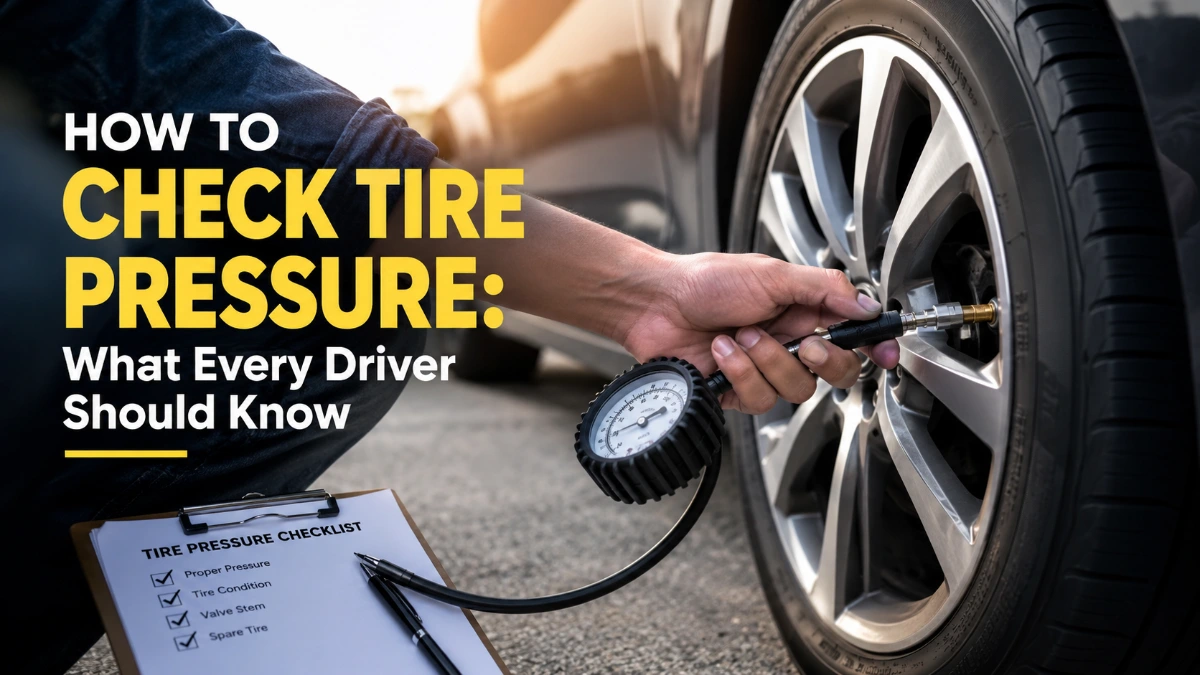
How to Check Tire Pressure: What Every Driver Should Know
Imagine this: your dashboard flashes a tire pressure warning on a Monday morning, and you have no gauge, no idea what number you’re aiming for, and five minutes before you need to leave. That scenario is exactly why understanding how to check tire pressure matters, and the good news is that the whole process takes less time than waiting for your coffee to brew.
The Number That Actually Matters
Most people assume the number stamped on the tire’s sidewall is what they should aim for. It isn’t. That figure represents the tire’s maximum safe pressure, not the pressure your vehicle’s manufacturer actually recommends for everyday driving.
The number you want lives elsewhere: on a sticker inside the driver’s side door jamb, or inside your owner’s manual. Manufacturers calculate this recommended PSI around your car’s specific weight, suspension setup, and handling behavior, which is why it’s typically lower than the sidewall maximum. It’s also common for front and rear tires to carry different recommended numbers, so read the full placard rather than assuming both axles match.
Gearing Up: What You’ll Actually Need
You don’t need a garage full of equipment. A single gauge covers the entire job, and a compressor only enters the picture if a tire needs topping up.
| Gauge Type | What to Know |
| Pencil-type | Compact stick gauge with an extending marked rod; cheap and glovebox-friendly |
| Dial gauge | Analog face display; often quicker to read at a glance |
| Digital gauge | Numeric screen readout; typically the most precise option for beginners |
A gauge with a built-in release valve is a nice bonus, since it lets you fix an overinflated tire without extra tools. No compressor at home? Gas stations and auto parts stores almost always have one, sometimes for a small fee.
Walking Through the Process
This is the part people actually search for: the exact motions involved in how to check tire pressure from start to finish.
- Twist the valve stem cap counterclockwise and set it aside.
- Press the gauge straight onto the valve stem until the hissing stops completely.
- Read the result, whether that’s an extended rod, a dial needle, or a digital number.
- Line that number up against the recommended PSI from your door jamb sticker.
- Screw the cap back on.
- Move to the next tire, and don’t skip the spare.
One detail trips up a lot of people: the gauge has to sit straight on the valve stem. Even a slight angle lets air escape mid-reading, which skews the number lower than reality.
Timing Changes Everything
Here’s something rarely mentioned upfront: when you check matters almost as much as how you check. Driving heats up the air inside a tire, and that heat causes the pressure reading to climb, sometimes by several PSI above the tire’s true resting pressure.
Tire manufacturers generally advise checking when tires are “cold,” meaning the car has sat for at least three hours or hasn’t been driven more than a mile. Skipping this detail is one of the most common reasons people misjudge how to check tire pressure and end up either over- or under-correcting. If you can only check after a drive, mentally account for the inflated number rather than immediately letting air out to hit the cold-tire target.
Fixing a Bad Reading
Once you know where your tire actually stands, adjusting it is a short next step.
If pressure is too low: Attach an air compressor to the valve stem and add air in short bursts, rechecking with your gauge between each burst so you land on the target rather than overshoot it.
If pressure is too high: Use the gauge’s release valve, or press the small pin inside the valve stem with a flathead screwdriver, letting air escape in controlled intervals while you recheck the reading.
Building It Into a Routine
Tire pressure isn’t a set-it-and-forget-it number. It drifts on its own through slow air loss and shifting outdoor temperatures, so a single check won’t hold up for months.
A monthly habit works well for most drivers, with extra checks added before long road trips and at the start of each new season, since colder air tends to drop pressure while warmer air raises it. And the spare tire deserves a spot on that same schedule; it’s frequently forgotten until the moment it’s actually needed, and it often runs at a different PSI than your regular four tires.
Why the TPMS Light Isn’t the Whole Story
A Tire Pressure Monitoring System can feel like it makes manual checks unnecessary, but that’s a misreading of what the light actually does. TPMS typically waits until pressure drops past a defined threshold before it triggers a warning, which means a tire can run moderately low for a while without any alert at all.
Manual checks catch what the light misses. Knowing how to check tire pressure by hand gives you the real number in real time, rather than waiting for a dashboard notification that only appears once the situation has already worsened.
Mistakes That Quietly Undo Accurate Readings
- Targeting the sidewall’s maximum PSI instead of the manufacturer’s recommended number from the door jamb.
- Checking right after a drive, when heat inflates the reading artificially.
- Letting the gauge sit at an angle on the valve stem causes it to leak air and produces a falsely low number.
- Skipping the spare tire until an emergency forces the issue.
- Treating the TPMS light as a full substitute for a manual check.
Frequently Asked Questions
Yes. The sidewall number is a maximum safety limit, while the recommended PSI on the door jamb sticker is what your manufacturer actually wants for daily driving.
At least three hours of parking, or under a mile of driving, gives you the “cold” reading that’s considered most accurate.
A digital gauge tends to be easier since it shows an exact number on a screen rather than requiring you to read a dial or rod.
It’s better not to. Spares often need a different PSI than your regular tires and are easy to forget until you’re stuck needing one
Not necessarily. It usually means pressure has crossed a set threshold, but a tire can be somewhat low before that light ever appears.
Recheck with your gauge after every short burst of air; if you go over, use the release valve or valve stem pin to let a little back out.
Not always. Front and rear tires often have different recommended PSI values, so check the full placard rather than assuming they match.
Using the tire’s sidewall maximum instead of the manufacturer’s recommended number, which leads to overinflation.