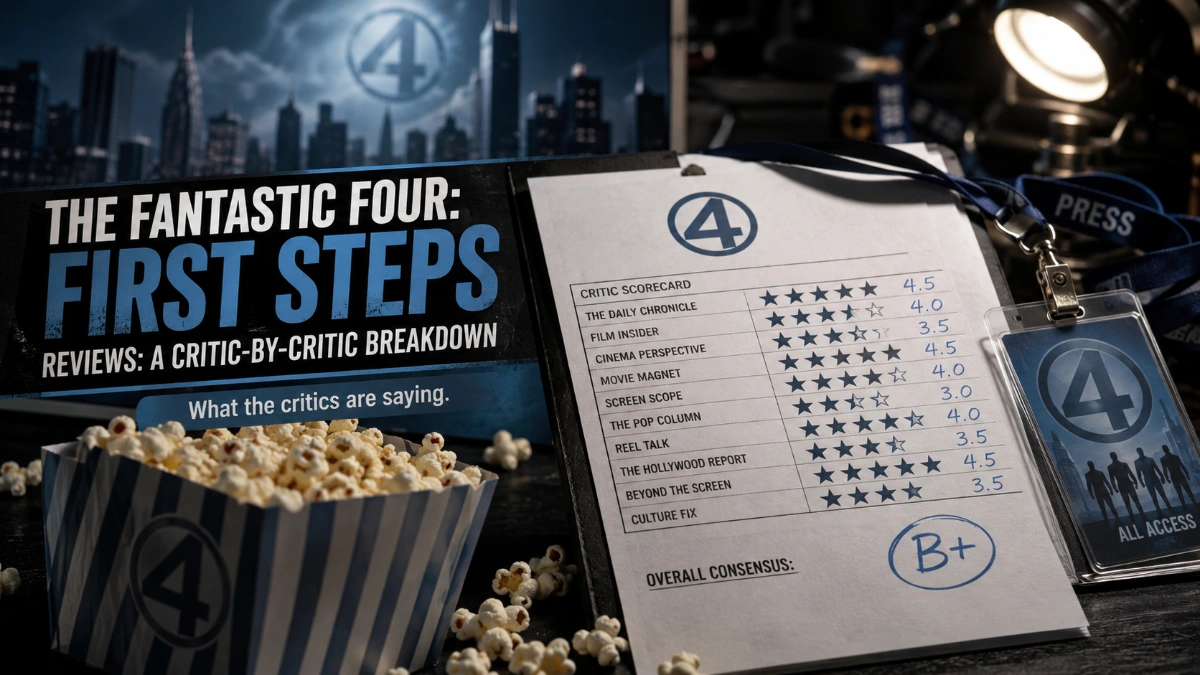
The Fantastic Four: First Steps Reviews: A Critic-by-Critic Breakdown
The Fantastic Four first steps reviews landed with a clear pattern: this is one of the better-received Marvel films in years, praised for its cast and craft, while sharing one recurring complaint about its villains. On Metacritic, the film holds a Metascore of 65 out of 100 — “Generally Favorable” — with critics splitting 59% positive, 35% mixed, and 6% negative, a spread that signals broad approval without unanimous enthusiasm.
What Critics Praised
The strongest thread running through the Fantastic Four First Steps reviews is the cast. David Rooney of The Hollywood Reporter wrote that the actors’ chemistry made the Baxter Building “hangout scenes” some of the film’s most appealing moments, while Variety’s Peter Debruge said the film “succeeds where earlier attempts have faltered.” Several reviewers singled out Vanessa Kirby as the standout, with Next Best Picture’s Giovanni Lago calling her performance as Sue Storm “the strongest among the leads.” Rotten Tomatoes’ roundup of early reactions described Marvel as “firing on all cylinders,” pointing to production design and Michael Giacchino’s score — which Consequence’s Liz Shannon Miller called “perhaps the composer’s greatest work to date” — as core strengths.
What Critics Criticized
Not every angle across the Fantastic Four: First Steps reviews is favorable, and the criticism clusters tightly around one issue: the villains. Next Best Picture’s Lago wrote that Ralph Ineson’s voice work as Galactus “cannot compensate for a generic, underwhelming threat,” while The Film Maven’s Kristen Lopez compared Julia Garner’s Silver Surfer unfavorably to other underused MCU antagonists. On script quality, Toisto.net’s Joonatan Itkonen described the writing as “a chaotic and unfocused script that feels like four movies hastily patched together,” and ComicBook.com’s Spencer Perry noted the character interactions “end up feeling like a checklist.” The BBC separately observed that despite “breezy competence and flair,” the film never builds real tension, and Forbes argued it falls into “the same old predictable formula” the MCU struggles to escape.
Critics vs. Audience Reception
One consistent pattern in the Fantastic Four: First Steps reviews is that critics and general audiences land in similar territory, though audiences are somewhat more divided. Metacritic’s user score sits at 6.5 out of 10 from user ratings, with a positive-to-negative split noticeably wider than the critic breakdown — suggesting general audiences are somewhat more polarized than professional reviewers, even though both groups broadly favor the film. Positive user reviews tend to praise the family dynamic and standalone storytelling, while critical reviews echo the same script and villain complaints found in professional coverage.
Where It Sits in the Franchise
Franchise context helps explain why the Fantastic Four: First Steps reviews turned out more positive than those for earlier attempts. The film is the 37th movie in the Marvel Cinematic Universe and the second reboot of the Fantastic Four film series, directed by Matt Shakman and set in an alternate universe, Earth-828, rather than the MCU’s main timeline. That standalone framing was repeatedly cited as a strength: The Hollywood Reporter’s Rooney called it “a legitimate standalone requiring no homework,” and Variety’s Debruge noted viewers “needn’t have carefully studied multiple other movies to make sense of what’s happening.” Commercially, the film grossed $521.9 million worldwide against a $229.6 million gross budget, making it the highest-grossing Fantastic Four film to date, and a sequel is already in development. A mid-credits scene featuring Robert Downey Jr.’s uncredited cameo as Doctor Doom ties the story directly into Avengers: Doomsday.
The Overall Verdict
Taken together, the Fantastic Four: First Steps reviews describe a film that succeeds in cast, tone, and visual craft while sharing one specific, recurring weakness: underwhelming villain execution paired with a script some critics found overstuffed. It suits viewers who want a character-driven, visually distinct superhero film rather than nonstop spectacle, but may disappoint anyone expecting a genuinely menacing Galactus or tighter plotting. Its standalone setup means newcomers can watch it without prior MCU knowledge, a point several critics flagged as a meaningful strength in an increasingly continuity-heavy franchise.
Frequently Asked Questions
The film holds a Metascore of 65 out of 100, categorized as “Generally Favorable,” based on a critic split of 59% positive, 35% mixed, and 6% negative.
Yes — cast chemistry, Vanessa Kirby’s performance, the production design, and Michael Giacchino’s score are the most consistently praised elements across reviews, while Galactus and Silver Surfer’s execution are the most consistent criticisms.
It’s set in an alternate universe, Earth-828, and functions as a standalone story, though a mid-credits scene ties it into Avengers: Doomsday.
Audience sentiment on Metacritic is somewhat more divided than critic sentiment, though both groups lean positive overall, with similar praise and criticism themes.
It’s the most frequently repeated criticism — multiple critics praised Ralph Ineson’s vocal performance as Galactus but felt the character’s threat was executed in a familiar, low-stakes way.
It grossed $521.9 million worldwide, making it the highest-grossing Fantastic Four film released so far.
Yes, a sequel is in development, and the team is set to return in Avengers: Doomsday.
No — critics specifically highlighted that this film requires no prior MCU viewing, since it takes place in a separate universe with its own self-contained story.