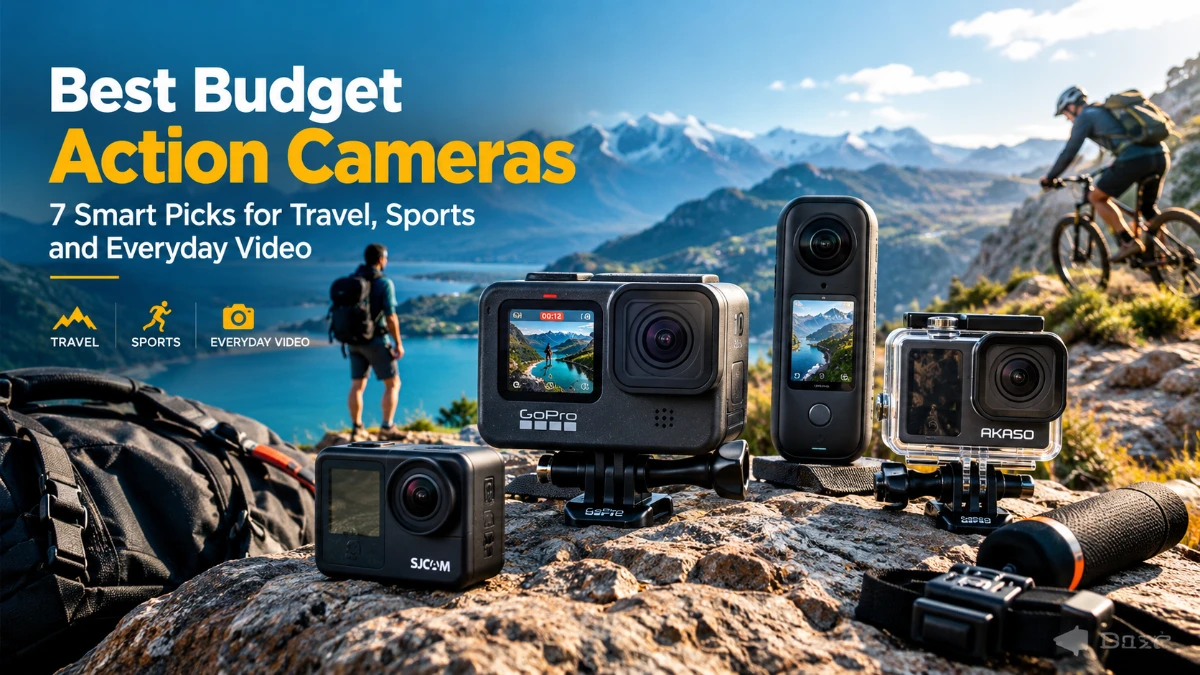
Best Budget Action Cameras: 7 Smart Picks for Travel, Sports and Everyday Video
The best budget action cameras are not defined by a single winner. For most buyers, the smart choice depends on whether they need low-cost travel clips, stable riding footage, waterproof recording, or a compact camera with a proven accessory ecosystem.
A practical starting point is simple: choose a basic model for occasional daylight video, a better-equipped camera for frequent movement and water use, or a discounted/refurbished premium model if its total price fits your budget. Do not choose on “4K” alone—check the recording modes, stabilization conditions, waterproof setup, battery design, storage requirements, and included mounts.
Quick picks by buyer type
| Buyer type | Best route | Why it fits | Watch before buying |
| First-time buyer on a tight budget | SJCAM SJ4000 Air | It lists 4K at 30fps, Wi-Fi, a 170-degree field of view, and a waterproof case. | Its official specification page does not list stabilization, so it is not the natural choice for buyers who need documented anti-shake support. |
| Compact, simple branded option | GoPro HERO | It offers 4K at up to 30fps, 2.7K at up to 60fps, a built-in Enduro battery, 16-foot waterproofing, and compatibility with more than 35 mounts and accessories. | HyperSmooth stabilization is applied through the Quik app; assess whether that workflow suits your needs. |
| Discounted performance upgrade | DJI Osmo Action 4 | It supports 4K up to 120fps, has a 1/1.3-inch sensor, and is waterproof to 18m without a case. | Buy it only when its verified sale, clearance, or trusted-refurbished total cost fits your budget; some modes limit stabilization. |
| Long days and front-facing framing | SJCAM SJ30 | It lists 4K up to 60fps, a flip screen, 5m body waterproofing, and microSD support up to 512GB. | Treat stated runtime as condition-dependent, and use a housing for deeper water. |
Define your budget first
For this guide, “budget” means an affordable total shooting setup, not just the camera body. Divide your purchase into three practical bands:
- Under $100: Best for first-time users, travel clips in good light, and occasional family or hobby footage.
- $100–$200: Better suited to buyers who need stronger mounting options, more dependable feature sets, or a more established accessory ecosystem.
- Discounted or trusted-refurbished upgrade: Older premium models can make sense only when their verified total price, warranty, included battery condition, and accessories make them competitive with new mid-budget alternatives.
The Best Budget Action Cameras may require a compatible microSD card, a mount, a charging plan, and possibly a waterproof housing before they are ready for a trip or sport. This is why an apparently cheaper option is not automatically the lowest-cost solution.
Pick the right capability level
Under $100: simple daylight footage
The SJCAM SJ4000 Air is a basic option for occasional travel clips and first-person daytime recording. Its official listing specifies 4K at 30fps, 1080p at up to 60fps, 720p at up to 120fps, Wi-Fi control, a 2-inch screen, a 170-degree field of view, and a waterproof case rated to 30m.
The listing does not name image stabilization. That does not prove that every variant lacks every form of processing, but it does mean buyers who specifically require documented stabilization should choose a model that clearly states which modes support it. A secure mount can reduce movement, but it cannot substitute for verified stabilization support.
$100–$200: compact branded simplicity
GoPro HERO is a compact option for buyers who value a simple camera, GoPro’s mounting system, and app-led editing features. GoPro lists 4K video at 30 or 25fps, 2.7K video at 60fps, 12-megapixel photos, a built-in Enduro battery, waterproofing to 16 feet, a replaceable water-repelling lens cover, and compatibility with more than 35 mounts and accessories.
For buyers considering Best Budget Action Cameras for casual travel, the appeal is straightforward operation and a large accessory ecosystem. The important limitation is that GoPro describes HyperSmooth stabilization as being automatically applied in the Quik app, so buyers should confirm that the post-capture stabilization and transfer workflow suits their filming plans.
Discounted upgrade: DJI Osmo Action 4
The DJI Osmo Action 4 is not automatically a budget purchase at every retailer. It becomes relevant when a legitimate sale, a clearance listing, or a trusted refurbished offer brings its complete cost into your target range.
DJI lists a 1/1.3-inch sensor, 4K recording up to 120fps, a 155-degree ultra-wide field of view, and body waterproofing to 18m without a case. Its feature set can suit buyers who need high-frame-rate recording, robust outdoor use, and more flexible capture modes than entry-level cameras typically offer.
The trade-off is that mode restrictions matter. DJI states that stabilization is unavailable in slow-motion and time-lapse modes, while its HorizonSteady option has defined resolution and frame-rate limits. The 155-degree field-of-view mode requires stabilization to be off and supports up to 4K at 60fps.
This is why the Best Budget Action Cameras should be chosen by the specific mode you will use most. A camera may support 4K, 120fps, and stabilization, but not necessarily all three together in the same setting.
Longer rides and creator-friendly framing: SJCAM SJ30
The SJCAM SJ30 is worth considering for buyers who want a flip screen, 4K recording up to 60fps, 2K recording up to 120fps, and a 5m body-waterproof rating. SJCAM also lists a 2,000mAh built-in battery and microSD-card support up to 512GB.
A waterproof case is listed for deeper use up to 30m. Its published battery figures are manufacturer conditions, so treat them as a planning reference rather than a promise that every recording mode, temperature, or battery age will produce identical runtime.
Features that matter most
Stabilization needs a mode check
“Stabilization included” is not enough information for cycling, motorcycling, skiing, helmet footage, or handheld walking video. With DJI’s RockSteady system, for example, the company explains that stabilization uses sensor-image analysis and edge cropping to counter movement; its support material also sets mode-specific limits.
When evaluating Best Budget Action Cameras, open the specifications or manual and check stabilization at your planned resolution, frame rate, and field of view. This one check can prevent a mismatch between the advertised headline and the footage you expect to record.
Waterproofing depends on the setup
A bare camera’s waterproof depth and a housing’s depth rating are different claims. DJI lists the Osmo Action 4 at 18m without a case and recommends its waterproof case for long-duration underwater shooting or situations with high water-impact pressure.
For snorkelling, surfing, boating, or swimming, check the specific depth rating, confirm whether it applies to the bare camera or housing, inspect seals and doors, and follow the manufacturer’s care guidance. For deeper or extended underwater filming, a properly rated housing is usually the safer choice.
4K is not the whole story
4K tells you the resolution, not the complete recording experience. Image quality also depends on the available frame rate, stabilization, sensor, field of view, light level, audio, compression, and how the footage will be edited.
The SJ4000 Air lists 4K at 30fps but reserves its 120fps option for 720p. The Osmo Action 4 lists 4K up to 120fps. Neither fact alone makes one camera right for everyone; the question is whether your priority is simple 4K travel clips, smooth slow motion, or stabilized moving footage.
Plan for storage, power, and mounts
The camera body is only one part of the system. The SJCAM SJ30, for example, has no internal storage and lists support for microSD cards up to 512GB. Recording at higher resolutions or frame rates can place more demand on storage and battery capacity.
Before choosing among the Best Budget Action Cameras, price a compatible microSD card, a mount designed for your activity, and a power solution. If you will be around water, also include the cost of the appropriate protective setup.
Use-case decision guide
| Your main use | Prioritize | Lower priority |
| Travel and holiday video | Ease of use, compact size, good-quality video, storage convenience | Extreme slow-motion capability |
| Cycling and motorcycling | Stabilization at your planned mode, secure mounts, battery planning | A headline resolution with no listed stabilization conditions |
| Beach, swimming, and snorkelling | Bare-camera depth rating, housing option, seal care | Treating every waterproof claim as equal |
| Beginner vlogging | Framing options, screen usability, app workflow, audio plan | Assuming an action camera replaces every dedicated vlogging camera |
| Slow-motion sports clips | Verified high-frame-rate modes at the resolution you need | Assuming every “4K camera” records 4K slow motion |
Avoid these buying mistakes
- Buying from the resolution label alone. Confirm exact frame rates, stabilization support, and field-of-view restrictions.
- Ignoring the full setup cost. Include storage, mounting, power, and waterproof protection in the decision.
- Treating housing and bare-camera waterproof claims as identical. Check the depth, duration, and operating conditions.
- Assuming all stabilization is in-camera and active in every mode. Read the manufacturer’s technical specifications and support documents.
- Buying a clearance or refurbished unit without checking model generation, included accessories, warranty terms, and battery condition.
- Using an unsuitable or unreliable memory card. Confirm the manufacturer’s card guidance before recording important footage.
- Skipping a return-policy check. This is sensible consumer practice when buying an unfamiliar brand, older model, or marketplace listing.
Frequently Asked Questions
Yes, for daytime travel clips and casual social video, a budget action camera can be enough. Prioritize ease of use, a dependable storage setup, and a camera that supports the recording modes you actually plan to use.
Is 4K necessary in a budget action camera?
Not always. 4K can be useful for detail and cropping, but stabilization, frame rate, lighting, storage, and editing needs may matter more for your footage.
Which budget action camera is best for cycling?
Choose a model with clearly documented stabilization at the resolution and frame rate you intend to record, plus a secure mount designed for your bike or body position.
Can I use an action camera for snorkelling?
Yes, but check whether the bare camera’s waterproof rating covers your expected depth and duration. Use a compatible waterproof case when the manufacturer recommends it for deeper or longer underwater use.
Do I need a waterproof housing?
It depends on the camera and activity. A housing may be unnecessary for shallow use within a camera’s stated bare-camera rating, but it can be required or advisable for deeper water and high-impact conditions.
Do cheap action cameras have stabilization?
Some do, but implementation and supported modes vary. Do not rely on a product headline—check the specification sheet for the settings where stabilization works.
How much storage do I need?
Your needs depend on video resolution, frame rate, compression, and filming duration. Start with a compatible microSD card from a reputable manufacturer and check the camera maker’s guidance on supported capacities and speeds.
Is a refurbished premium action camera better than a new cheap one?
It can be, if the verified total cost fits your budget and the seller provides a trustworthy warranty or return route. Check the exact model, battery condition, included accessories, and whether you will use its additional features.