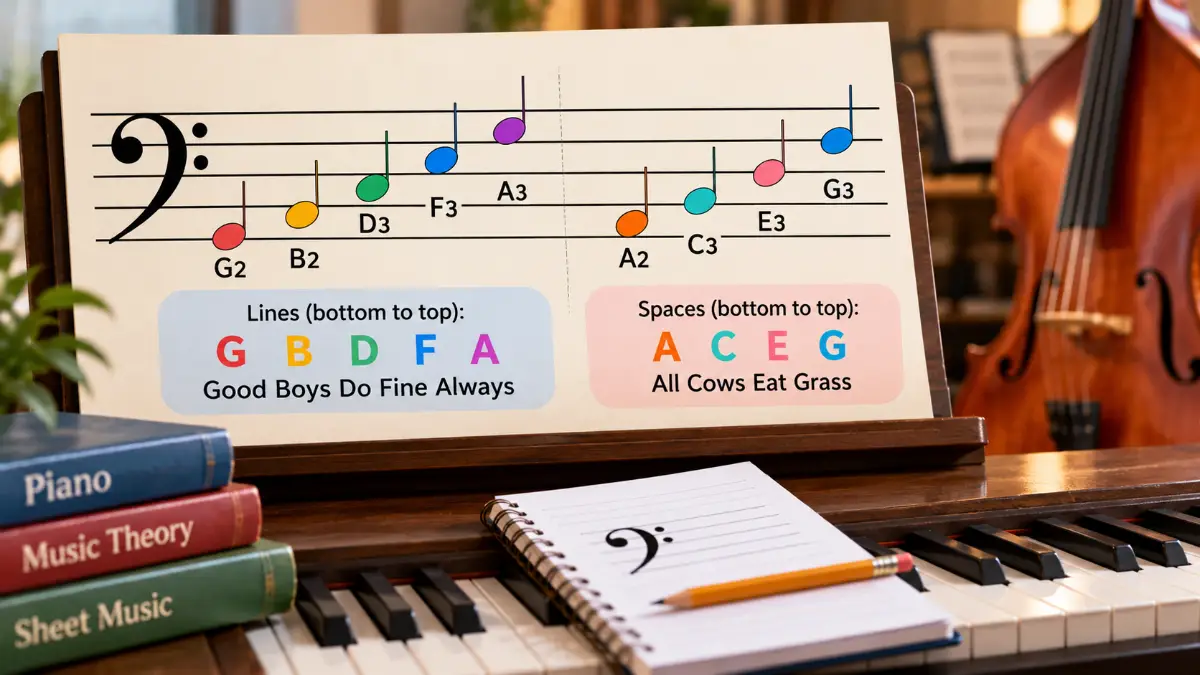
Bass Clef Notes: Chart, Lines, Spaces, and How to Read Them
Bass clef notes are written on the five lines and four spaces of a musical staff. From bottom to top, the five line notes are G2, B2, D3, F3, and A3, while the four space notes are A2, C3, E3, and G3. The bass clef, also called the F clef, places F3 on the fourth line. Knowing these positions helps you read sheet music for piano, cello, bassoon, and other lower-register instruments.
Two simple memory tricks can help you get started: “Good Boys Do Fine Always” for the lines and “All Cows Eat Grass” for the spaces. As these patterns become familiar, you’ll spend less time counting lines and more time recognizing notes at a glance.
Bass Clef Notes Chart: All Lines and Spaces
A bass clef staff has five horizontal lines and four spaces between them. Each position represents a musical note, with higher pitches appearing farther up the staff.
This bass clef notes chart shows all nine positions, starting at the top and moving downward.
| Staff Position | Note | Memory Trick |
| Line 5 (top) | A3 | Always |
| Space 4 | G3 | Grass |
| Line 4 | F3 | Fine |
| Space 3 | E3 | Eat |
| Line 3 | D3 | Do |
| Space 2 | C3 | Cows |
| Line 2 | B2 | Boys |
| Space 1 | A2 | All |
| Line 1 (bottom) | G2 | Good |
The numbers identify octaves using scientific pitch notation. For example, G2 is one octave below G3, and C4 represents middle C on a piano.
This numbering helps distinguish notes that share the same letter name but sound at different pitches. You can also explore the relationship between bass clef notes and piano keys to understand where each note belongs.
Five Lines of the Bass Clef
Read the five lines from bottom to top:
G – B – D – F – A
The familiar mnemonic “Good Boys Do Fine Always” follows the same order.
Each word represents one line. “Good” stands for G2 on the bottom line, “Boys” represents B2 on the second line, and “Do” identifies D3 on the middle line. The fourth and fifth lines are F3 and A3.
Once you know the sequence, you can identify any line note without counting through every position.
Four Spaces of the Bass Clef
The four spaces also have a straightforward pattern:
A – C – E – G
Remember them with “All Cows Eat Grass.”
The bottom space is A2, followed by C3, E3, and G3 as you move upward.
These two mnemonics are especially helpful when you’re learning to read music without writing note names above the staff.
How to Read and Memorize Bass Clef Notes
Reading music becomes easier when you understand the relationship between neighboring notes. Rather than memorizing nine unrelated positions, you can use one familiar note to work out the others.
Why Is It Called the F Clef?
The bass clef gets its other name, F clef, from the position of F3 on the fourth line.
Look closely at the bass clef symbol. Its two dots sit on either side of that line, marking the location of F3.
This gives you a useful reference point. The space immediately above F3 is G3, while the space below it is E3.
Once you can find F3 quickly, identifying nearby notes becomes much easier. This relationship is also explained in introductory music notation lessons, which teach how clefs establish note positions.
Read Notes in Alphabetical Order
Musical notes follow seven letter names:
A – B – C – D – E – F – G
After G, the sequence begins again at A.
Every move from a line to the neighboring space, or from a space to the next line, advances one letter in the musical alphabet.
Starting at the bottom of the bass staff, for example:
- First line: G2
- First space: A2
- Second line: B2
- Second space: C3
- Third line: D3
Continue upward, and the pattern remains the same.
This approach is useful when you encounter an unfamiliar note or temporarily forget a mnemonic.
Simple Ways to Remember the Notes
Begin with three dependable reference points: G2 on the bottom line, D3 on the middle line, and F3 on the fourth line.
Then identify the notes around them. If you recognize D3, for example, the space directly below it must be C3. Similarly, the space above F3 is G3.
Try reading notes in random order instead of always starting at the bottom. Mixing line and space notes encourages you to recognize their positions directly, rather than counting your way through the staff each time.
A little regular practice is more useful than memorizing the phrases without applying them to actual notation.
Bass Clef Ledger Lines and Middle C
Not every musical note fits within the five lines of the staff. When pitches extend beyond their normal range, musicians use short horizontal marks called ledger lines.
These lines extend the staff so that higher and lower notes can be written clearly. The same alphabetical pattern continues beyond the regular lines and spaces.
| Note | Position |
| F2 | Space directly below the bottom line |
| E2 | First ledger line below the staff |
| B3 | Space directly above the top line |
| C4 | First ledger line above the staff |
Notice that F2 and B3 sit just outside the staff without needing ledger lines. E2 and C4, however, are written directly on them.
Understanding ledger lines in music notation makes it easier to read notes beyond the usual staff range.
Where Is Middle C in Bass Clef?
Middle C (C4) sits on the first ledger line above the bass clef staff.
You can find it by starting at A3 on the top line. The space directly above is B3, and the next position, on the ledger line, is C4.
Middle C is particularly useful for piano students because it connects the bass and treble staves in standard grand-staff notation.
Bass Clef Notes for Piano and the Grand Staff
Every bass clef note corresponds to a particular piano key. The note’s position on the staff tells you which pitch to play, while its letter name and octave number help you locate that pitch on the keyboard.
Three useful reference notes are:
- C3: The C key one octave below middle C, written in the second space of the bass staff.
- F3: The F key below middle C, written on the fourth line.
- C4: Middle C, written on the first ledger line above the bass staff.
Piano music commonly uses a grand staff, which combines a treble staff above a bass staff.
The upper staff usually contains right-hand music, while the lower staff generally contains left-hand music. That’s the usual arrangement, not an absolute rule. Either hand may play notes written in either clef when a passage calls for it.
Middle C appears on the first ledger line above the bass staff and the first ledger line below the treble staff. Both notations point to the same piano key.
Bass Clef vs. Treble Clef: What’s the Difference?
Bass and treble clefs use the same five-line staff, but their note positions represent different pitches.
For example, the bottom line of the bass clef represents G2. In the treble clef, that same line position represents E4.
The bass clef lines spell G–B–D–F–A, while the treble clef lines spell E–G–B–D–F, both read from bottom to top.
Knowing this difference matters when switching between clefs, particularly in piano music. You can compare the two systems using a treble and bass clef notes chart that identifies their corresponding positions.
Bass clef is commonly used for lower-register music, including cello, bassoon, trombone, and piano left-hand parts.
Bass guitar and double bass also use bass clef, although these instruments generally sound one octave lower than their written pitches.
Before naming any note, check the clef symbol. Its position determines how you interpret the lines and spaces.
Practice Reading Bass Clef Notes
The best way to check your understanding is to identify notes without looking at the chart. Try these six questions before checking the answers.
- Which note appears on the third line of the bass staff?
- What note is written in the second space?
- Which note appears on the fourth line?
- What is the note in the top space?
- Which note sits on the first ledger line above the staff?
- Which note sits on the first ledger line below the staff?
Answers:
- D3
- C3
- F3
- G3
- C4 (middle C)
- E2
If you missed one, find the nearest note you recognize and move alphabetically to the correct position.
Once you’re comfortable identifying the notes, try another round without using the mnemonics. Over time, familiarizing yourself with the positions will help you read bass clef notes more confidently and with less counting.
Read Also: Bass Clef Notes
Frequently Asked Questions
Sharps and flats change the pitch of a note by one semitone, but they don’t change its position on the staff. For example, an F-sharp is written at the same vertical position as F, with the sharp indicated by an accidental or key signature.
Yes. Bass clef notation can extend above middle C using additional ledger lines and spaces. However, when a musical passage stays in a higher register, another clef may sometimes make it easier to read.