How Many Oz in a Liter? US & Imperial Conversion Chart
How many oz in a liter? There are approximately 33.814 US fluid ounces in 1 liter, commonly rounded to 33.81 fl oz. In the British Imperial measurement system, 1 liter equals approximately 35.195 Imperial fluid ounces. Both measurements describe liquid volume, not weight.
For everyday US measurements, a 500 mL water bottle contains about 16.91 fluid ounces, while a 2-liter soda bottle holds approximately 67.63 fluid ounces. These conversions help when comparing beverage sizes, reading product labels, or measuring ingredients for recipes.
How Many Oz in a Liter? Conversion Formula Explained
Converting liters to fluid ounces is straightforward: multiply the volume in liters by the appropriate conversion factor. The factor differs slightly depending on whether you’re using US or Imperial measurements.
Liters to US Fluid Ounces Formula
To convert liters into US fluid ounces, multiply the number of liters by 33.814. This rounded factor is based on the official US fluid-ounce measurement conversion.
Formula:
USfluidounces=Liters33.814
For example, to find the number of US fluid ounces in 2 liters:
233.814=67.628
Rounded to two decimal places, 2 liters equals 67.63 US fl oz.
Here are a few other common conversions:
- 0.5 liter = 16.91 US fl oz
- 1 liter = 33.81 US fl oz
- 1.5 liters = 50.72 US fl oz
- 2 liters = 67.63 US fl oz
These rounded values are accurate enough for most everyday liquid measurements.
How to Convert Fluid Ounces Back to Liters
If you know the volume in US fluid ounces and need the equivalent in liters, divide by 33.814 instead of multiplying.
Formula:
Liters=USfluidounces33.814
Suppose a container holds 32 US fluid ounces. The calculation is:
3233.8140.946
So, 32 US fl oz equals approximately 0.946 liters, or 946 milliliters.
For Imperial measurements, use approximately 35.195 as the factor when converting liters into Imperial fluid ounces.
Liters to Ounces Conversion Chart
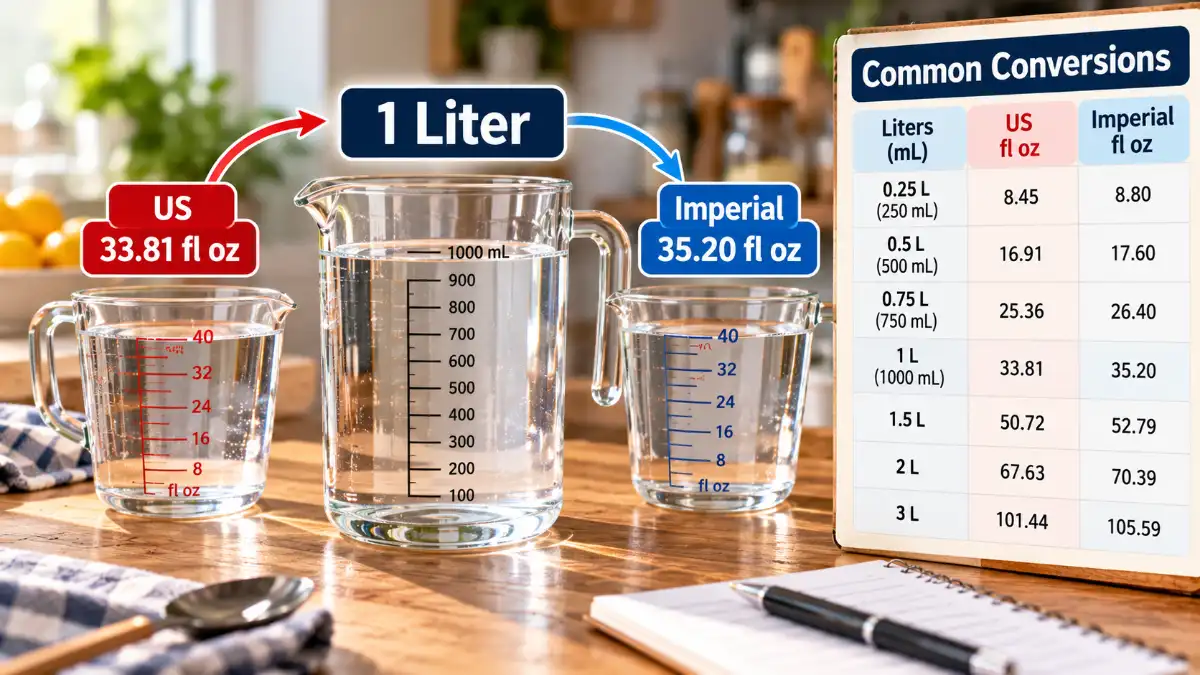
This liters to ounces conversion chart provides a quick reference for common liquid quantities. It includes both US and Imperial fluid ounces so you can choose the measurement system that matches your recipe or container.
| Liters / Milliliters | US Fluid Ounces | Imperial Fluid Ounces |
| 250 mL (0.25 L) | 8.45 fl oz | 8.80 fl oz |
| 500 mL (0.5 L) | 16.91 fl oz | 17.60 fl oz |
| 750 mL (0.75 L) | 25.36 fl oz | 26.40 fl oz |
| 1 L | 33.81 fl oz | 35.20 fl oz |
| 1.5 L | 50.72 fl oz | 52.79 fl oz |
| 2 L | 67.63 fl oz | 70.39 fl oz |
| 3 L | 101.44 fl oz | 105.59 fl oz |
All fluid-ounce values are rounded to two decimal places.
One liter equals exactly 1,000 milliliters. This follows the standard metric volume relationships.
When working with milliliters, divide the amount by 1,000 to get liters, then multiply by the appropriate fluid-ounce conversion factor.
For example, 750 mL equals 0.75 liters. Multiplying 0.75 by 33.814 gives approximately 25.36 US fluid ounces.
US vs. Imperial Fluid Ounces: What’s the Difference?
US and Imperial fluid ounces measure the same type of quantity—volume—but they represent slightly different amounts.
One US fluid ounce equals approximately 29.5735 milliliters, while one Imperial fluid ounce equals approximately 28.4131 milliliters. These differences are reflected in the official US and Imperial ounce conversion factors.
Since an Imperial fluid ounce is smaller, a liter contains more Imperial fluid ounces than US fluid ounces.
- US measurement: 1 liter ≈ 33.814 US fl oz.
- Imperial measurement: 1 liter ≈ 35.195 Imperial fl oz.
For American recipes, grocery labels, and beverage measurements, the US conversion is generally the right one to use.
However, if you’re following a recipe from the UK or using an imported measuring container, check which fluid-ounce system it follows. Mixing the two can affect measurements, particularly when a recipe depends on precise ingredient proportions.
Fluid Ounces vs. Ounces of Weight
Although the names sound similar, fluid ounces and ordinary ounces measure different things.
A fluid ounce (fl oz) measures volume—the space a liquid occupies. An ounce (oz) measures mass, commonly referred to as weight in everyday use.
This distinction also matters when converting ounces into pounds, because those conversions involve weight rather than liquid volume.
Consider water, milk, and cooking oil. One liter of each takes up the same amount of space, but the liquids don’t necessarily weigh the same because their densities differ.
Water has a density close to 1 gram per milliliter under common conditions. Cooking oil is generally less dense, while milk has a slightly different density from pure water.
As a result, you cannot directly convert liters into ounces of mass without knowing the substance’s density. The distinction between volume and weight is also important in standard food measurement conversions.
When a recipe calls for fluid ounces, use a liquid measuring cup or another suitable volume-measuring tool. If it specifies ounces by weight, a kitchen scale is the more appropriate choice.
Practical Liter-to-Ounce Examples
These conversions are especially useful when comparing liquid products or working with recipes that use different measurement systems.
500 mL water bottle: A half-liter bottle holds slightly more than a 16 US fl oz container. Although the sizes are close, they aren’t identical.
750 mL beverage container: This common bottle size contains approximately 25.36 US fl oz. Knowing that makes it easier to compare packages labeled in milliliters and fluid ounces.
1-liter container: A liter holds slightly more than one US liquid quart, which contains exactly 32 US fluid ounces.
2-liter soda bottle: A standard 2-liter bottle contains around 67.63 US fl oz. You can use this figure when comparing larger beverage bottles with smaller containers.
Cooking measurements: If a recipe requires 0.5 liters of stock, milk, or water, measure approximately 16.91 US fluid ounces. The volume conversion remains the same regardless of the liquid, even though its weight may differ.
Frequently Asked Questions
One liter equals approximately 33.81 US fluid ounces, so 34 fl oz is the closer estimate. A US liquid quart contains exactly 32 fluid ounces, equivalent to about 0.946 liters. Neither 32 nor 34 fluid ounces is exactly one liter.
No. A 500 mL bottle contains approximately 16.91 US fluid ounces, making it slightly larger than a 16 fl oz container. Exactly 16 US fluid ounces equals about 473.18 milliliters.