Minutes to Hours: Formula, Calculator Method, and Conversion Chart
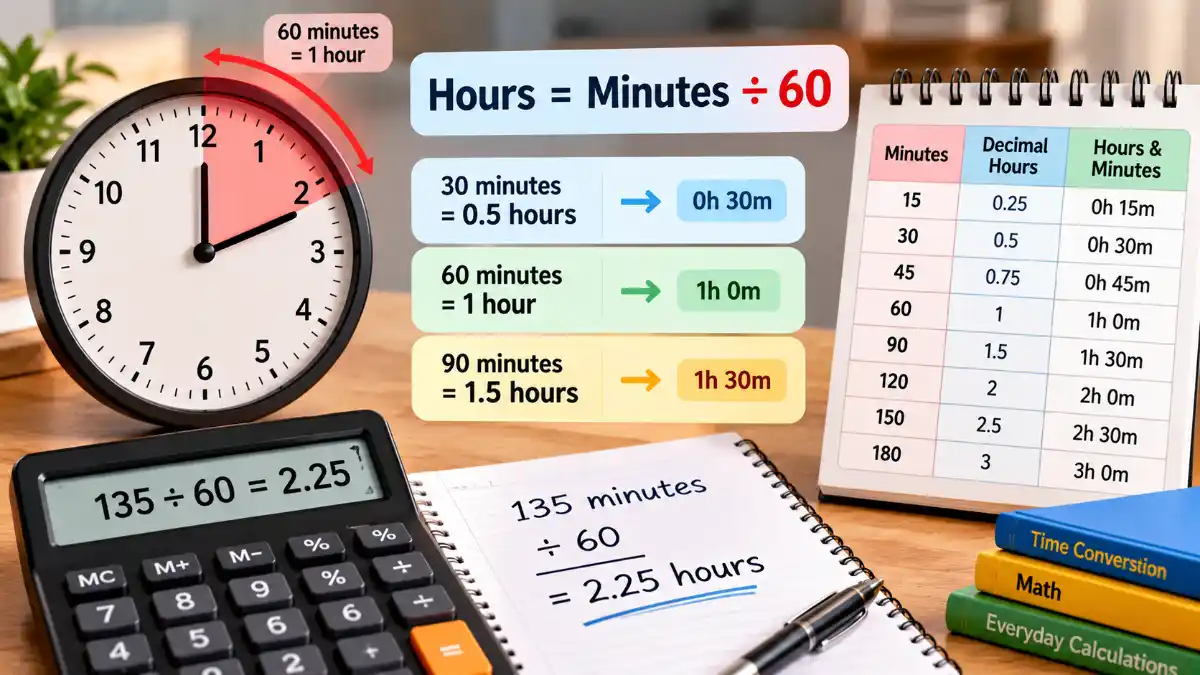
To convert minutes to hours, divide the number of minutes by 60. Since 1 hour contains 60 minutes, the formula works for any duration. For example, 30 minutes = 0.5 hours, 60 minutes = 1 hour, and 90 minutes = 1.5 hours.
You can write the result in decimal hours or as hours and minutes. For instance, 150 minutes equals 2.5 decimal hours, or 2 hours and 30 minutes. Both represent the same amount of time, but they’re used differently. Decimal hours are helpful for timesheets and calculations, while hours and minutes are more familiar when planning everyday activities.
Minutes to Hours Calculator Method
You don’t need a special calculator to convert minutes into hours. A basic calculator works, as long as you divide by 60.
Minutes to hours formula:
Hours = Minutes ÷ 60
This calculation follows the standard relationship between minutes and hours, as defined in the official measurement-unit standards.
Let’s convert 135 minutes:
135 ÷ 60 = 2.25 hours
To express that result in hours and minutes, separate the complete hours from the remaining minutes:
- 2 complete hours = 120 minutes
- 135 − 120 = 15 minutes
Result: 135 minutes = 2.25 hours = 2 hours 15 minutes.
If you’d rather enter a number and get both formats automatically, a minutes-to-hours calculator can do that.
Some conversions produce repeating decimals. Rounding is fine for a quick estimate, but keep enough decimal places when calculating work hours or payments.
How to Convert Minutes to Hours
There are two ways to express the answer: decimal hours and conventional hours-and-minutes notation. The calculation is simple in either case.
Convert Minutes to Decimal Hours
Decimal hours express time as a whole number of hours plus a fraction of an hour. Divide the minutes by 60 to find that value.
Examples:
- 15 ÷ 60 = 0.25 hours
- 20 ÷ 60 = 0.3333… hours
- 45 ÷ 60 = 0.75 hours
- 90 ÷ 60 = 1.5 hours
- 150 ÷ 60 = 2.5 hours
Think of 45 minutes as three-quarters of an hour. That’s why it becomes 0.75 hours in decimal form.
You’ll often see this format in employee timesheets, billing records, and spreadsheets because decimal values are easier to use in arithmetic.
Convert Minutes to Hours and Minutes
If you want the answer in hours and minutes, count the complete 60-minute periods, then work out how many minutes are left.
Take 185 minutes as an example:
- Divide 185 by 60. There are 3 complete hours.
- Multiply 3 × 60 = 180 minutes.
- Subtract 185 − 180 = 5 minutes.
Result: 185 minutes = 3 hours 5 minutes.
The same approach works for durations shorter than an hour. For example, 45 minutes contains no complete hours, so it remains 0 hours and 45 minutes.
Minutes to Hours Conversion Chart
Use this minutes to hours conversion chart when you need a quick answer without doing the math yourself.
| Minutes | Decimal Hours | Hours and Minutes |
| 1 | 0.0167 | 0h 1m |
| 5 | 0.0833 | 0h 5m |
| 10 | 0.1667 | 0h 10m |
| 15 | 0.25 | 0h 15m |
| 20 | 0.3333 | 0h 20m |
| 30 | 0.5 | 0h 30m |
| 45 | 0.75 | 0h 45m |
| 60 | 1 | 1h 0m |
| 75 | 1.25 | 1h 15m |
| 90 | 1.5 | 1h 30m |
| 120 | 2 | 2h 0m |
| 135 | 2.25 | 2h 15m |
| 150 | 2.5 | 2h 30m |
| 180 | 3 | 3h 0m |
| 200 | 3.3333 | 3h 20m |
| 240 | 4 | 4h 0m |
Note: Repeating decimals are rounded to four decimal places. The hours-and-minutes values are exact.
Decimal Hours vs. Hours and Minutes
Decimal hours and hours-and-minutes notation may look similar, but the numbers after the decimal point or colon mean different things.
A decimal represents a fraction of an hour. In conventional time notation, the minutes are counted in groups of 60.
Here’s the difference:
- 2.5 hours = 2 hours 30 minutes
- 2.75 hours = 2 hours 45 minutes
- 2:30 = 2 hours 30 minutes when written as a duration
- 2.30 decimal hours = 2 hours 18 minutes
To convert the decimal portion into minutes, multiply it by 60.
For example:
0.75 × 60 = 45 minutes.
That means 1.75 decimal hours equals 1 hour and 45 minutes, not 1 hour and 75 minutes.
This distinction is especially important in spreadsheets. Programs such as Excel can store time values differently from ordinary decimal numbers, so understanding how spreadsheet time conversions work helps prevent incorrect results.
Practical Uses of Minutes to Hours Conversion
Work Timesheets and Payroll
When employees record their working time, the hours often need to be expressed as decimals for payroll calculations.
Suppose someone works 7 hours and 45 minutes.
45 ÷ 60 = 0.75 hours.
The total working time is 7.75 decimal hours.
At an hourly rate of $20:
7.75 × $20 = $155 before deductions, assuming every recorded hour is paid at the same rate, and no additional pay rules apply.
It’s best not to round individual entries unnecessarily. Even small differences can add up over multiple shifts. In the United States, employers must follow applicable wage-and-hour requirements, including rules governing timekeeping and rounding practices.
School Assignments
Imagine a student spends 95 minutes completing homework.
95 ÷ 60 = approximately 1.5833 hours.
In everyday terms, that’s exactly 1 hour and 35 minutes.
For a study schedule, hours and minutes are generally easier to understand. Decimal hours become useful when adding study time or working with numerical records.
Travel and Daily Schedules
Suppose a journey takes 140 minutes. Dividing by 60 gives approximately 2.3333 hours, which is exactly 2 hours and 20 minutes.
You can also add several activities together before converting. If three tasks take 40, 50, and 30 minutes, their combined duration is 120 minutes, or 2 hours.
How to Convert Hours Back to Minutes
The reverse calculation is just as simple. Multiply the number of hours by 60.
Minutes = Hours × 60
Examples:
- 0.5 hours × 60 = 30 minutes
- 1.5 hours × 60 = 90 minutes
- 2.5 hours × 60 = 150 minutes
- 4 hours × 60 = 240 minutes
When a duration already includes hours and minutes, convert the hours first and then add the remaining minutes.
For example:
3 hours 25 minutes = (3 × 60) + 25 = 205 minutes.
Common Minutes-to-Hours Conversion Mistakes
A frequent mistake is dividing minutes by 100 instead of 60. An hour has 60 minutes, so 45 minutes equals 0.75 hours, not 0.45 hours.
It’s also easy to mistake decimal hours for conventional time notation. For instance, 1.50 decimal hours means 1 hour and 30 minutes, not 1 hour and 50 minutes.
Rounding too soon can create another problem. Twenty minutes equals 0.3333… hours, while 0.33 hours represents only 19.8 minutes. That difference may seem small, but it matters when accuracy is important.
For precise results, keep the original number of minutes or enough decimal places throughout the calculation. Round only when you need to present the final answer.
Read Also: Minutes to Hours
Frequently Asked Questions
Yes. The same formula works for fractional minutes. Simply divide the value by 60. For example, 90.5 minutes equals approximately 1.5083 decimal hours, or exactly 1 hour, 30 minutes, and 30 seconds.
Avoid rounding too early because it can affect the final amount. Keep accurate records and follow the payroll rules that apply to your workplace. When time rounding is permitted, it must not systematically result in employees being underpaid.