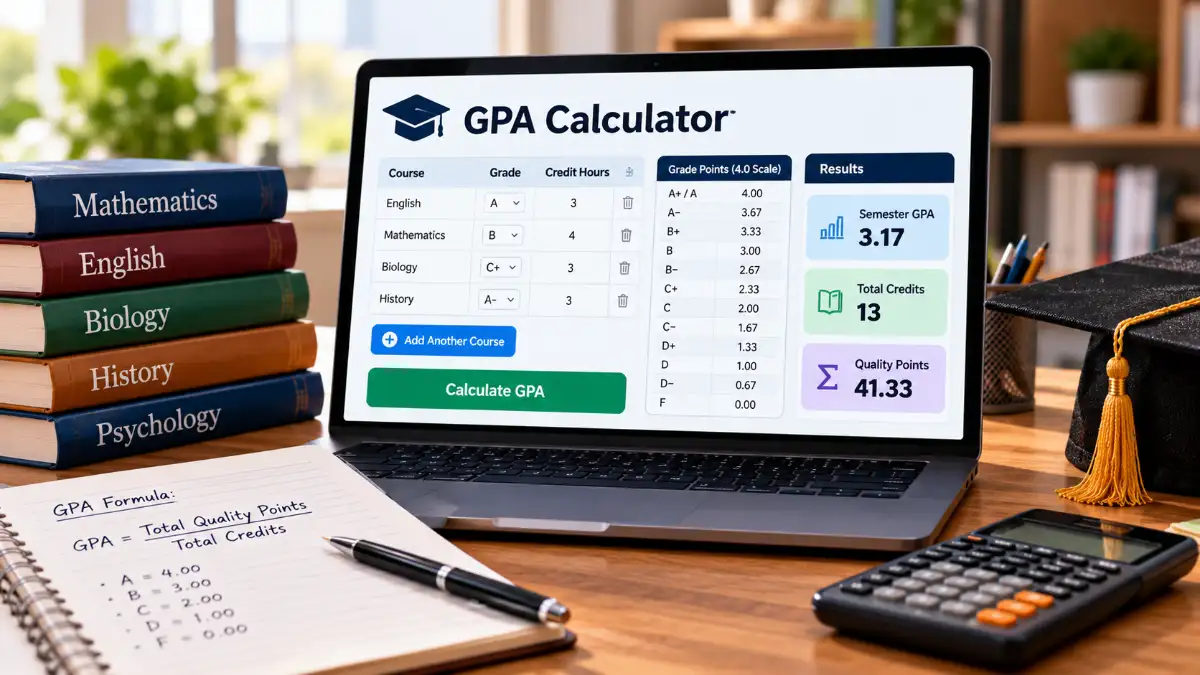
College GPA Calculator: Calculate Semester and Cumulative GPA
Use this college GPA calculator to calculate your semester GPA by entering your course grades and credit hours. The tool uses a common US 4.0 grading scale to calculate your credit-weighted grade point average, total GPA credits, and quality points. You can also enter previous academic results to estimate your updated cumulative GPA and plan the grades you need in future semesters.
How to Use the College GPA Calculator
Start by entering your courses, choosing the letter grade earned in each class, and adding the corresponding credit hours. You can include more courses using Add Another Course or remove any you don’t need.
Click Calculate GPA to see your semester average, total GPA credits, and quality points. To estimate your overall college GPA, enter your previous cumulative GPA and the credit hours that contributed to it.
For the closest estimate, make sure your grades and credit hours match your college’s records. Because universities may use different grading scales, your results can differ from the figures on your official transcript.
College GPA Grading Scale (4.0 Scale)
Most US colleges use a grading system based on a 4.0 scale, but the points assigned to individual letter grades aren’t identical everywhere.
The calculator uses the following conversions, consistent with a published University grading scale:
| Letter Grade | Grade Points |
| A+, A | 4.00 |
| A− | 3.67 |
| B+ | 3.33 |
| B | 3.00 |
| B− | 2.67 |
| C+ | 2.33 |
| C | 2.00 |
| C− | 1.67 |
| D+ | 1.33 |
| D | 1.00 |
| D− | 0.67 |
| F | 0.00 |
These values aren’t universal. Some institutions assign 4.3 points to an A+, while others use different plus/minus values or don’t award certain grades. For example, Stanford’s grade weighting policy uses a different point scale.
Check your college’s grading policy before treating an estimated GPA as your official academic average.
How to Calculate College GPA With Credit Hours
Your college GPA is a weighted average, meaning courses with more credit hours have a greater effect on the result. A four-credit course, for instance, carries four times the weight of a one-credit course.
The standard GPA calculation formula is:
GPA=TotalQualityPointsTotalGPACreditHours
To find quality points, multiply each course’s grade-point value by its credit hours. Then add the quality points and divide by the total eligible credits.
For example:
| Course | Grade | Credit Hours | Quality Points |
| English | A (4.0) | 3 | 12 |
| Mathematics | B (3.0) | 4 | 12 |
| Biology | C (2.0) | 3 | 6 |
| Total | 10 | 30 |
The student’s GPA is:
\[ 30\div10=\boxed{3.00} \]
A college semester GPA calculator handles these calculations automatically, so you don’t need to work through each course manually.
Semester GPA vs. Cumulative GPA
Your semester GPA reflects your grades during a single academic term. Your cumulative GPA combines GPA-eligible courses completed across multiple semesters.
To estimate your updated cumulative GPA, use:
\[ \frac{(\text{Previous GPA}\times\text{Previous Credits})+\text{New Quality Points}}{\text{Previous Credits}+\text{New GPA Credits}} \]
Suppose your cumulative GPA is 3.20 across 30 credits. During your next 15-credit semester, you earn a 3.60 GPA.
Your updated cumulative average would be:
(3.2030)+(3.6015)45=3.33
You can’t simply average 3.20 and 3.60 because the two GPA figures represent different credit totals.
When using a cumulative GPA calculator, enter only credits that contribute to your institution’s GPA calculation. Not every credit shown on a transcript necessarily counts. Also, if your previous GPA has already been rounded, the estimate may differ slightly from the official figure.
How Special Grades Affect Your College GPA
Not every grade or completed course affects your GPA the same way. Colleges have their own policies, so the treatment of certain academic records can vary.
- Failed courses (F): Typically count as zero quality points, while the attempted GPA credits remain part of the calculation.
- Withdrawals (W): Usually don’t affect GPA, although they may still influence academic progress requirements.
- Incompletes (I): Some institutions temporarily exclude them, while others may assign a provisional zero-point value until the grade is resolved.
- Pass/Fail courses: Passing results are often excluded from GPA calculations. Whether a failing result counts depends on the school’s rules.
- Transfer credits: Credits may transfer between institutions without the original grades affecting the new institution’s GPA.
- Repeated courses: Depending on the policy, a college may replace an earlier grade, count multiple attempts, or impose other restrictions.
These differences matter because a calculator using standard letter grades cannot automatically account for every academic policy. The college GPA calculation and grading rules provide another example of how institutional requirements influence GPA.
For the most accurate estimate, leave out courses that don’t count toward your GPA and follow your institution’s rules for repeated classes and special grades.
How to Calculate the GPA You Need Next Semester
If you’re trying to improve your academic average, knowing your current GPA and remaining credit hours can help you set a realistic target.
The required future GPA is calculated as:
RequiredGPA=T(C+F)-(GC)F
In this formula:
- T = Target cumulative GPA
- G = Current cumulative GPA
- C = Completed GPA credits
- F = Planned future GPA credits
For example, suppose your GPA is 3.00 across 60 credits, and you want to reach 3.20 after completing another 15 credits.
You would need a 4.00 GPA in those future courses to reach your goal.
A target that requires more than 4.00 is not achievable within the specified credits under this calculator’s scale, unless your college permits adjustments such as grade replacement that change your cumulative calculation.
Read Also: College GPA Calculator
Frequently Asked Questions
Yes. On a typical 4.0 scale, a 3.0 GPA is equivalent to a B average. That doesn’t mean every course received a B, though. A combination of higher and lower grades can produce the same result once credit hours are taken into account.
Yes, especially if you haven’t completed many GPA credits yet. A strong semester can make a noticeable difference early in college. If you’ve already earned a large number of credits, however, each new semester generally has less influence on your overall average.