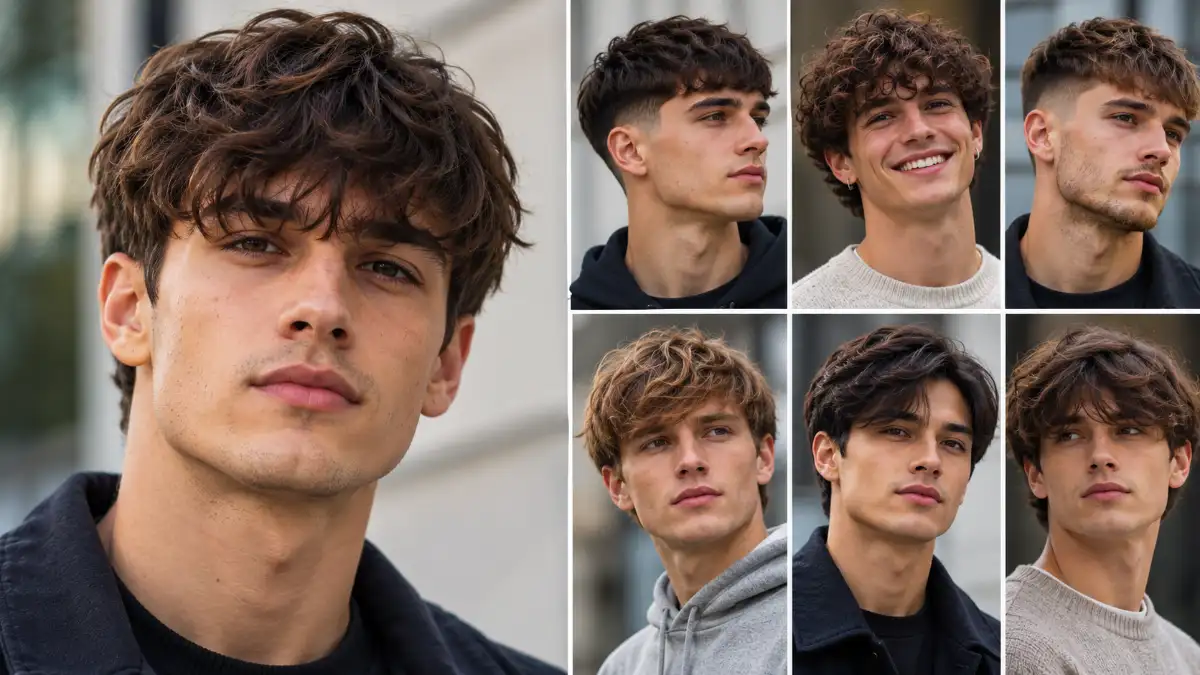
Textured Fringe Haircut: 12 Styles, Face Shapes & Styling Tips
A textured fringe haircut is a men’s hairstyle with layered or carefully textured hair that falls forward over the forehead. The uneven, separated ends create natural movement instead of the straight, uniform edge of a blunt fringe. You can pair it with tapered sides, a fade, or a softer scissor-cut finish, making it adaptable to different hair types and personal styles.
Whether you prefer a clean low taper textured fringe, a relaxed messy look, or natural curls, choosing the right version comes down to your hair density, growth pattern, face shape, and daily styling preferences. A well-chosen cut should be manageable at home, not just look good when you leave the barbershop.
What Is a Textured Fringe Haircut?
A textured fringe features hair directed toward the forehead, with cutting techniques that give individual strands movement and separation. Barbers may use point cutting, layering, or selective texturizing to soften the ends without making the fringe look overly thin.
Three features define the style:
- Forward movement: The front hair falls toward the forehead rather than being brushed completely upward or backward.
- Separated ends: Slight variations in length create a softer, less uniform outline.
- Customizable sides: A taper, fade, or fuller scissor-cut finish changes the haircut’s overall shape.
A textured fringe isn’t quite the same as a traditional French crop. French crops usually have a relatively short top and front fringe, while textured fringes can be longer, looser, or more layered. The two styles can overlap, though, since a French crop can also feature textured ends.
12 Popular Textured Fringe Haircut Styles for Men
These textured fringe styles for men offer different combinations of fringe length, side volume, and natural texture. The biggest differences are how much hair remains on the sides and how the front is cut and styled.
1. Classic Textured Fringe
The classic version has a medium-length top with softly separated strands falling toward the forehead. The sides stay relatively balanced, without a dramatic fade. It’s a good starting point if you want a natural-looking haircut that doesn’t require a sharply defined finish.
2. Low Taper Textured Fringe
A low taper textured fringe keeps most of the fullness on the sides while gradually shortening the hair around the sideburns and neckline. The textured front adds movement without making the overall cut look too short. It’s a practical choice for a neat but understated appearance.
3. Low Fade Textured Fringe
A low fade blends shorter hair into longer sections across the lower sides and back. While a low taper mainly concentrates on the sideburns and neckline, a low fade generally covers a broader area. The result is a cleaner, more noticeable transition that still sits relatively low.
4. Mid Fade Textured Fringe
A mid fade starts the transition higher up the head, removing more side volume than a low fade. This creates a stronger contrast with the textured top while leaving more fullness around the upper sides than a typical high fade.
5. High Fade Textured Fringe
A high fade brings the shorter sections farther up the sides, making the longer fringe stand out more prominently. It creates a sharper contrast and a closely cropped appearance around much of the head. Regular touch-ups can help maintain that defined shape.
6. Short Choppy Textured Fringe
This variation features shorter front sections cut with intentionally uneven ends. The compact shape is generally easier to manage than a long fringe, although careful cutting is still important to prevent the front from looking too blunt or patchy.
7. Messy Textured Fringe Haircut
A messy textured fringe haircut has a relaxed, tousled finish with loosely separated strands. Keeping enough length through the top allows the hair to move naturally. A small amount of lightweight styling product can add definition without making the fringe look stiff.
8. Curly Textured Fringe
A curly fringe lets natural curls fall across the forehead while the sides remain shaped and controlled. Because curls often appear shorter when dry, the barber should account for shrinkage before deciding how much length to remove.
9. Wavy Textured Fringe
Naturally wavy hair already has the movement this haircut aims to create. Light layering can help distribute volume, while a small amount of suitable styling product can bring out the waves without weighing them down.
10. Long Layered Textured Fringe
Longer layers produce a flowing fringe that may reach the eyebrows or fall slightly below them. This version offers more flexibility in styling direction, but you’ll need to manage the front sections if they start getting into your eyes.
11. Side-Swept Textured Fringe
Instead of falling straight forward, the fringe moves diagonally across the forehead. This creates a slightly asymmetrical shape and can be particularly convenient when your hair naturally grows toward one side.
12. Scissor-Cut Textured Fringe
This version keeps the sides fuller, using scissor cutting to create softer transitions rather than a prominent clipper fade. It’s well suited to anyone who prefers a more relaxed haircut without sharply defined sides.
Which Textured Fringe Suits Your Face Shape?
The right fringe length and amount of side volume can change how your facial proportions appear. Face shape is a useful starting point, but it shouldn’t determine your haircut on its own.
| Face shape | Styling considerations |
| Oval | Experiment with different fringe lengths and adjust the volume to your preference. |
| Round | A lighter fringe with some height on top may make the face appear longer. |
| Square | Soft, uneven fringe edges can balance a more angular jawline. |
| Heart-shaped | A moderately full fringe and balanced sides may soften the contrast between the forehead and jaw. |
| Long | A fuller forward fringe with less height on top may create more balanced proportions. |
Your forehead height, hairline, and natural growth direction also affect the result. A skilled barber can adjust the length and shape to suit your features rather than following face-shape rules too strictly.
Does a Textured Fringe Work With Your Hair Type?
A textured fringe can work with straight, wavy, curly, thick, and fine hair. The key is adjusting the cutting technique and styling approach to your natural texture.
- Straight hair: Point cutting and light styling can create separation when the hair doesn’t have much natural movement.
- Wavy hair: Natural waves already provide texture, so you may need less styling product.
- Curly hair: The barber should consider your curl pattern and how much the hair shrinks as it dries.
- Thick hair: Carefully placed layers can remove excess bulk without sacrificing the overall shape.
- Fine hair: Gentle texturizing and a lighter fringe can help preserve the appearance of fullness.
Hair density matters just as much as texture. Removing too much weight from fine or low-density hair can make the fringe look sparse. Strong cowlicks can also push the hair in an unexpected direction, so it’s usually better to work with your natural growth pattern.
How to Ask Your Barber for a Textured Fringe
Be specific about the fringe length, top length, side treatment, and finish you want. Bringing reference photographs showing the front and sides makes it easier to communicate the look you’re after.
Here’s an example of what you can say:
“I’d like a textured fringe that falls naturally toward my forehead, with around 2–3 inches (5–7.6 cm) on top. Please keep the ends softly textured with point cutting, use a low taper around the sides and neckline, and avoid making the fringe too blunt.”
Those measurements are only a starting point. Your barber can adjust them based on your hair type, growth direction, and how far you want the fringe to fall.
If you have curly hair, discuss how long the fringe should look when dry. For fine hair, ask for conservative texturizing so you don’t lose too much density.
How to Style a Textured Fringe at Home
Styling a textured fringe doesn’t have to involve a complicated routine. Once the haircut works with your natural hair pattern, a few simple steps can help maintain its shape.
- Start with slightly damp hair. Gently towel-dry your hair rather than rubbing it aggressively.
- Direct the hair forward. Use your fingers and a blow dryer on a moderate heat setting to guide the fringe toward your forehead.
- Create separation. Move small sections with your fingers instead of brushing everything into one straight line.
- Apply a suitable product. Try a little matte clay for definition, texture powder for grip, or sea salt spray for a looser finish, depending on your hair type.
- Adjust the shape. Separate a few strands at the front until the fringe looks natural. Avoid repeatedly working the hair once it’s in place.
Fine hair often responds better to lightweight products, while curly hair may benefit from curl cream or a light styling gel. There’s no need to use several products together if one gives you the finish you want.
How Often Should You Trim a Textured Fringe?
Getting a trim every 3–6 weeks is a reasonable starting point, but the best schedule depends on how quickly your hair grows, how long you wear the fringe, and how sharp you want the sides to look.
High and mid fades may need earlier touch-ups to keep their clean transitions. Longer, softer fringes often grow out more naturally and may not need trimming as frequently.
Between appointments, wash your hair as needed, avoid heavy product buildup, and refresh the fringe with a little water and light restyling. If the front starts covering your eyes or no longer holds its intended shape, it’s probably time for a trim.
Read Also: Textured Fringe Haircut
Frequently Asked Questions
Yes. A cowlick may change how the fringe falls, but it doesn’t automatically rule out the haircut. Your barber can adjust the length, layering, or styling direction to accommodate the way your hair naturally grows. A strong cowlick may still require some daily styling.
Yes. If your hair naturally has enough wave, curl, or body, water, finger styling, and careful drying may be enough to create a textured finish. Very straight or soft hair may need a small amount of lightweight product to keep the strands separated throughout the day.


