Paleontologist: Meaning, Job Duties, Education, and Salary
A paleontologist is a scientist who studies fossils to understand ancient organisms and the history of life on Earth. These scientists examine fossilized bones, teeth, shells, footprints, and plant remains to learn about prehistoric life, evolution, extinction, and ancient ecosystems. Paleontology brings together biology, which helps explain organisms and evolution, and geology, which provides clues about rocks, geological time, and Earth’s history.
Although dinosaurs are closely associated with paleontology, the field covers far more than prehistoric reptiles. Paleontologists also study ancient mammals, marine organisms, insects, plants, and microscopic life. Some spend time excavating fossils, while others focus on laboratory research, museum collections, or publishing scientific findings. Their work helps piece together how life and environments have changed over millions of years.
What Does a Paleontologist Do?
A paleontologist discovers, examines, and interprets fossils to understand how ancient organisms lived and evolved. The work involves much more than digging up bones. Depending on their specialty and workplace, paleontologists may spend their days outdoors, in laboratories, or examining specimens preserved in museums.
Their main responsibilities include:
- Finding fossils: Using geological maps and rock formations to identify locations where fossils are likely to be preserved.
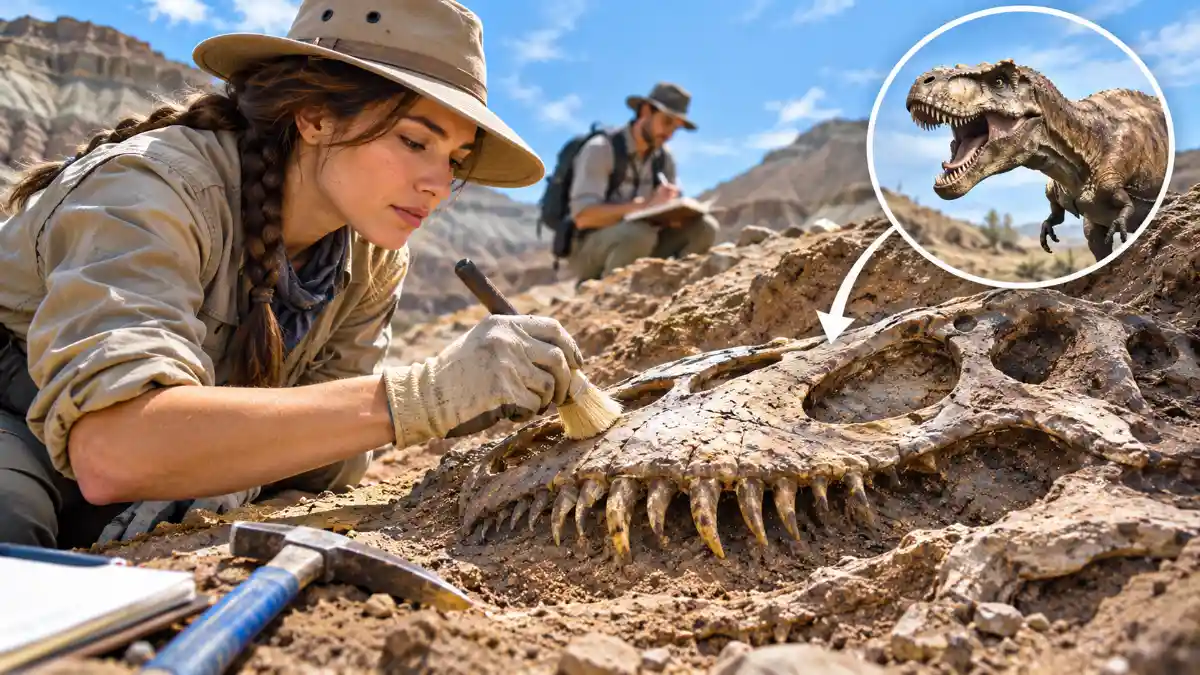
- Excavating specimens: Carefully removing fossils from surrounding rock while recording their position and geological context.
- Preparing fossils: Cleaning, stabilizing, and occasionally reconstructing specimens with specialized laboratory tools.
- Analyzing discoveries: Comparing fossils with known organisms to investigate anatomy, evolution, and ancient environments.
- Determining geological ages: Examining rock layers, associated fossils, and suitable dating methods to estimate when organisms lived.
- Conducting research: Documenting discoveries, testing scientific explanations, and publishing findings in academic journals.
- Managing collections: Preserving specimens, maintaining research records, and contributing to museum exhibitions and educational programs.
Excavation is only one part of the profession. Fieldwork is often seasonal or sporadic, while laboratory analysis, collection-based research, and scientific writing may take up much of a paleontologist’s time.
For example, studying fossilized marine shells can reveal changes in ancient ocean environments. Dinosaur footprints, meanwhile, may offer clues about how prehistoric animals moved and behaved.
The scientific work of paleontologists combines fossil evidence, geological observations, and careful analysis to reconstruct ancient ecosystems.
Types of Paleontologists
Paleontology includes several specializations, each focusing on particular organisms or types of fossil evidence.
| Specialization | What They Study | Examples |
| Vertebrate paleontology | Fossil animals with backbones | Dinosaurs, ancient mammals, fossil fish |
| Invertebrate paleontology | Fossil animals without backbones | Trilobites, ammonites, corals |
| Paleobotany | Ancient plants and their fossil remains | Fossil leaves, wood, seeds |
| Micropaleontology | Microscopic fossils | Foraminifera, fossil pollen, diatoms |
These specialties sometimes overlap. For instance, researchers studying microscopic plant fossils may work in both paleobotany and micropaleontology.
Each specialization helps answer different questions about biodiversity, evolutionary relationships, environmental changes, and extinction events.
The variety of evidence is remarkable. As explained in the National Park Service’s overview of fossils, fossils can include preserved remains, impressions, and traces of organisms, ranging from microscopic life to large prehistoric animals.
How to Become a Paleontologist
Becoming a paleontologist generally involves studying science, gaining practical research experience, and developing expertise in a particular field. In the United States, the educational pathway varies depending on whether you want to pursue academic research, museum work, fossil preparation, or another related career.
1. Build a science foundation in high school
Start with biology, chemistry, physics, mathematics, and Earth science. These subjects help you understand fossils, geological processes, and the scientific methods used to investigate ancient life.
2. Earn a relevant bachelor’s degree
Most aspiring paleontologists study geology, biology, Earth science, zoology, or a related subject.
A bachelor’s degree typically takes four years of full-time study in the United States. Courses covering evolution, sedimentology, anatomy, statistics, and geological history provide particularly useful preparation.
3. Gain practical research experience
Classroom knowledge becomes more valuable when combined with hands-on experience. University research projects, museum volunteering, supervised fossil preparation, and fieldwork can introduce students to professional paleontological methods.
These opportunities also develop important skills, including specimen documentation, geological interpretation, data analysis, and scientific communication.
4. Consider graduate education
A master’s degree provides opportunities for advanced study and research experience. A PhD is commonly expected for independent academic research positions and university faculty roles.
However, a doctorate is not required for every paleontology-related career. Some museum technician, fossil preparation, and collection-support positions accept different combinations of education, training, and practical experience.
The professional pathway to becoming a paleontologist emphasizes building a broad scientific foundation before pursuing more specialized research.
5. Develop specialized scientific skills
Paleontologists need strong observation skills, analytical thinking, geological knowledge, attention to detail, and the ability to communicate scientific findings clearly.
Modern research also involves computer modeling, digital imaging, statistics, and data analysis. Familiarity with these techniques can be valuable when examining complex fossils or interpreting large scientific datasets.
Where Do Paleontologists Work?
Paleontologists work in several professional settings, and their daily responsibilities can differ considerably.
- Universities: Conduct research, teach students, supervise projects, and publish scientific findings.
- Natural history museums: Examine fossils, manage collections, prepare specimens, and support public education.
- Government agencies: Document, protect, and manage paleontological resources, including fossils found on public lands.
- Scientific research institutions: Investigate evolutionary history, fossil diversity, and ancient environmental conditions.
- Private-sector organizations: Conduct fossil resource assessments, support geological investigations, and contribute to related scientific projects.
Some jobs involve traveling to remote excavation sites, while others are based primarily in laboratories, offices, or museum collections.
Paleontologist Salary and Career Outlook
A paleontologist’s salary varies depending on education, experience, specialization, employer, and location. Because professionals work across universities, museums, government agencies, and other organizations, no single nationwide salary figure accurately represents everyone employed in paleontology.
For context, the broader U.S. geoscientist occupation had a median annual wage of $101,920 in May 2025, according to U.S. geoscientist employment and wage statistics.
However, this figure includes geoscientists working in several industries. It is not a paleontologist-specific median salary and should not be treated as the typical earnings of someone studying fossils.
Compensation can differ considerably between museum technicians, university researchers, professors, and government scientists. Employment terms also vary, with some researchers working in temporary or project-funded positions.
Research careers can be competitive, particularly when pursuing permanent academic or museum appointments. Advanced qualifications, publications, practical experience, and specialized expertise may improve an applicant’s suitability for particular positions.
Similarly, employment projections for the broader geoscience profession do not necessarily reflect the number of opportunities available specifically in paleontology.
Paleontologist vs. Archaeologist: What’s the Difference?
The main difference between a paleontologist and an archaeologist lies in what they study and the questions their research seeks to answer.
Paleontologists study fossils and the history of life on Earth. Their research may involve dinosaur bones, ancient marine organisms, fossil plants, or prehistoric footprints. These discoveries help explain evolution, extinct species, and past environments.
Archaeologists study past human societies and cultures through material evidence such as pottery, tools, buildings, and settlement sites.
For example, examining a fossilized dinosaur skeleton generally falls within paleontology. Investigating pottery discovered at an ancient human settlement belongs to archaeology.
The disciplines sometimes overlap, particularly when researchers investigate early humans and the environments they inhabited. However, their primary research goals remain different.
The distinction between paleontology and archaeology is important because both disciplines examine evidence from the past but interpret it through different scientific perspectives.
Read Also: Paleontologist
Frequently Asked Questions
Most aspiring paleontologists begin with a bachelor’s degree in geology, biology, Earth science, or a related field. A master’s degree can provide specialized research training, while a PhD is commonly required for independent academic research and university teaching positions. Some museum and fossil preparation jobs have different educational requirements.
Paleontology can be a rewarding career for people interested in fossils, prehistoric life, geology, and scientific discovery. It offers opportunities in museums, universities, government agencies, and research institutions. However, permanent research positions can be competitive, and advanced education is often necessary. Career prospects depend on qualifications, experience, specialization, and available positions.
No. Paleontologists study many forms of ancient life, including prehistoric mammals, fish, marine invertebrates, plants, and microscopic organisms. Dinosaurs are just one area of paleontology. Fossils help scientists understand evolution, extinction, and how ecosystems changed over millions of years.