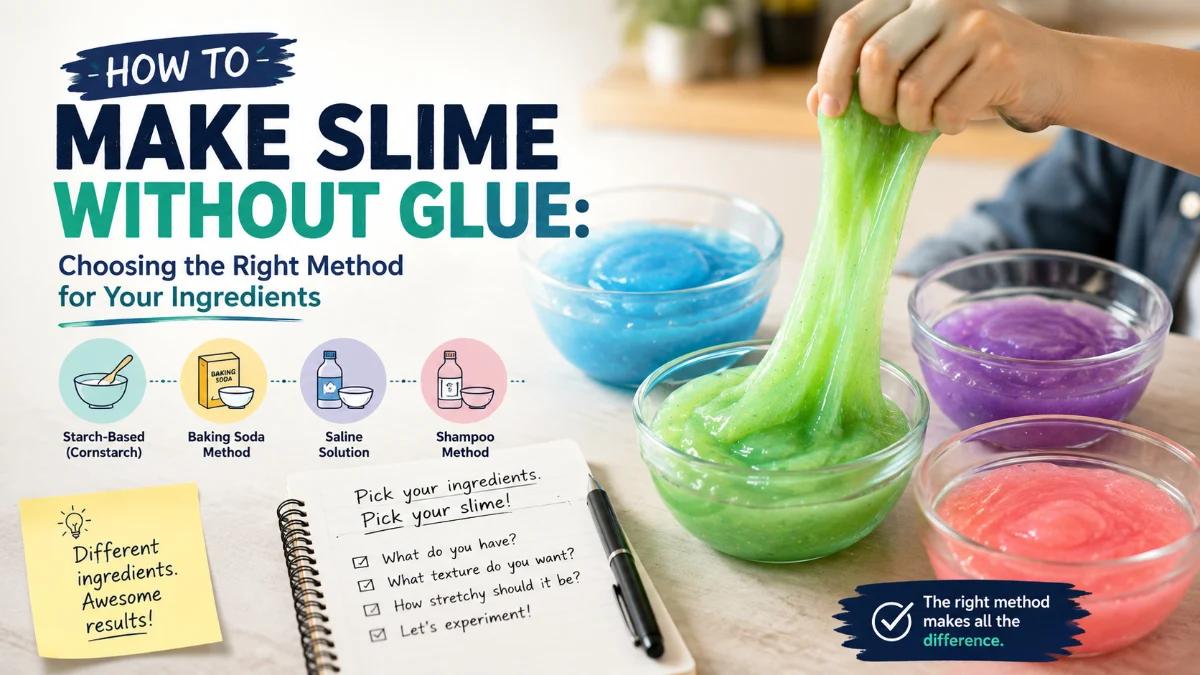
How to Make Slime Without Glue: Choosing the Right Method for Your Ingredients
If you’ve ever wanted to know how to make slime without glue, the fastest way in is to start with whatever’s already in your bathroom cabinet or kitchen drawer. Four methods are covered below, and each uses a different base ingredient, so the real first step is checking what you have on hand before picking a recipe.
| Method | Core Ingredients | Time to Make | Texture | Best For |
| Cornstarch + Shampoo | Shampoo, cornstarch, water | 10-15 min | Closest to classic stretchy slime | Anyone wanting the most glue-like feel |
| Cornstarch + Dish Soap | Cornstarch, dish soap | 5-10 min | Moldable, playdough-like | First-timers, most forgiving ratio |
| Shampoo + Salt | Shampoo, dish soap, salt | 20-25 min (incl. freezer time) | Soft but short-lived | Quick experiments, not long-term storage |
| Psyllium Husk | Psyllium husk, water | 5 min active + 1 hr cooling | Jelly-like, food-grade | Toddlers or children who mouth objects |
Each row above answers a different version of how to make slime without glue, depending on what’s realistically sitting in the house. The cornstarch-based methods dominate for a reason: they most closely mimic the stretch of traditional glue slime, while the salt and psyllium versions trade some durability for speed or safety.
If You Have Shampoo and Cornstarch
This is the first and most popular way to learn how to make slime without glue. This combination gets closest to a classic glue-based slime texture, since cornstarch acts as a binding thickener much like the polymer in glue does. Thick gel shampoo or a 3-in-1 formula works better than thin, watery shampoo, which tends to produce a looser, less stretchy result no matter how much cornstarch is added.
Start by combining half a cup of thick shampoo with two and a half cups of cornstarch in a large bowl, stirring until it forms a crumbly paste. Water needs vary by shampoo brand, so add it gradually: begin with about a quarter cup, one tablespoon at a time, and go up to three-quarters of a cup total until the mixture turns smooth and slightly stretchy rather than crumbly.
The single biggest mistake in this method is adding water too fast, since the mixture can jump from crumbly straight to runny with barely a usable stage in between. Once it holds together, knead by hand for a minute or two, and stir in food coloring before the cornstarch goes in if you want even color distribution.
If You Have Dish Soap and Cornstarch
Compared to the shampoo version, this is the more forgiving entry point into how to make slime without glue, because the ratio tolerates small measurement errors without falling apart. Mix half a cup of cornstarch with one-third cup of liquid dish soap, working the soap in gradually with a spoon or your hands over about five minutes.
Where the shampoo method produces something closer to true stretchy slime, dish soap slime lands somewhere between playdough and slime: moldable, mildly stretchy, and more satisfying to squish than to stretch long. If it’s too sticky, add a bit more cornstarch; if it won’t hold together, work in a few more drops of soap. Thicker dish soap brands tend to finish smoother than watery ones.
If You Have Shampoo, Dish Soap, and Salt
This is the fastest route to trying how to make slime without glue, since it skips cornstarch entirely and uses salt’s osmotic pull to thicken the mixture instead, though it comes at the cost of durability. Squeeze a generous amount of shampoo into a bowl, add a similarly sized squirt of dish soap, then stir in a pinch of salt.
Place the bowl in the freezer for 20 minutes. It will firm up enough to handle when it comes out, but it softens again quickly as it warms in your hands. This recipe is based on a single tested source rather than several independently cross-checked accounts, so it’s best treated as a quick experiment rather than a batch meant to last more than one sitting.
If You Have Psyllium Husk (Best for Toddlers)
Unlike the three soap-based methods above, this one uses a food-grade fiber powder instead of shampoo or dish soap, making it the safer pick when young children are likely to put their hands or the slime itself in their mouths. Microwave three tablespoons of psyllium husk with about one and two-thirds cups of water for up to five minutes, stirring every minute until it turns thick and gel-like.
Let it cool for a full hour before handling, since it comes out very hot. As with the salt method, this ratio comes from a single documented source, so results may shift slightly depending on microwave wattage. Once cooled, it has a distinctly jelly-like stretch, and while it’s food-grade, it still isn’t meant to be eaten as a snack.
Fixing a Batch That Isn’t Working
Even with a clear plan for how to make slime without glue, a batch can still go wrong the first time. Regardless of which method you picked, most failures reduce to two problems: too sticky or too runny, and both are fixable without starting over from scratch.
For stickiness, work in a small amount of extra cornstarch at a time until it firms up. For runniness, the fix depends on the method: more cornstarch for the shampoo or dish soap versions, or another 5 to 10 minutes in the freezer for the salt-based version. The most common troubleshooting mistake is overcorrecting with a large addition all at once instead of adjusting incrementally.
How Long Each Version Lasts
Once the immediate question of how to make slime without glue is solved, storage becomes the next practical concern. Shelf life is where the comparison table above matters most in practice, since durability varies sharply by method.
Cornstarch-based batches typically dry out within a day or two of regular play, while the shampoo-and-salt version separates fastest of all, sometimes within a single session once it’s handled. Store any batch in an airtight container or a zip-top bag with the air pressed out, at room temperature and away from direct sunlight.
A few drops of water kneaded in can temporarily revive a drying batch, though every glue-free recipe eventually breaks down. Smaller batches made for one sitting tend to be more practical than trying to preserve a large one for a week.
Safety Considerations by Method
Every method here skips borax, which is the shared safety advantage across all four approaches to how to make slime without glue. Borax has been linked to skin irritation with repeated or prolonged contact, especially for children with eczema, cuts, or otherwise broken skin.
The psyllium husk and plain cornstarch-and-water combinations are the safer choices for toddlers, since dish soap and shampoo can irritate eyes and shouldn’t be ingested. Keep glitter or small mix-ins away from children under three because of the choking risk, and treat hand-washing after play as standard practice no matter which recipe was used.
Frequently Asked Questions
The cornstarch-and-shampoo method produces the closest texture to traditional glue-and-borax slime, since cornstarch mimics the binding effect of glue’s polymer base more closely than salt or fiber does.
The shampoo-and-dish-soap-and-salt method is the fastest, ready in about 20-25 minutes, including freezer time, though it’s also the least durable and best treated as a short-lived experiment.
Yes, the shampoo-and-salt method skips cornstarch entirely, using salt’s osmotic thickening effect instead, though the result is softer and shorter-lived than starch-based versions.
Both carry similar eye-irritation risks and shouldn’t be ingested, so neither is meaningfully safer for toddlers than the other; the psyllium husk method is the better choice if ingestion risk is a concern.
All glue-free slime dries out faster than traditional slime because it lacks glue’s long-lasting polymer structure. Kneading in a few drops of water can revive a batch temporarily, but it will eventually need remaking.
The psyllium husk method is the most toddler-appropriate option since its ingredients are food-grade, though supervision is still recommended and it isn’t meant to be eaten as a snack.
It depends on the method: roughly 2.5 cups for the shampoo version and 1/2 cup for the dish soap version, with the exact texture adjusted by adding small amounts gradually.
No refrigeration is required for storage, though the salt-based method does need a 20-minute freezer step during preparation to firm up before use.