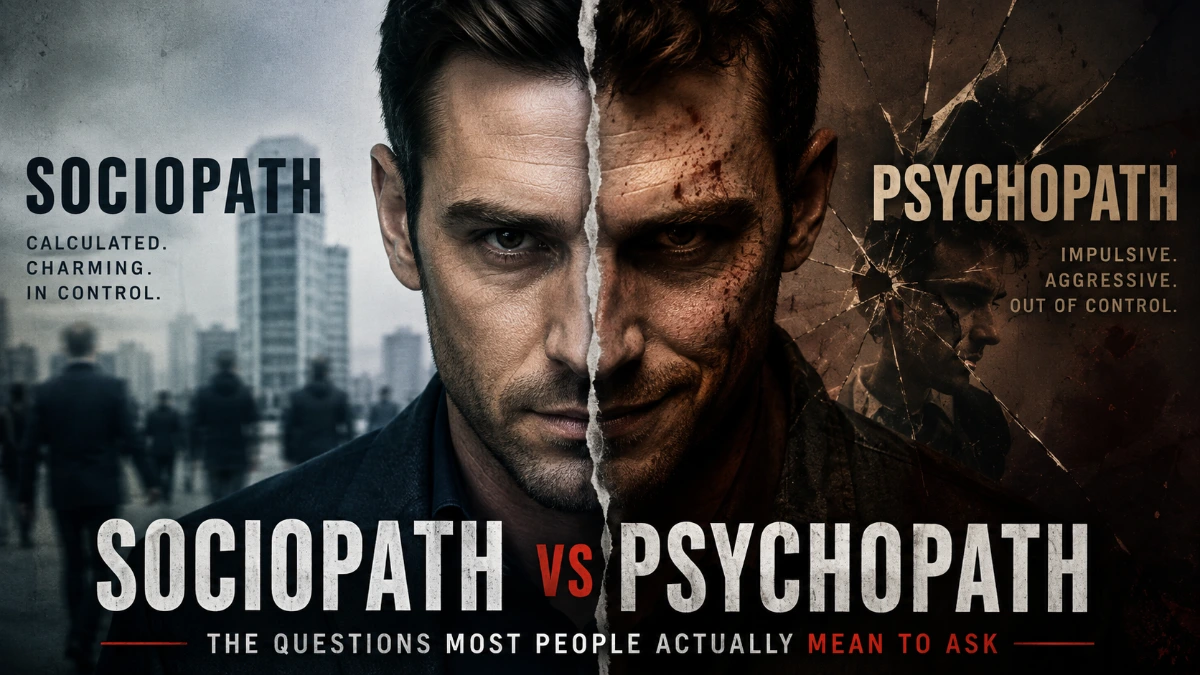
Sociopath vs Psychopath: The Questions Most People Actually Mean to Ask
Ask the wrong question and the whole topic gets distorted. Sociopath vs Psychopath is usually treated as a contest between two labels, but the more accurate question is what these words are actually pointing to.
They are not official diagnoses. They are informal ways of describing different antisocial trait patterns that fall under antisocial personality disorder (ASPD).
That alone clears up most confusion. The real Sociopath vs Psychopath distinction is not about two separate disorders. It is about two different ways antisocial traits may present: one more impulsive and emotionally volatile, the other more detached, controlled, and calculating.
What is the real difference?
The most useful starting point is not a stereotype from film or true crime—it is pattern recognition.
- Psychopathic-leaning traits: More often described as emotionally cold, low-fear, manipulative, superficially charming, and behaviorally controlled.
- Sociopathic-leaning traits: More often described as reactive, impulsive, aggressive, erratic, and less able to maintain a stable outward mask.
This does not mean every person fits neatly into one box. In real cases, the distinction is blurry, and people may show a mix of both kinds of traits at the same time. That is one reason rigid internet definitions tend to mislead more than they clarify.
Is either one a real diagnosis?
The most important fact in any Sociopath vs Psychopath article is that clinicians do not diagnose either term on its own. The formal diagnosis is Antisocial Personality Disorder (ASPD).
Under DSM-based evaluation, a diagnosis requires:
- A persistent pattern of violating others’ rights and social rules (meeting at least three of seven standard criteria).
- The person must be at least 18 years old.
- Evidence of conduct disorder behavior present before age 15.
That diagnostic threshold matters because it forces precision. Once you understand that, the debate becomes less about naming a type of person and more about identifying which trait pattern is being described.
Do causes explain the difference?
Another reason this topic gets oversimplified is that people want a one-word explanation for the cause. Research does not support that. Antisocial behavior reflects both genetic and environmental influences rather than a single source.
- Genetic Factors: Psychopathic traits appear to show somewhat stronger heritability.
- Environmental Factors: Disruptions such as abuse, neglect, trauma, and instability play a major role in antisocial development overall.
That is why the popular shortcut—born psychopath, made sociopath—is memorable, but too simplistic to trust.
Which one is more dangerous?
A lot of content quietly pushes readers toward one hidden question: which one is more dangerous? That is where many articles become misleading. Psychopathy has often been framed as the more severe presentation, but peer-reviewed research complicates that idea.
Violence risk is linked more strongly to impulsive antisocial behavior and social deviance than to the cool, emotionally detached traits most people imagine when they hear the word psychopath. The useful takeaway is not that one label is always worse—it is that specific traits matter more than the label itself.
What should readers actually do with this?
The most practical use of the Sociopath vs Psychopath distinction is educational, not diagnostic. It helps explain why two people with antisocial traits may behave very differently. It does not give enough basis to diagnose a partner, co-worker, family member, or public figure from a distance.
If someone’s behavior is manipulative, threatening, deceitful, exploitative, or unsafe:
- Focus on practical steps: Set boundaries, document incidents, build a safety plan, and seek professional evaluation when appropriate.
- Avoid internet diagnoses: Trying to argue over whether someone is a sociopath or a psychopath is rarely helpful in high-risk situations.
- Seek clinical guidance: If the concern is about your own behavior patterns, a licensed mental health assessment is far more useful than adopting a label.
Frequently Asked Questions
Not as formal diagnoses. They are informal labels used around ASPD-related trait patterns.
Because they feel vivid and easy to understand, especially in media and everyday conversation, even though they are less precise than clinical language.
Yes. Trait presentation can overlap, which is why the distinction is often blurry in real life.
No. Research does not support a simple rule that psychopathic traits automatically mean higher violence risk.
Trauma and instability can contribute to antisocial development, but they are not the only causes and do not explain every case.
The formal diagnosis is antisocial personality disorder, not sociopathy or psychopathy.