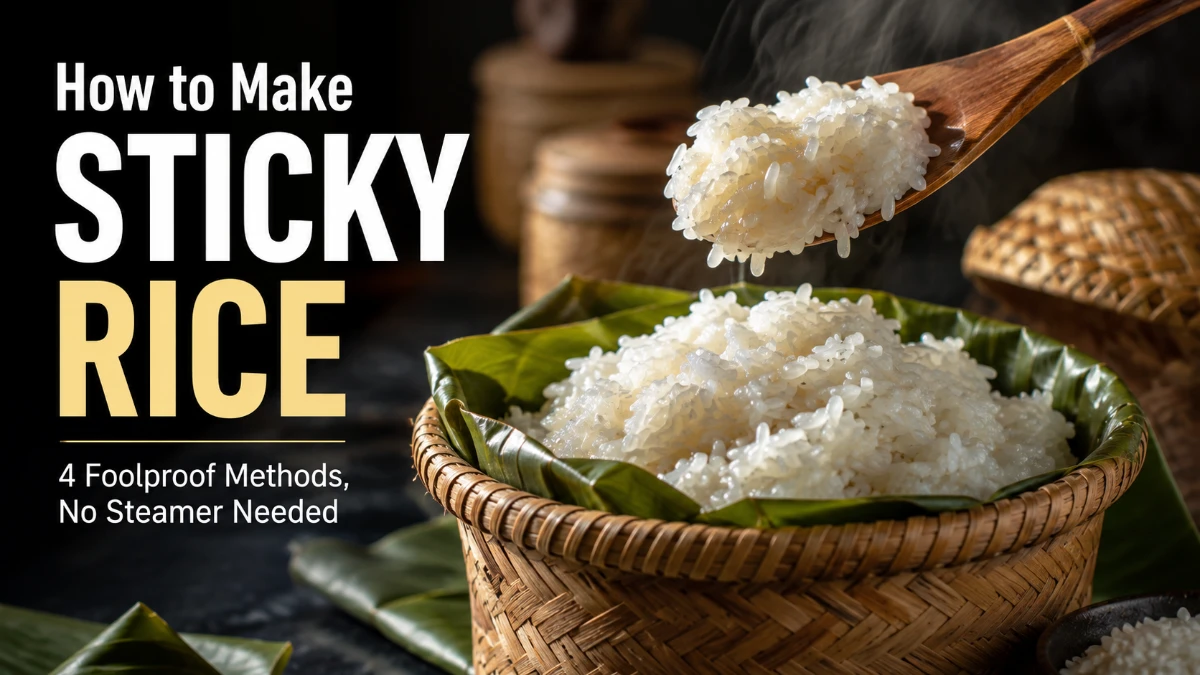
How to Make Sticky Rice: A Complete No-Fail Guide for Every Kitchen
Making sticky rice comes down to three things: using true glutinous rice, giving it a proper soak, and cooking it with gentle steam rather than boiling it in a pot full of water like regular rice. Skip any one of these steps, and you’ll end up with grains that are either hard in the center or turned into a gluey mush.
If you’re wondering how to make sticky rice successfully the first time, the most important thing is to start with the right rice. This guide covers the traditional steamer method along with practical alternatives for anyone without a bamboo steamer, a rice cooker, or much patience. It also includes the resting step that many recipes leave out, which is often the difference between good and great sticky rice.
What Is Sticky Rice?
Sticky rice, also called glutinous rice or sweet rice, is a short-grain variety that turns soft and cohesive when cooked because it’s made up almost entirely of a starch called amylopectin. Despite the name, it contains no gluten.
It’s a staple in Southeast Asian and southern Chinese cooking, used in savory Lao and Thai meals as well as desserts like mango sticky rice.
This guide focuses specifically on cooking true glutinous rice. If you’re actually trying to make regular rice stickier for dishes like fried rice, you’ll get a softer, clingier result by using less rinsing and slightly more water, but it won’t clump the way real sticky rice does.
Choosing the Right Rice
Look for rice labeled “glutinous rice,” “sweet rice,” or “sticky rice” at the grocery store. It’s often sold in bags with a red or green label from Thai or Chinese brands.
Jasmine rice is not the same thing. It comes from a different rice family with far less of the starch that makes sticky rice clump, so no amount of extra water or reduced rinsing will make it fully replicate that chewy, clingy texture.
If glutinous rice isn’t available locally, Asian grocery stores or online retailers are the most reliable sources. Buying the real thing is worth it for dishes where the characteristic texture matters.
How to Make Sticky Rice: Quick Answer
The basic process is simple: choose true glutinous rice, rinse it two to three times, soak it, drain it thoroughly, and steam it until the grains are tender and slightly translucent. Let the cooked rice rest, covered, before serving so the moisture can even out.
The simplest answer to how to make sticky rice is to use the traditional steaming method, but a rice cooker, stovetop setup, or microwave can also work depending on your equipment.
Soaking the Rice
Soaking is one of the most important preparation steps.
Rinse the rice two to three times under cold water until it runs mostly clear. This removes surface starch and helps prevent a gummy exterior.
Then soak the rice before cooking.
| Soaking Time | Best Use |
| 30–60 minutes | When you’re short on time |
| A few hours | Everyday cooking |
| At least 4 hours | More even, tender grains |
| Overnight | Traditional steaming and advanced preparation |
A short soak of 30 minutes to a few hours works for everyday meals, while soaking overnight or for at least 4 hours produces more even, tender grains, especially for traditional steaming.
Short on time? A hot-water soak speeds up grain softening compared with a cold soak and can get you to reasonably good results in about 30–60 minutes.
Step 1: Rinse and Soak the Rice
- Rinse the glutinous rice two to three times under cold water until the water runs mostly clear.
- Soak the rice for at least 30 minutes when you’re short on time.
- For more even results, soak it for at least 4 hours or overnight.
- Drain the rice thoroughly before cooking.
Don’t skip the draining step. Excess water can affect the final texture, particularly when steaming or using a rice cooker.
Step 2: Cooking Methods
There isn’t just one correct way to make sticky rice. The best method depends on the equipment you have.
| Method | Best For | Main Advantage |
| Steamer | Best overall texture | Traditional approach |
| Stovetop / No-Steamer | Basic kitchen setup | Works without a dedicated bamboo steamer |
| Rice Cooker | Convenience | Hands-off cooking |
| Microwave | Small portions | Useful when you have limited equipment |
Steamer Method
This is the traditional approach and gives the best texture.
- Line a bamboo steamer basket or a metal steamer with cheesecloth or muslin.
- Drain the soaked rice well and spread it evenly in the lined basket.
- Bring water to a boil in a pot or wok sized so the water won’t touch the rice.
- Cover and steam for roughly 15–25 minutes for a standard batch. Larger batches or less-soaked rice may need up to 30–35 minutes.
- Flip or stir the rice once during steaming so it cooks more evenly.
- Continue steaming until the grains look translucent and feel tender rather than chalky or opaque.
- Remove the rice from the heat and let it rest, covered, for 5–10 minutes before serving.
The short resting period matters. It allows remaining moisture to even out across the batch and helps produce a more consistent texture.
For the most reliable way to make sticky rice, use this steaming method when you have the equipment available.
Stovetop / No-Steamer Method
If you need to know how to make sticky rice without a steamer, there are two practical approaches: improvise a steaming setup or use a careful absorption method.
Option 1: Use a Mesh Strainer
A fine mesh strainer can be set inside a pot to create a simple steaming setup.
- Soak and drain the rice thoroughly.
- Place the rice in the fine mesh strainer.
- Bring water to a boil underneath the strainer, making sure the water does not touch the rice.
- Cover the pot.
- Cook over steam until the grains are tender and no longer chalky in the center.
- Let the rice rest covered for about 5–10 minutes before serving.
Spread the rice in a reasonably even layer rather than piling it too thickly. A thick layer can contribute to uneven cooking.
Option 2: Absorption Method
You can also use an absorption method similar to cooking regular rice, but sticky rice scorches more easily on direct heat.
- Soak and drain the rice.
- Add the drained rice and a controlled amount of water to a suitable pot.
- Cover and cook over low heat.
- Check periodically rather than cooking over high heat.
- If the rice looks dry before the grains are tender, add a small splash of water.
- Continue until the grains are tender.
- Remove from the heat and let the rice rest, covered, for about 5–10 minutes before serving.
This approach requires more attention than steaming because direct heat can cause the bottom of the pot to scorch.
Rice Cooker Method
A rice cooker is one of the easiest hands-off ways to cook sticky rice.
After soaking and draining, start with roughly 2/3 cup of water for every 1 cup of pre-soaked rice as a baseline. Adjust upward slightly if your cooker or rice brand runs drier.
- Rinse the rice two to three times.
- Soak the rice.
- Drain it thoroughly.
- Add the pre-soaked rice to the rice cooker.
- Start with roughly 2/3 cup of water for every 1 cup of pre-soaked rice.
- Select the regular white rice setting, or a glutinous/sticky setting if your cooker has one.
- Keep the lid closed while the rice cooks.
- Once cooking finishes, leave the lid closed and let the rice rest undisturbed for 10–15 minutes.
- Check the grains for tenderness before serving.
The resting period is important because it helps finish softening the grains and prevents crumbly or unevenly cooked results.
A rice cooker can be a convenient way to make sticky rice when you want a hands-off method, but the exact result can vary with the cooker and rice brand.
Microwave / Quick Method
For small portions or when you don’t have suitable steaming equipment, the microwave can work.
- Soak the rice as usual.
- Drain it thoroughly.
- Place the rice in a microwave-safe covered dish with a small amount of water.
- Microwave in short bursts of a few minutes at a time.
- Stir and check the rice between bursts.
- Continue until the grains are tender and no longer chalky in the center.
- Let the cooked rice sit covered for a few minutes before serving.
This method is less consistent than steaming, so it works best for one or two servings rather than large batches.
Because microwave power and equipment can vary, use the texture of the rice as the final guide rather than relying on one fixed cooking time.
How to Tell When Sticky Rice Is Done
When learning how to make sticky rice, don’t rely on cooking time alone. Use the appearance and texture of the grains to judge doneness.
A few quick checks will tell you if your rice is ready:
- Appearance: The grains look glossy and slightly translucent, not chalky white.
- Texture: The grains feel tender and clingy, holding together in soft clumps.
- Bite test: There is no hard or gritty center when you bite into a few grains.
- Red flag: If the rice is still opaque and firm in the middle, it needs more time. If it has become overly wet and gluey, it has gone slightly too far.
Why Is My Sticky Rice Hard in the Middle?
The most common causes are insufficient soaking or insufficient cooking time.
If the grains are still hard or chalky in the center, return the rice to the steamer or cooker for a few more minutes and check again.
For the next batch, soak the rice longer and make sure it is cooked until the center is tender.
Why Did My Sticky Rice Turn Mushy?
Too much water or overcooking are the usual causes.
For your next batch:
- Reduce the water slightly.
- Avoid overcooking.
- Check the rice for doneness earlier.
- Rinse less aggressively if excessive rinsing has been contributing to the texture problem.
Troubleshooting Common Problems
| Problem | Likely Cause | Fix |
| Rice is hard or chalky in the center | Insufficient soaking or cooking time | Soak longer next time; return the rice to the steamer for a few more minutes |
| Rice turned mushy or gluey | Too much water, over-rinsing, or overcooking | Reduce water slightly next batch; rinse less aggressively; check doneness earlier |
| Rice cooked unevenly | Grains piled too thickly in the steamer | Spread rice in a thinner layer and stir once partway through cooking |
| Rice sticking or scorching in a rice cooker | Skipped rinse step or lid opened too early | Rinse thoroughly before cooking and let the rice rest undisturbed once the cycle ends |
| Rice dried out on a rice cooker’s warm setting | Left on warm too long | Unplug the cooker once done and serve promptly, or transfer leftovers to storage |
| Bottom of the pot scorched (stovetop method) | Heat too high in the no-steamer method | Lower the heat and add a splash more water if the pot runs dry |
Storing and Reheating Sticky Rice
Cooled sticky rice keeps well in an airtight container in the refrigerator for a few days.
To reheat it, use a quick re-steam or microwave it with a damp paper towel or a splash of water covering the rice. This restores much of its original soft texture because sticky rice tends to firm up and dry out when cold.
Avoid leaving sticky rice on a rice cooker’s warm setting for extended periods. This dries the grains and can turn them slightly yellow over time.
What to Serve With Sticky Rice
Sticky rice pairs naturally with grilled meats and papaya salad in Lao and Thai cooking.
It’s also the base for popular desserts like mango sticky rice. Sticky rice is commonly shaped into rice balls or used in dim sum-style dishes across Chinese cuisine.
Once you’re comfortable with the base method, dedicated recipes for those specific dishes are a natural next step.
Final Takeaway
The key to making sticky rice successfully is choosing true glutinous rice, soaking it properly, cooking it gently, and allowing it to rest before serving.
Steaming remains the traditional approach and gives the best texture, while a rice cooker, mesh-strainer setup, stovetop method, or microwave can provide practical alternatives depending on the equipment available.
Pay attention to the grains rather than relying only on the clock: properly cooked sticky rice should look glossy and slightly translucent, feel tender and clingy, and have no hard center.
Read more: How Many Calories Should I Eat a Day?
Frequently Asked Questions
Regular rice, including jasmine, won’t clump the way true sticky rice does because it lacks the same starch content. It can be steamed softer as a workaround in dishes where texture isn’t critical, but it won’t fully replicate true sticky rice.
Anywhere from 30 minutes to overnight works, with longer soaks of 4 or more hours giving more even results, especially for the steamer method.
Yes. A 5–15-minute covered rest after cooking, especially in a rice cooker, helps finish softening the grains and prevents crumbly or unevenly cooked results.
It likely needed a longer soak or more cooking time. Return it to the steamer or cooker for a few more minutes and check again.
Yes. A mesh strainer set inside a pot or a careful absorption method on the stovetop works as an alternative.
Start with about 2/3 cup of water per 1 cup of pre-soaked glutinous rice, then adjust based on your specific cooker and rice brand.
A quick re-steam or a microwave with a damp paper towel or a splash of water over the rice restores most of its original texture.
No. Sushi rice is a short-grain rice that’s sticky compared with long-grain varieties, but it’s not the same as true glutinous sticky rice, which is far stickier.
It’s used in savory Lao and Thai dishes, mango sticky rice, rice balls, and various dim sum preparations across Chinese cuisine.