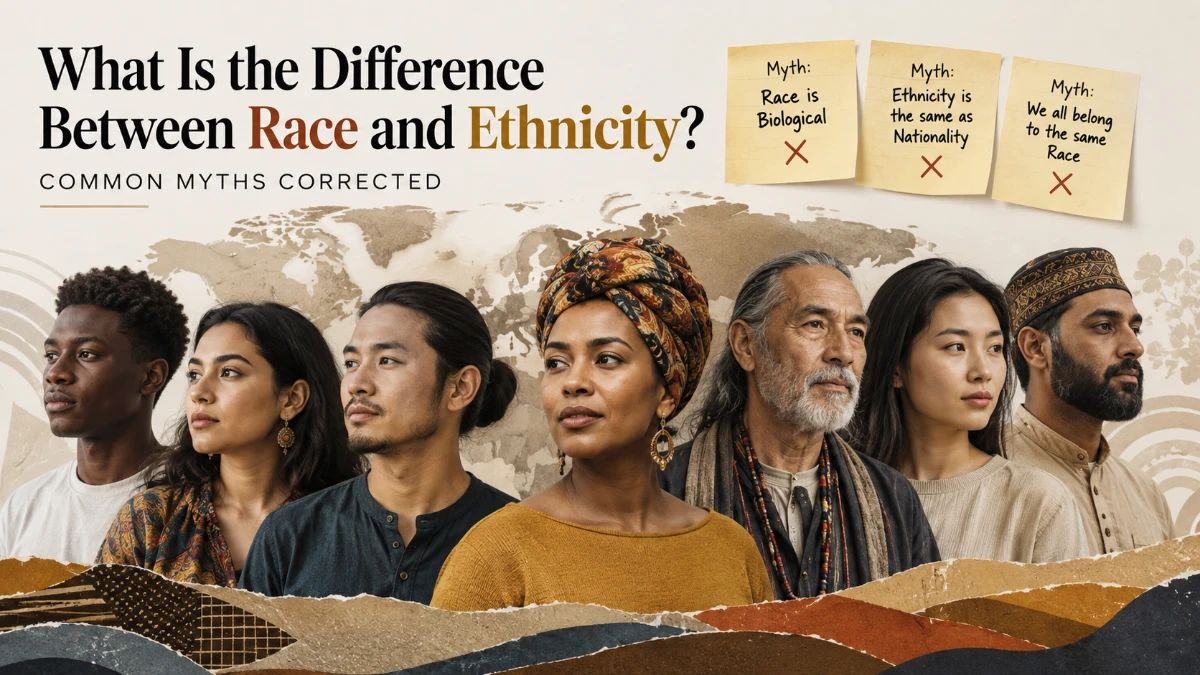
What Is the Difference Between Race and Ethnicity? Common Myths Corrected
What Is the Difference Between Race and Ethnicity?
Ask ten people to explain race and ethnicity, and most will describe the same fuzzy, overlapping idea — because these two terms carry more myths than clear definitions. The fact is simpler than the confusion suggests: race classifies people by physical traits and is usually assigned externally, while ethnicity classifies people by shared culture and is usually self-identified. The clearest way to understand what is the difference between race and ethnicity is to walk through the misconceptions that keep the two tangled together.
Myth: Race and Ethnicity Mean the Same Thing
Fact: They describe two different dimensions of identity entirely. Race is organized around visible physical characteristics — skin color, facial structure, hair type — and has historically been a label applied to people rather than chosen by them. Ethnicity, on the other hand, is organized around shared culture: language, customs, religion, and ancestral history that a person actively identifies with.
The confusion is understandable. Both terms sort people into groups, both show up on the same government forms, and both get used loosely in everyday speech. But sorting by appearance and sorting by cultural belonging are fundamentally different acts of classification.
Myth: Race Is a Fixed Biological Category
Fact: Race is a social construct, not a scientific one. When researchers examine actual human genetic variation, most of it occurs within groups society labels as a single race — not between different racial groups. That means two people classified under the same race can be more genetically distinct from one another than either is from someone classified into a different race. This is why organizations such as the American Anthropological Association describe race as a socially constructed idea rather than a biological reality.
Adding to this, racial categories aren’t even consistent worldwide. A person sorted one way in the United States might be categorized entirely differently in Brazil or South Africa, since each country built its racial framework around its own particular history. If race were truly biological, it wouldn’t shift depending on which country’s system is applied.
Myth: Ethnicity Is Just Another Word for Nationality
Fact: Ethnicity and nationality operate on completely different logic. Nationality is a legal status — the country you’re a citizen of — and has nothing inherently to do with culture or physical traits. Ethnicity, by contrast, is about shared ancestry, language, and tradition, and it can exist entirely independent of national borders.
This is exactly why diaspora communities exist: groups of people can maintain a shared ethnic identity for generations after leaving their ancestral homeland, holding a completely different nationality while still culturally identifying with their ethnic roots. Someone can be a citizen of one country, ethnically identify with a heritage from another, and be racially classified in yet a third way — all three concepts moving independently.
Myth: People of the Same Race Share the Same Ethnicity
Fact: Racial classification and ethnic identity frequently diverge. Two people both classified racially as Black might identify ethnically as Jamaican and Nigerian, respectively — each carrying distinct languages, culinary traditions, and histories despite sharing a racial label. The reverse is also common: people from the same ethnic background can be classified into different racial categories depending on which country’s system is applied to them.
This overlap-without-equivalence is the clearest proof that race and ethnicity are answering different questions about a person, not describing the same thing from two angles.
Myth: Government Forms Ask About Race and Ethnicity for No Real Reason
Fact: The separation is intentional and meaningful. The U.S. Census, for example, treats Hispanic or Latino origin as a distinct ethnicity question, kept entirely separate from its race question, which itself spans multiple categories. Institutions like the Census Bureau and the American Psychological Association maintain this separation because each question captures something the other doesn’t — race captures externally perceived physical grouping, while ethnicity captures self-identified cultural belonging.
Race vs. Ethnicity at a Glance
| Dimension | Race | Ethnicity |
| Basis | Physical traits (skin color, facial features) | Cultural traits (language, ancestry, tradition) |
| Assigned by | Society or institutions, externally | The individual, self-identified |
| Scientific standing | Social construct, not biologically valid | Cultural/social category |
| Consistency across countries | Varies significantly | More stable, tied to heritage rather than geography |
| Sample groups | Black, White, Asian, Indigenous | Punjabi, Han Chinese, Irish, Yoruba |
These examples illustrate the concept only — they don’t represent a complete or universal classification list.
Where the Confusion Actually Comes From
If the distinction is this clear, why does the mix-up persist? A few habits are responsible:
- Both terms group people, creating surface-level overlap in everyday use
- Forms and surveys sometimes present the two questions close together without explanation
- Older classification systems historically fused physical and ancestral traits into one broad “race” concept, long before ethnicity emerged as its own separate idea, and that habit lingers in casual language today
- Media and daily conversation rarely take the time to draw a precise line between the two
Why the Distinction Actually Matters
Beyond satisfying curiosity, getting this right shapes accurate self-identification, better demographic research, and sharper conversations about discrimination and identity. That’s precisely why race and ethnicity remain separate questions on official forms rather than being merged into one — each one measures a genuinely different part of who a person is.
Frequently Asked Questions
Is it accurate to say race and ethnicity are basically interchangeable?
No. Race sorts people by physical traits assigned externally, while ethnicity sorts people by self-identified cultural and ancestral belonging.
Can a person hold one racial classification but identify with several ethnicities?
Yes. Racial classification tends to stay externally fixed, while a person can personally connect with multiple ethnic identities based on family heritage.
Is there scientific evidence that race is biological?
No. Genetic research consistently shows more variation within socially defined racial groups than between them, supporting race as a social rather than biological concept.
How does nationality fit alongside race and ethnicity?
Nationality is a legal citizenship status, entirely separate from race’s physical classification and ethnicity’s cultural identity — all three can differ for the same person.
Why do official forms like the census separate race and ethnicity into different questions?
Because they measure different things: race captures external physical classification, while ethnicity, such as Hispanic or Latino origin on the U.S. Census, captures self-identified cultural belonging.
Can someone’s self-identified ethnicity shift over their lifetime?
Yes, as people learn more about their heritage or choose to emphasize different aspects of their cultural background, their ethnic self-identification can evolve.
Does skin tone reliably indicate a person’s ethnicity?
No. Skin tone relates more closely to racial classification, while ethnicity depends on cultural and ancestral factors that aren’t visible from appearance alone.
Are racial categories consistent across every country?
No. Racial classification differs substantially by country and time period, reinforcing that race functions as a social construct rather than a fixed universal standard.
Is it possible for people with the same ethnic identity to be classified into different races?
Yes, depending on the classification system in use, people sharing an ethnic background can be sorted into different racial categories in different countries.
Does identifying with an ethnicity cancel out a person’s racial classification?
No. Race and ethnicity function independently, so a person can hold both a racial classification and a distinct ethnic identity at the same time without contradiction.