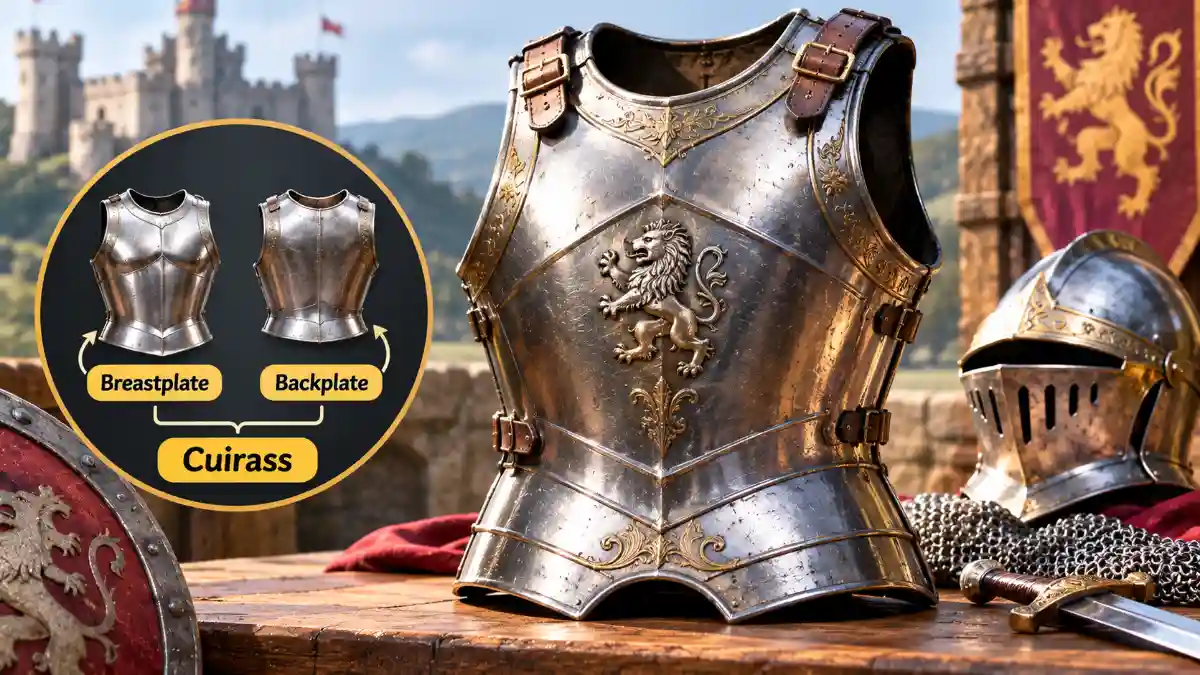
Cuirass: Meaning, Pronunciation, History, and Armor Uses
A cuirass is protective body armor worn over the chest and often the back, commonly consisting of a breastplate and backplate. Soldiers historically wore cuirasses to protect their upper bodies from swords, spears, and other battlefield weapons. How much protection they offered depended on the materials, construction, and weapons involved.
The word cuirass is a noun, commonly pronounced “kwi-RASS” (/kwɪˈræs/) in American English. Its plural form is cuirasses. This type of armor appeared in ancient warfare, medieval Europe, Renaissance military equipment, and the uniforms of certain cavalry soldiers. You can also hear the correct pronunciation in the Cambridge English pronunciation guide.
What Does a Cuirass Look Like?
A cuirass generally resembles a rigid shell shaped to fit the upper torso. A complete version usually has two main pieces: a breastplate covering the chest and a backplate protecting the back.
These pieces can be connected at the shoulders and sides with leather straps, buckles, hinges, or other fastenings. Many metal designs have curved surfaces that can help deflect blows, while others feature reinforced edges or additional protective plates.
Not every cuirass looks alike. Ancient bronze examples often followed different construction methods from the fitted steel armor worn by European knights. Some were shaped to resemble the muscles of the human torso, while later designs emphasized practical protection and movement.
A cuirass generally leaves the arms and legs exposed. Soldiers could combine it with helmets, shoulder defenses, and other armor components when additional coverage was needed.
What Were Cuirasses Made Of?
Cuirass armor was made from materials such as leather, bronze, iron, and steel. Each material offered different levels of protection, depending on its thickness, quality, and construction.
Leather: Leather appeared in various forms of historical body armor. Its ability to resist cuts and impacts depended on how it was prepared, layered, and reinforced. Leather protection did not necessarily follow the same two-piece construction as metal cuirasses.
Bronze: Bronze was used to make rigid chest armor in ancient civilizations. Armorers could shape bronze plates to follow the body’s contours. A surviving Greek bronze cuirass from the fourth century BCE demonstrates this approach, with breast and back plates modeled around the human torso.
Iron: Iron was another important armor-making material. Its durability and protective properties varied depending on the quality of the metal and the techniques used to work it.
Steel: Steel became especially important in later European plate armor. Skilled armorers shaped it into curved, fitted plates intended to protect the torso while allowing the wearer to move.
How Much Protection Did a Cuirass Provide?
A well-made cuirass could reduce the risk of injuries from blades, thrusting weapons, and certain projectiles. However, wearing one did not guarantee safety.
Its effectiveness depended on several factors, including the material’s strength, plate thickness, construction, the weapon involved, and the angle at which a blow struck the armor.
Weight was another consideration. Thicker or heavier plates could provide greater protection in some situations, but soldiers still needed enough mobility to fight, ride horses, and carry out their duties.
A cuirass was therefore a practical form of defense, not an impenetrable shield.
History of the Cuirass: From Ancient Warfare to Cavalry
Cuirasses evolved over centuries as military tactics, weapons, and armor-making techniques changed. Although protecting the torso remained their main purpose, different civilizations developed their own designs.
Ancient and Medieval Cuirasses
Ancient Greek warriors sometimes wore bronze cuirasses shaped around the chest and abdomen. Some featured raised details resembling human muscles, while others had simpler forms.
Roman soldiers also used rigid torso protection, although their equipment varied across military units and historical periods. Not all Roman armor followed the same construction.
In medieval Europe, chain mail remained an important defense for centuries. As metalworking techniques improved, rigid plates became increasingly common, particularly during the later Middle Ages.
By the 14th and 15th centuries, European armorers were developing increasingly sophisticated torso protection. Breastplates and backplates eventually became important components of complete plate armor. A surviving German breastplate from around 1480 illustrates how armorers used connected metal sections to balance protection with mobility.
The equipment worn by medieval soldiers depended on their military role, region, period, and available resources. A knight from the early Middle Ages would not necessarily have worn the same armor as one fighting several centuries later.
Renaissance Armor and Cuirassiers
During the Renaissance, European armorers refined the construction of steel plate armor. Breastplates were carefully shaped to fit the body, with reinforced areas and designs intended to improve protection.
A surviving Italian or Flemish cuirass dated approximately 1490–1500 includes a steel breastplate and backplate. Its distinctive neckline and arm openings reflect developments in European armor construction near the end of the 15th century.
Cuirasses were not limited to Europe. An Indian cuirass from Hyderabad, dated 1778–79, features breastplate and backplate components forged from crucible steel. Its construction demonstrates how armor-making traditions differed between regions.
The cuirass later became closely associated with cuirassiers, cavalry soldiers traditionally equipped with protective torso armor.
Cuirassiers played a notable role in European military history, particularly during the Napoleonic Wars. Their equipment commonly included a metal cuirass and helmet, although the exact uniforms and protective gear varied between armies.
Even as firearms became increasingly important, some cavalry units continued wearing cuirasses. Depending on the period, they served practical defensive purposes, reflected military traditions, or became part of ceremonial uniforms.
Cuirass vs. Breastplate: What’s the Difference?
The main difference between a cuirass and a breastplate lies in how much of the torso each protects.
A breastplate covers the front of the body, while a complete cuirass generally combines a breastplate with a backplate. Together, these pieces protect both the chest and back.
However, historical terminology can vary. In some contexts, the word cuirass refers to a breastplate alone rather than a complete two-piece arrangement.
Here is how these related armor types compare:
| Armor Type | Main Purpose | Body Coverage |
| Cuirass | Protects the torso | Chest and often back |
| Breastplate | Protects the front of the torso | Chest and upper abdomen |
| Backplate | Protects the rear of the torso | Upper and middle back |
| Full plate armor | Provides extensive rigid body protection | Torso, arms, legs, and other areas |
| Chain mail | Offers flexible protection through interconnected metal rings | Varies according to the garment |
Unlike chain mail, which is made from interlinked metal rings, a metal cuirass generally uses solid plates.
A cuirass can also be part of a complete suit of plate armor. However, the term refers to the torso protection itself, not the entire armored outfit.
Where Does the Word Cuirass Come From?
The English word cuirass developed from French cuirasse, meaning protective body armor.
Its deeper roots lead back through Old French to the Latin word corium, meaning leather or hide. The historical etymology of cuirass reflects this connection between early protective garments, leather, and armor terminology.
The related word cuirassier refers to a cavalry soldier traditionally associated with wearing a cuirass.
Although military armor is its most familiar meaning, cuirass also has other uses. In zoology, it can describe a hard protective covering formed from plates or scales. The word is occasionally used figuratively to suggest an emotional or psychological barrier, much like a protective shell.
Read Also: Cuirass
Frequently Asked Questions
Yes, some historical cuirasses could resist particular firearm shots, but not all were designed for that purpose.
Certain armorers produced reinforced plates and tested them by firing weapons at the metal. For example, a surviving French shot-proof cuirass from the early 18th century has a dent believed to demonstrate a historical test of its protective strength.
However, bullet resistance depended on the armor’s thickness, metal quality, construction, projectile characteristics, firing distance, and impact conditions.
A cuirass capable of resisting a particular historical firearm was not necessarily effective against other weapons. Historical armor should never be assumed to provide reliable protection against modern bullets.
Cuirasses were worn by various soldiers throughout history, including ancient Greek warriors, medieval knights, Renaissance soldiers, and European cavalry troops. Cuirassiers became especially associated with this armor during the Napoleonic Wars.
Medieval knights wore rigid torso armor to protect vital areas such as the chest and back from swords, spears, and other weapons. During the later Middle Ages, breastplates and backplates became important parts of plate armor, offering protection while allowing movement.
The weight of a cuirass varied according to its material, size, thickness, and historical period. Some surviving examples weigh several pounds, while heavier designs could weigh considerably more. There was no universal standard weight because armor was made for different purposes and wearers.
A cuirass primarily protects the torso, usually with a breastplate and backplate. A corslet generally refers to a more extensive set of body armor that may include additional pieces protecting the shoulders, arms, or other areas. However, historical usage of these terms sometimes overlaps.
Traditional metal cuirasses are still worn by certain ceremonial military units, including some European cavalry guards. Their modern role is mainly ceremonial and historical rather than practical battlefield protection. Modern military personnel generally use specialized ballistic body armor instead of traditional steel cuirasses.