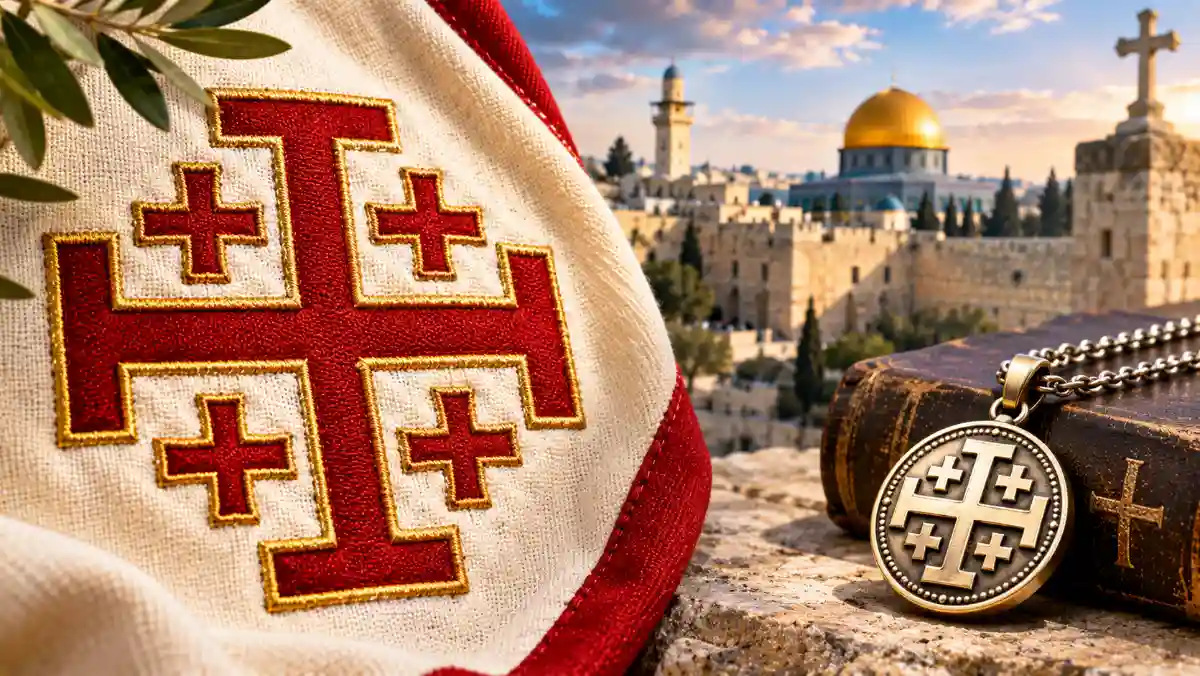
Jerusalem Cross: Meaning, Symbolism, History, and Uses
The Jerusalem cross is a Christian and heraldic symbol featuring one large central cross surrounded by four smaller crosses, one in each quadrant. Its traditional design includes a cross potent, a cross with T-shaped ends, at the center. The five crosses have several religious interpretations, including the five wounds of Jesus Christ, the four Evangelists, and the spread of Christianity throughout the world. The emblem also has a historical connection to the medieval Kingdom of Jerusalem and the Crusades.
Also known as the fivefold cross, this distinctive emblem remains an important part of Christian religious tradition, especially in communities connected with the Holy Land. Its meanings have developed over centuries, and historians distinguish these religious interpretations from the symbol’s less certain medieval origins.
What Does the Jerusalem Cross Symbolize?
The Jerusalem cross carries several traditional Christian meanings rather than one universally accepted interpretation. Its arrangement of five crosses is commonly associated with Christ’s sacrifice, the Gospel message, and Jerusalem’s importance in Christianity.
| Part of the symbol | Traditional Christian meaning |
| Large central cross | Jesus Christ and his sacrifice on the cross |
| Four smaller crosses | The four Evangelists: Matthew, Mark, Luke, and John |
| Five crosses together | The five wounds of Jesus during the Crucifixion |
| Four surrounding crosses | Christianity spreading to the four corners of the world |
| Complete design | Christian faith, sacrifice, and the spiritual significance of Jerusalem |
The Five Wounds of Christ
One of the best-known interpretations connects the five crosses to the wounds Jesus suffered during the Crucifixion.
According to Christian tradition, these include the wounds in his hands, feet, and side. Together, they recall Christ’s suffering and sacrifice, as well as the Christian belief in redemption through his death and resurrection.
This interpretation remains important in religious devotion. The Franciscan Custody of the Holy Land recognizes the connection between the five crosses and Christ’s wounds, while also explaining the symbol’s wider spiritual significance.
Jesus and the Four Evangelists
Another traditional explanation identifies the large central cross with Jesus Christ and the four smaller crosses with Matthew, Mark, Luke, and John.
The arrangement emphasizes the relationship between Christ and the Evangelists, whose Gospels communicate his life, teachings, death, and resurrection.
The four surrounding crosses can also symbolize Christianity reaching every direction of the world, sometimes described as the four corners of the earth.
These interpretations reflect Christian devotional traditions. They do not necessarily establish what the emblem meant when its familiar design first appeared.
Jerusalem Cross History and Its Connection to the Crusades
The Jerusalem cross is closely associated with the Crusades, although the historical evidence reveals a more complicated story than popular accounts often suggest.
The Kingdom of Jerusalem was established in 1099, following the First Crusade. European Crusader forces captured Jerusalem on July 15, 1099, and established a Latin Christian kingdom in the region. The Metropolitan Museum of Art’s history of the Crusades provides additional context for the conquest and the kingdom’s establishment.
Over time, the five-cross emblem became associated with the kingdom. However, historians have not established that the familiar arrangement served as its official symbol from the beginning.
The recognizable design appears in heraldic evidence associated with Jerusalem during the late 13th century. Its use as an emblem of Crusader identity became more widespread during the 14th century.
Research into late medieval Jerusalem cross iconography explains how the symbol developed through heraldry, competing claims to Jerusalem’s crown, and later representations of the Crusades.
Did Godfrey of Bouillon Create the Jerusalem Cross?
Godfrey of Bouillon, a prominent leader of the First Crusade, is often credited with adopting the Jerusalem cross in 1099.
Yet surviving contemporary evidence does not establish that he personally created or used the familiar five-cross design.
His association with the emblem emerged through later heraldic traditions. Medieval artists and writers sometimes attributed coats of arms to earlier historical figures, even when those particular designs were not documented during their lifetimes.
The Jerusalem cross is therefore an authentic medieval heraldic emblem, but its precise origins and the identity of its original designer remain uncertain.
Religious Significance of the Jerusalem Cross Today
The Jerusalem cross continues to hold particular importance in Catholic institutions connected with Jerusalem and the Holy Land. Its meaning, however, extends beyond Catholicism, and Christians from other traditions may also recognize it as an expression of faith.
Franciscan Custody of the Holy Land
The Franciscan Custody of the Holy Land uses a red Jerusalem cross against a white background.
Within Franciscan tradition, the five crosses recall the wounds of Christ and his sacrifice during the Crucifixion.
The emblem also expresses devotion to Jesus and the sacred places associated with his life, death, and resurrection. Its connection with the Holy Land makes it particularly meaningful in Christian pilgrimage and religious observance.
Order of the Holy Sepulchre
The Equestrian Order of the Holy Sepulchre of Jerusalem also uses the five-cross design as a distinctive religious insignia.
For the Order, the emblem represents Christian identity, spiritual commitment, and support for the Christian presence in the Holy Land.
The Order’s explanation of its religious symbolism places its insignia within the broader meaning of Christian faith and religious service.
Although the symbol has strong Catholic associations, it does not belong exclusively to one denomination. Other Christians may wear or display it as an expression of faith, remembrance, or devotion.
Red vs. Gold Jerusalem Cross: What Is the Difference?
Jerusalem crosses appear in different colors, but gold and red are the most recognizable versions. Their historical associations are not identical.
| Version | Historical or religious association |
| Gold cross on white or silver | Traditional heraldic arms associated with the medieval Kingdom of Jerusalem |
| Red cross on white | Commonly associated with the Franciscan Custody and the Order of the Holy Sepulchre |
The gold version is especially interesting in heraldry. Traditional heraldic rules generally discourage placing one metal color over another, yet the Kingdom of Jerusalem’s arms feature gold on a silver or white background.
The red version is particularly familiar in Catholic religious insignia and devotional objects associated with the Holy Land.
Neither color has one fixed spiritual meaning in every setting. Its significance depends on the historical period, religious institution, or tradition in which it appears.
Jerusalem Cross vs. Other Christian and Crusader Crosses
Unlike a standard Christian cross, the Jerusalem cross combines five separate crosses within a single design.
Several other Christian and medieval cross styles have distinct shapes and historical associations.
| Cross type | Main distinguishing feature |
| Jerusalem cross | One central cross potent surrounded by four smaller crosses |
| Latin cross | A single cross with a longer vertical arm |
| Greek cross | A single cross with four arms of equal length |
| Cross potent | A single cross with T-shaped bars at the ends of its four arms |
| Templar cross | Commonly a single red cross, often depicted with flared arms |
The term Crusader cross is broader and less precise than Jerusalem cross. Different military orders and Crusader-era groups used different cross designs, so the terms should not automatically be treated as interchangeable.
Likewise, a cross potent can appear on its own. The four smaller surrounding crosses are what distinguish the familiar Jerusalem design from a single cross potent.
Modern Uses of the Jerusalem Cross
Today, the Jerusalem cross appears in religious settings, decorative objects, and personal expressions of Christian identity.
Christian jewelry: Necklaces, pendants, and rings featuring the five-cross design often represent personal faith, devotion, or a connection with Jerusalem.
Pilgrimage souvenirs: Visitors to Christian holy places may encounter the emblem on keepsakes, prayer accessories, and other devotional objects.
Church decorations: The design can be found in religious artwork, banners, architectural details, and ceremonial materials.
Flags and heraldry: It remains recognizable in historical coats of arms and religious emblems, reflecting its long association with Jerusalem.
Tattoos: Some people choose Jerusalem cross tattoos to express Christian faith, remembrance of Christ’s sacrifice, or a personal connection with the Holy Land. Others appreciate its historical background or distinctive design. The meaning ultimately depends on the individual wearing it.
From medieval heraldry to modern religious jewelry, the Jerusalem cross continues to connect Christian symbolism with the history and spiritual importance of Jerusalem.
Read Also: Jerusalem Cross
Frequently Asked Questions
No. The Bible does not specifically describe or prescribe the Jerusalem cross as a five-cross emblem. Its traditional meanings draw on Christian beliefs and biblical themes, particularly the Crucifixion and the spread of the Gospel. The recognizable heraldic design developed later in Christian history.
No. The Jerusalem cross typically features one large central cross surrounded by four smaller crosses. The familiar Russian Orthodox cross usually has three horizontal crossbars, including a slanted lower bar. Both are Christian symbols, but their designs and traditional associations differ. The Jerusalem cross is also found in some Eastern Christian contexts.
The five crosses traditionally represent the five wounds of Jesus Christ during the Crucifixion. Another interpretation connects the large central cross with Jesus and the four smaller crosses with the Evangelists: Matthew, Mark, Luke, and John. These are traditional Christian interpretations rather than proven explanations of the symbol’s original design.
Yes. Christians from different denominations may wear a Jerusalem cross necklace or pendant as an expression of faith, devotion, or connection to the Holy Land. Although the symbol has strong Catholic associations, it is not exclusively Catholic. Its religious significance depends on the wearer’s beliefs and traditions.
A Jerusalem cross tattoo often represents Christian faith, Christ’s sacrifice, spiritual devotion, or a personal connection to Jerusalem. Some people choose the five-cross design because of its medieval history or distinctive appearance. However, tattoo meanings are personal, and the symbol does not carry one universal interpretation for everyone.
Some Christians wear the Jerusalem cross as a reminder of their faith and seek spiritual comfort through its religious significance. However, Christian traditions do not universally regard the emblem as a protective object, and there is no biblical promise that wearing it prevents harm. Its primary significance lies in Christian devotion, sacrifice, and remembrance.