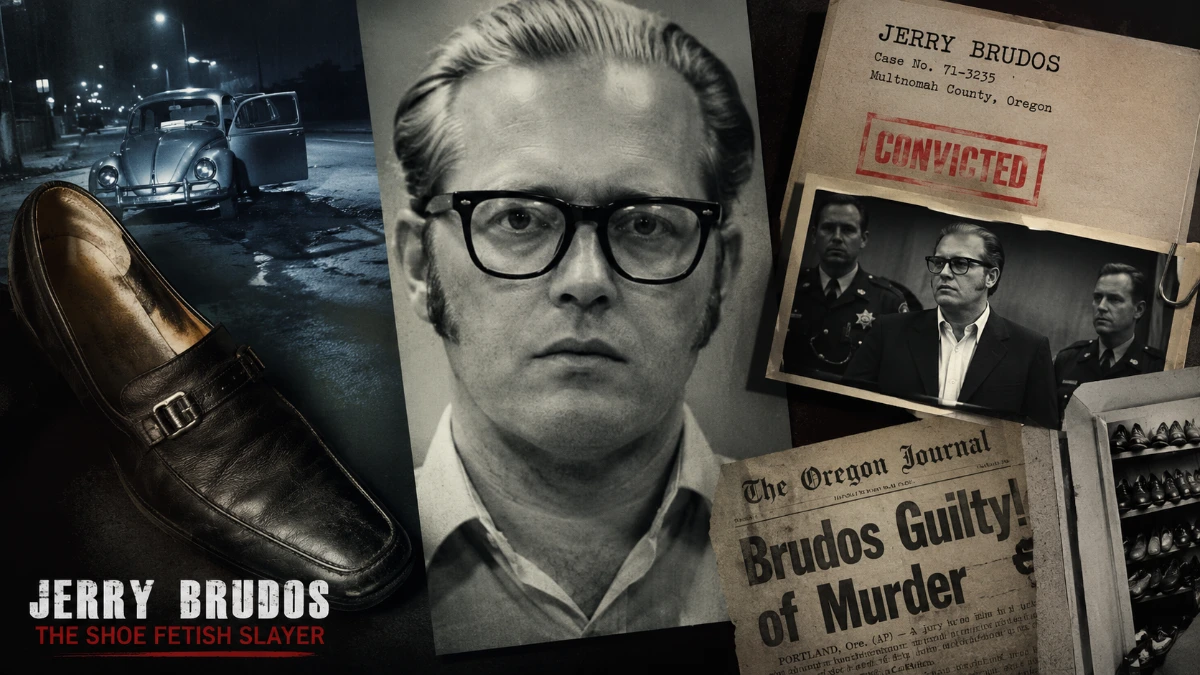
Jerome Henry “Jerry” Brudos (January 31, 1939 – March 28, 2006) was an American serial killer and necrophile who murdered at least four young women in Oregon between 1968 and 1969, earning the nicknames “The Lust Killer” and “The Shoe Fetish Slayer”. He pleaded guilty in June 1969 and received three consecutive life sentences, spending nearly 37 years in prison until his death from liver cancer.
Who Was Jerry Brudos
Brudos was born in Webster, South Dakota, and developed an obsessive fetish for women’s shoes and undergarments in childhood, which escalated into theft, prowling, and eventually murder by his late twenties. He worked as an electrician, was married with two children, and maintained an outwardly ordinary suburban life in Salem and later Portland, Oregon, while secretly committing his crimes in a garage “workshop”.
Crimes and Victims
Between January 1968 and April 1969, Brudos strangled four young women, mutilating several of the bodies after death and keeping items such as severed feet, breasts, and clothing as trophies. He also attempted to abduct at least two other women, both of whom escaped.
| Victim | Age | Date | Circumstances |
| Linda Kay Slawson | 19 | January 26, 1968 | Lured while selling encyclopedias door-to-door; strangled; body never recovered |
| Jan Susan Whitney | 23 | November 26, 1968 | Offered roadside help after her car broke down; strangled; necrophilia committed |
| Karen Elena Sprinker | 19 | March 27, 1969 | Abducted from a downtown Salem parking lot; raped and strangled |
| Linda Dawn Salee | 22 | April 23, 1969 | Abducted from a Portland shopping center parking lot; strangled |
A fifth attempted abduction of 15-year-old Gloria Jean Smith on April 22, 1969, failed when she escaped; this incident helped police link Brudos to the case.
Arrest and Investigation
The break in the case came in May 1969, when a college student’s tip and physical evidence, including wiring and car parts matching those used to weigh down victims’ bodies, led investigators to Brudos’s home. Searches of the residence uncovered incriminating photographs of victims and their belongings, prompting his arrest.
Trial, Plea, and Sentencing
Brudos initially entered a plea of not guilty by reason of insanity, but seven examining psychiatrists determined he was legally sane, diagnosing antisocial personality disorder and paraphilic fetishism rather than psychosis. On June 27, 1969, he changed his plea to guilty before a Marion County Circuit Court judge and was sentenced to three consecutive terms of life imprisonment; his confessed fourth killing (Slawson) was never separately prosecuted since her body was never found.
Appeals and Parole History
Brudos’s attorneys pursued appeals, including a challenge to the consecutive-sentence structure and a later claim involving hypoglycemia affecting his plea, both of which were rejected. He attended recurring parole-board interviews over the decades without success, and on June 21, 1995, the Oregon Parole Board formally told him he would never be released, citing no evidence of rehabilitation.
Imprisonment and Death
Brudos served his sentence at the Oregon State Penitentiary, where victims’ family members regularly attended his hearings to oppose his release, and he showed no documented remorse throughout his incarceration. He died in custody on March 28, 2006, at age 67, from liver cancer.
Notable Quotations
The following quotations are drawn from documented investigative and court history rather than dramatized retellings, distinguishing verified statements from unsupported paraphrases circulating online.
- To a woman during a date, after she expressed unease about him: “Think of those two girls who were found in the river”.
- Responding to why she trusted him despite that remark: “How did you know I wouldn’t take you to the river and strangle you?”
- To 15-year-old Gloria Smith during his failed attempt to abduct her: “I want you to come with me. I won’t hurt you … I won’t rape you.
- Reflecting on his own actions during a psychological interview: “There must be something wrong with me.
- When a psychiatrist asked how much he cared about his victims, Brudos crumpled a piece of paper and replied: “That much… I care about those girls as much as I care about that piece of wadded-up paper.
- Oregon Parole Board chair Marva Fabien, informing him he would never be paroled: “You will be in prison for the rest of your life, and there will be no further parole hearings.
Cultural Depictions
Brudos returned to public attention in October 2025 through a cameo appearance in Netflix’s “Monster: The Ed Gein Story,” portrayed by actor Happy Anderson. His case was also the subject of Ann Rule’s 1983 true-crime book “Lust Killer,” a primary source for much of the documented case history and quotations used in later coverage.
Frequently Asked Questions
He was convicted of three murders (Whitney, Sprinker, Salee) and confessed to a fourth (Slawson), whose body was never recovered.
No. He received three consecutive life sentences after pleading guilty in June 1969; he was never sentenced to death.
No. He attended recurring parole hearings, and in 1995, the Oregon Parole Board formally stated he would never be released.
He died of liver cancer on March 28, 2006, in Oregon State Penitentiary.
His wife, Ralphene (Darcie) Brudos, was tried as an accomplice in 1969 but was acquitted after a key eyewitness account was discredited.