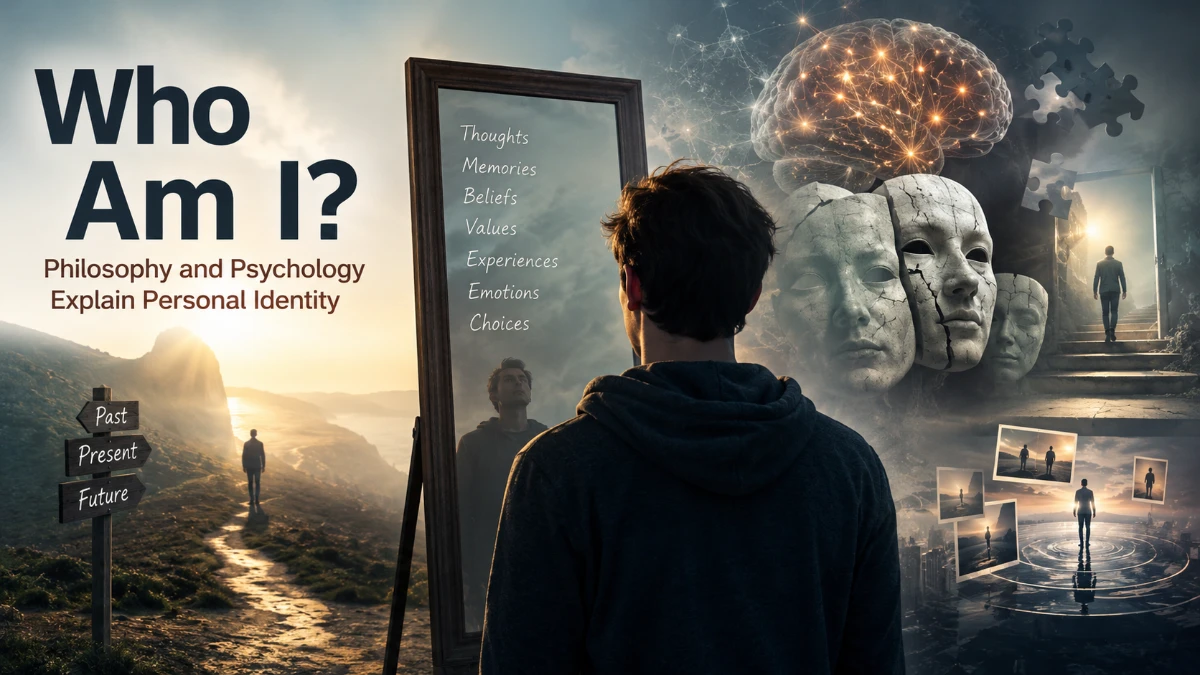
Who Am I?
“Who am I?” is a question about identity, self-understanding, and what makes you the person you are. In philosophy, it is closely connected to personal identity: what makes you the same individual over time despite physical and psychological change. In psychology, it relates to self-concept—the beliefs, traits, values, roles, memories, and experiences you use to understand yourself.
There is no single universally accepted answer. Philosophy examines whether identity depends on consciousness, memory, the body, or psychological continuity, while psychology studies how people develop and organize their sense of self.
What “Who Am I” Really Asks
The question contains several related inquiries.
Personal identity asks: What makes me the same person across time?
Psychological identity asks: What beliefs, characteristics, memories, values, and experiences make up my sense of self?
Existential identity asks: What gives my life meaning, and who am I becoming through my choices?
Keeping these questions separate helps explain why “Who am I?” can have different answers depending on whether we approach it philosophically, psychologically, or personally.
The Philosophical Meaning of “Who Am I?”
Philosophers have debated personal identity for centuries. The central problem is not simply describing a person’s characteristics but determining what makes one individual the same person at different points in time.
Socrates and “Know Thyself”
The ancient Greek tradition associated with Socrates placed self-knowledge at the center of philosophical life. To ask who you are is therefore not merely to list your personality traits. It can involve examining your beliefs, values, decisions, assumptions, and way of life.
From this perspective, answering “Who am I?” requires honest reflection rather than simply accepting the identity given to you by other people.
Descartes and Consciousness
René Descartes connected personal existence with conscious thought. His famous reasoning begins from the certainty that thinking is occurring and uses that certainty as a foundation for understanding the self.
This perspective helped establish consciousness as an important part of philosophical discussions about what it means to be a person.
Locke’s Memory and Consciousness Theory
John Locke argued that personal identity is connected to continuity of consciousness rather than simply the same body or an immaterial soul. Memory plays a central role because consciousness can extend backward to experiences attributed to oneself.
Locke’s view raises an important question: if your body and many of your characteristics change, what psychological connection makes you the same person?
Reid’s Brave Officer Objection
Thomas Reid challenged Locke’s memory-based account with his famous Brave Officer example.
Imagine a boy who is punished at school and later becomes a brave officer. The officer remembers being the boy. Later, the officer becomes a general who remembers being the officer but no longer remembers the childhood punishment.
If memory alone establishes identity, the boy is the officer and the officer is the general. But if the general cannot remember being the boy, the theory appears to imply that the boy is not the general. Reid argued that this conflicts with the transitive nature of identity.
Butler’s Circularity Objection
Joseph Butler raised a different criticism. He argued that memory may presuppose personal identity rather than create it. In other words, saying that a memory belongs to you may already assume that the person who remembers and the person who experienced the event are the same individual.
Hume and the Bundle Theory
David Hume took a radically different approach. When he examined his own experience, he reported finding particular perceptions—such as sensations, emotions, thoughts, and memories—rather than a separate, unchanging self behind them.
His bundle theory therefore challenges the idea that introspection reveals one permanent inner entity. What we call the self may instead be understood as a constantly changing collection or bundle of perceptions and experiences.
Psychological Continuity
Later philosophical approaches developed the idea of psychological continuity. Instead of requiring a direct memory connection between every stage of a person’s life, these theories consider overlapping psychological connections such as memories, intentions, beliefs, desires, and character traits.
This allows identity to persist through gradual psychological change rather than requiring an unchanged personality or complete memory.
Existential and No-Self Perspectives
Existentialist approaches often shift attention from discovering a fixed essence to considering freedom, responsibility, choice, and becoming. Who you are can partly be understood through what you choose to do with your circumstances.
Other philosophical traditions, particularly Buddhist approaches to the self, question whether there is a permanent, independent self at all. These perspectives demonstrate that “Who am I?” does not have one universally accepted philosophical solution.
How Psychology Explains “Who Am I?”
Psychology approaches the question differently. Rather than asking only what makes someone numerically the same person, psychologists examine how people represent, evaluate, experience, and develop their sense of self.
Self-Concept
Self-concept refers broadly to the beliefs and representations people have about themselves. It can include perceptions of personality, abilities, appearance, relationships, roles, values, and other characteristics.
Self-concept is influenced by experience and social interaction and can develop as people encounter new situations and reinterpret earlier experiences.
Self-Awareness
Self-awareness is the capacity to notice and reflect on your own thoughts, emotions, behavior, and characteristics.
For example, recognizing that you become anxious before important decisions is a form of self-awareness. It can help you examine patterns instead of simply reacting to them.
Self-Esteem
Self-esteem concerns how positively or negatively a person evaluates themselves.
It is related to self-concept but is not identical to it. Someone can have a detailed understanding of their strengths and weaknesses without necessarily evaluating themselves positively.
Self-Concept Clarity
Self-concept clarity (SCC) refers to how clearly, consistently, and stably a person’s self-beliefs are defined.
Research distinguishes self-concept clarity from self-esteem. A person can have high self-esteem while still feeling uncertain about who they are, or have relatively clear self-beliefs while evaluating themselves negatively.
Social Identity
Social identity refers to aspects of the self associated with membership in social groups and communities. Roles, relationships, cultural contexts, and group memberships can therefore influence how people understand themselves.
This does not mean that social identity completely determines personal identity. Rather, it represents one important part of how people experience and describe themselves.
Narrative Identity
People also make sense of themselves through the stories they construct about their lives. Narrative identity connects memories, experiences, challenges, relationships, and goals into an evolving account of who a person has been and who they may become.
This helps explain why two people can experience similar events but develop very different understandings of themselves.
Personal Identity vs. Social Identity
Personal identity and social identity answer different questions.
| Concept | Core Question | What It Concerns |
| Personal identity | What makes me the same person over time? | Continuity of the individual |
| Self-concept | What do I believe about myself? | Traits, abilities, values, roles, and characteristics |
| Social identity | Which groups and relationships are part of my identity? | Social memberships and relationships |
| Self-esteem | How do I evaluate myself? | Positive or negative self-evaluation |
| Narrative identity | What story do I tell about my life? | Meaningful connections between past, present, and future |
Philosophy’s personal identity problem is therefore distinct from everyday categories such as profession, nationality, or group membership. Those categories can describe what you are or how you identify, while personal identity asks whether the individual at one point in time is the same individual at another.
Philosophy and Psychology Side by Side
| Dimension | Philosophy (Personal Identity) | Psychology (Self-Concept) |
| Core question | What makes you numerically the same person over time? | What beliefs make up your current sense of self? |
| Key thinkers/researchers | Locke, Hume, Reid, Butler | Baumeister, Campbell et al. |
| Main focus | Consciousness, memory, psychological continuity, and competing theories of the self | Self-beliefs, self-awareness, self-esteem, clarity, roles, and identity |
| Focus across time | Whether identity persists despite change | How self-understanding develops and changes |
| Approach | Philosophical and conceptual | Psychological and empirical |
What Makes You the Same Person Over Time?
There is no universally accepted answer.
One approach emphasizes consciousness and memory. Another emphasizes broader psychological continuity. Some views give greater importance to bodily continuity, while other philosophical traditions question whether there is a permanent self underlying experience at all.
Psychology adds another dimension: even when a person remains the same individual, their self-concept can change significantly as they grow, form relationships, adopt new values, experience setbacks, and pursue different goals.
This means that continuity and change are not necessarily opposites. A person can remain connected to their past while developing into someone substantially different.
How to Explore Your Own Answer
You can use a simple framework to explore “Who am I?” without assuming that one characteristic defines your entire identity.
1. Identify Your Core Values
Ask which principles consistently influence your decisions. Examples might include honesty, independence, loyalty, creativity, family, learning, or compassion.
2. Examine Your Traits and Patterns
Consider how you typically respond to challenges, relationships, uncertainty, success, and failure. Look for recurring patterns rather than isolated incidents.
3. Consider Your Relationships
Ask how family, friends, colleagues, communities, and other relationships influence the way you see yourself.
4. Examine Your Experiences
Which experiences changed your beliefs, priorities, or understanding of yourself?
5. Separate Temporary States From Identity
A temporary emotion, mistake, failure, or difficult period does not necessarily define who you are.
6. Consider Your Future Self
Identity is not only about your past. Ask what kind of person you want to become and which choices would move you toward that future.
A useful reflection formula is:
Who I am = values + traits + relationships + experiences + choices + goals
This is not a scientific equation. It is simply a practical framework for examining the different elements that contribute to self-understanding.
Is There One Correct Answer to “Who Am I?”
Probably not in any simple or universally accepted sense.
Philosophy provides competing theories about what makes a person the same over time. Psychology explains how people develop beliefs and representations about themselves. Your own answer may also change as your circumstances, relationships, values, and goals change.
The important distinction is between having an identity and having a complete, unchanging definition of yourself. You can have continuity without remaining exactly the same.
So, Who Am I?
“Who am I?” cannot be reduced to one memory, personality trait, social role, or life experience. Philosophy asks what makes you the same person despite change, while psychology examines how your self-concept, self-awareness, relationships, values, memories, and experiences shape your understanding of yourself.
Together, these perspectives suggest that identity involves both continuity and change. Understanding who you are may therefore be less about discovering one permanent definition and more about examining the connections between who you have been, who you are now, and who you are choosing to become.
Frequently Asked Questions
It’s both. Philosophy addresses questions about personal identity, consciousness, and what makes someone the same person over time. Psychology studies self-concept, self-awareness, self-esteem, social identity, and other processes involved in understanding oneself.
Locke connected personal identity with continuity of consciousness. Memory is important to his account because consciousness can extend backward to experiences attributed to oneself. His theory became the subject of important objections, including those raised by Thomas Reid and Joseph Butler.
Thomas Reid’s Brave Officer example involves a boy, an officer, and a general whose memories overlap but are not identical. Reid used the case to argue that Locke’s memory criterion creates a problem for the transitivity of identity.
Hume argued that introspection reveals a changing collection or bundle of perceptions rather than a separately discoverable, permanent self. His view is commonly known as the bundle theory of the self.
Self-concept is the collection of beliefs and representations people have about themselves. It can include perceived traits, abilities, roles, values, relationships, and other characteristics.
Self-concept clarity describes how clearly, consistently, and stably a person’s self-beliefs are organized. It is related to self-esteem but is conceptually distinct from how positively someone evaluates themselves.
Self-concept concerns what you believe and understand about yourself. Personal identity, particularly in philosophy, asks what makes you the same individual across time.
Yes. Your values, roles, beliefs, relationships, personality characteristics, and goals can change. Philosophical theories differ on what kinds of continuity are necessary for you to remain the same person despite those changes.
Values can provide a stable framework for decisions and help people understand what matters to them. They can therefore become an important part of psychological and narrative identity, although they are not the only components of identity.
There is no universally accepted single answer. Philosophy offers competing theories of personal identity, while psychology studies the processes through which people develop and understand their sense of self.